

Forex Trading Education
Exness Swap Rates and Overnight Fees Explained
Complete guide to swap charges, rollover calculations, and Islamic account alternatives at Exness.

Forex Analyst
Forex Analyst specializing in currency markets, market trends, technical and fundamental analysis, and providing clear insights to help traders make informed decisions.
Exness swap represents the interest rate differential applied when a trading position remains open past the daily rollover point. This cost or credit reflects the difference between the interest rates of the two currencies in a forex pair, or the financing cost for holding CFD positions on stocks, indices, commodities, and cryptocurrencies. Understanding how these charges accumulate is essential for traders who hold positions beyond a single session, as swap can significantly impact profitability over time.
Contents
- What Is Exness Swap and How It Works
- Swap Calculation Methodology at Exness
- Forex Pair Swap Rates and Examples
- Stock CFD Swap Charges
- Index CFD Overnight Fees
- Cryptocurrency Swap Considerations
- Commodity and Energy Swap Rates
- Swap-Free Islamic Account Options
- Managing Swap Costs in Trading Strategy
- Exness Trading Calculator for Swap Estimation
- Comparing Exness Swap Rates with Industry
- Swap Rate Monitoring and Alerts
- Impact of Leverage on Swap Costs
- Tax Implications of Swap Income and Expense
- Key Takeaways About Exness Swap
The broker calculates swap automatically at the end of each trading day, typically at 22:00 UTC during winter and 21:00 UTC during summer. For forex pairs, the calculation uses the tom-next rate, which incorporates the interest rate differential between the base and quote currencies plus the broker's markup. For CFD instruments, swap reflects the cost of financing the leveraged position. Traders can view current swap rates for every symbol directly in the trading platform or through the broker's website specification pages.
Exness applies swap charges to Standard, Standard Cent, Pro, Raw Spread, and Zero accounts. The exact rate varies by instrument, account type, and market conditions. Wednesday rollover carries triple swap to account for the weekend when markets are closed, meaning positions held overnight from Wednesday to Thursday incur three times the normal daily charge. This triple-swap convention is standard across the forex industry and applies to all brokers using the same settlement schedule.
What Is Exness Swap and How It Works
Swap, also known as rollover or overnight financing, is the interest paid or earned for holding a leveraged position overnight. In forex trading, every currency has an associated interest rate set by its central bank. When you buy a currency pair, you are effectively borrowing the quote currency to purchase the base currency. The swap rate reflects the net interest differential between the two currencies. If the base currency has a higher interest rate than the quote currency, you may receive a positive swap credit. If the base currency has a lower rate, you pay a negative swap debit.
Exness sources its swap rates from liquidity providers and applies a small markup to cover operational costs. The resulting rates are published in the contract specifications for each trading instrument. For forex majors like EURUSD, GBPUSD, and USDJPY, swap rates typically range from a few tenths of a pip to several pips per day depending on the interest rate environment. During periods of divergent monetary policy, such as when the Federal Reserve raises rates while the European Central Bank holds steady, swap differentials can widen significantly.
- Swap applies automatically at daily rollover (22:00 UTC winter, 21:00 UTC summer)
- Long and short positions have separate swap rates for the same symbol
- Wednesday rollover charges triple swap to cover weekend financing
- Swap rates update periodically to reflect changing central bank rates
- Positive swap credits the account; negative swap debits the account
The swap mechanism operates identically across MetaTrader 4, MetaTrader 5, Exness Terminal, and the Exness mobile app. Traders can monitor accrued swap in real time within the trade tab of their platform. The swap column shows the cumulative financing cost or credit for each open position since inception. This transparency allows traders to factor ongoing costs into their risk management and position sizing decisions.
Swap Calculation Methodology at Exness
Exness calculates swap using a standardized formula that accounts for the instrument's contract size, the current swap rate in points, and the number of days the position is held. For forex pairs, the formula is: Swap = Contract Size × Swap Rate (in points) × Point Value × Number of Nights. The point value depends on the quote currency and the account currency. For a standard lot of EURUSD (100,000 units) with a swap rate of -0.5 points and a point value of $10 per pip, the daily swap would be -$5 per night.
For CFD instruments such as stocks, indices, commodities, and cryptocurrencies, the calculation uses the instrument's specific contract size and the applicable swap rate. Stock CFDs typically use a financing rate based on the relevant interbank offered rate plus a markup. Index CFDs follow a similar methodology. Commodity CFDs like gold and oil incorporate the cost of carry, which includes storage, insurance, and interest components. Cryptocurrency CFDs often carry higher swap rates due to the volatility and borrowing costs associated with digital assets.
Scroll horizontally to see all columns
| Component | Forex Pairs | Stock CFDs | Index CFDs | Crypto CFDs |
|---|---|---|---|---|
| Contract Size | 100,000 (standard lot) | 1 share per lot | Index points per lot | 1 coin per lot |
| Rate Source | Tom-next + markup | Interbank rate + markup | Interbank rate + markup | Borrowing cost + markup |
| Point Value | Quote currency per pip | Account currency per point | Account currency per point | Account currency per point |
| Triple Swap Day | Wednesday | Friday | Friday | Friday |
The triple-swap convention differs by asset class. Forex pairs charge triple swap on Wednesday to cover Saturday and Sunday when the interbank market is closed. Stock and index CFDs typically charge triple swap on Friday to cover the weekend. Cryptocurrency markets operate 24/7, but many brokers still apply a weekend financing adjustment on Friday. Exness follows industry-standard conventions for each asset class, and the exact triple-swap day is documented in the contract specifications for each symbol.
Forex Pair Swap Rates and Examples
Forex swap rates vary significantly across currency pairs based on the prevailing interest rate differential. Major pairs like EURUSD, GBPUSD, and USDJPY typically have modest swap rates because the underlying economies often have similar monetary policy stances. However, pairs involving emerging market currencies or currencies with widely divergent interest rates can carry substantial daily swap charges. For example, a long position in USDTRY (US Dollar vs Turkish Lira) may incur a large negative swap due to Turkey's historically higher interest rates compared to the United States.
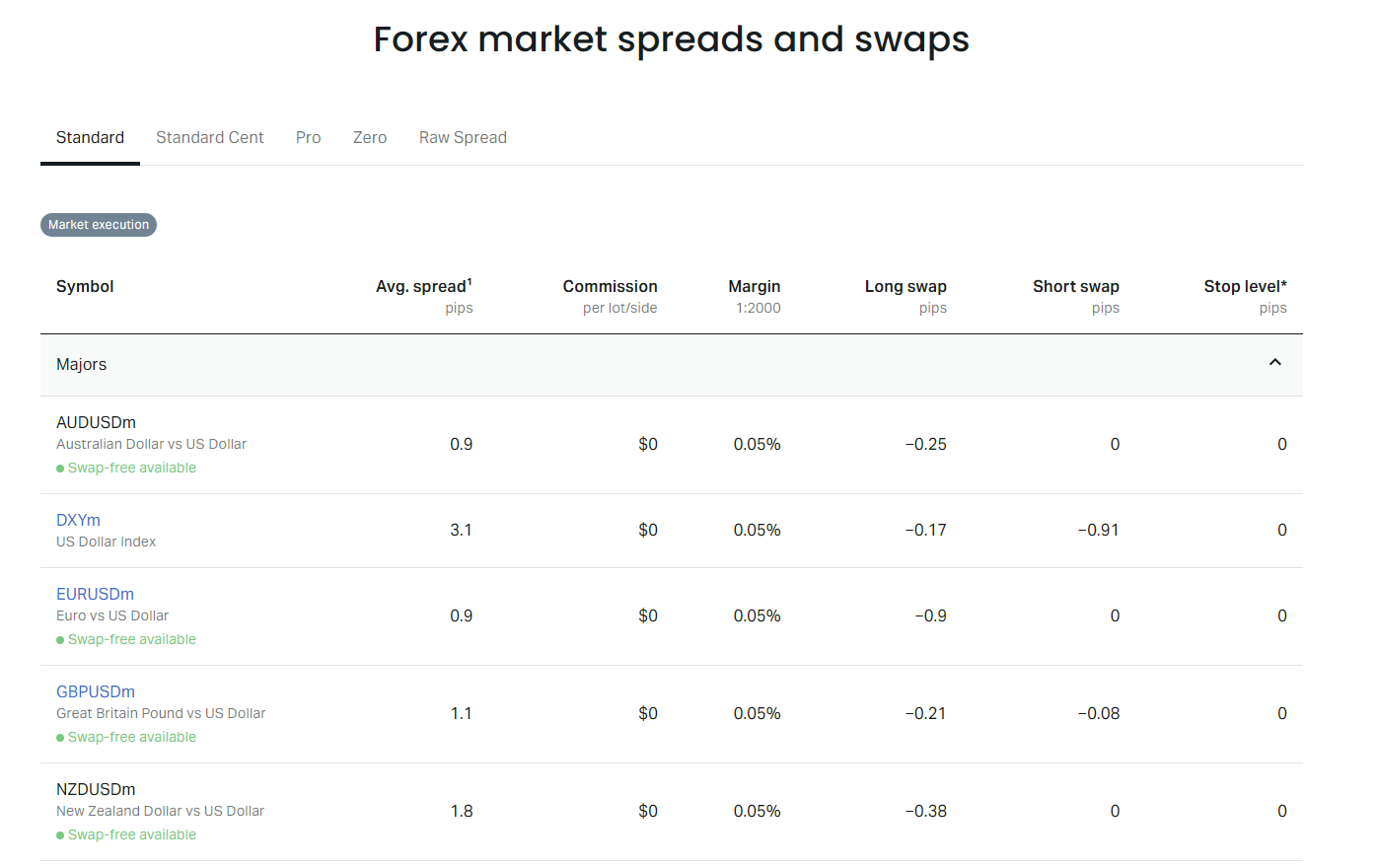
Exness publishes both long and short swap rates for every forex pair. These rates are not symmetrical; the long swap for EURUSD differs from the short swap for EURUSD. This asymmetry exists because the interest rate differential works in opposite directions depending on which currency you are buying. A trader holding a long EURUSD position pays the EUR interest rate and receives the USD interest rate. A trader holding a short EURUSD position pays the USD rate and receives the EUR rate. The broker's markup is applied to both sides.
The image above displays the swap rates for various forex pairs as shown in the Exness trading platform. Notice that major pairs like EURUSD show relatively small swap values, while exotic pairs can show much larger numbers. Traders should always verify current rates before entering positions intended to be held overnight, as swap rates adjust when central banks change policy rates.
Scroll horizontally to see all columns
| Symbol | Long Swap | Short Swap | Typical Direction |
|---|---|---|---|
| EURUSD | -0.8 | -0.2 | Negative both sides |
| GBPUSD | -1.2 | 0.1 | Mixed |
| USDJPY | 2.5 | -4.8 | Positive long, negative short |
| AUDUSD | -0.5 | -0.9 | Negative both sides |
| USDCHF | 3.1 | -5.2 | Positive long, negative short |
| USDCAD | -0.3 | -1.1 | Negative both sides |
| NZDUSD | -0.7 | -0.4 | Negative both sides |
| EURGBP | -0.4 | -0.6 | Negative both sides |
The table above illustrates typical swap rate patterns. Pairs where the base currency has a lower interest rate than the quote currency tend to have negative long swaps. Pairs like USDJPY and USDCHF often show positive long swaps because the US dollar historically carries a higher interest rate than the Japanese yen or Swiss franc. These rates are illustrative; actual rates change daily and should be confirmed in the trading platform.
Carry trade strategies rely on positive swap accumulation over weeks or months. Exness provides competitive rates for carry traders, but risk management remains essential as exchange rate moves can dwarf swap gains.
Stock CFD Swap Charges
Stock CFD swap rates at Exness are derived from the cost of financing a leveraged equity position. When you buy a stock CFD, you are effectively borrowing the full notional value of the shares from the broker. The swap charge reflects the applicable benchmark interest rate (such as SOFR for US stocks, SONIA for UK stocks, or €STR for European stocks) plus the broker's markup. Short stock CFD positions may receive a credit based on the same benchmark minus a spread, though hard-to-borrow stocks can incur additional borrowing fees that exceed the standard financing rate.
Exness offers CFDs on hundreds of global stocks across major exchanges including NYSE, NASDAQ, LSE, XETRA, and others. Each stock has its own swap rate, which updates to reflect changes in the underlying benchmark rate and any corporate actions such as dividends. Long positions are adjusted for dividend payments; short positions are charged the dividend amount. These adjustments occur on the ex-dividend date and are separate from the daily swap accrual.
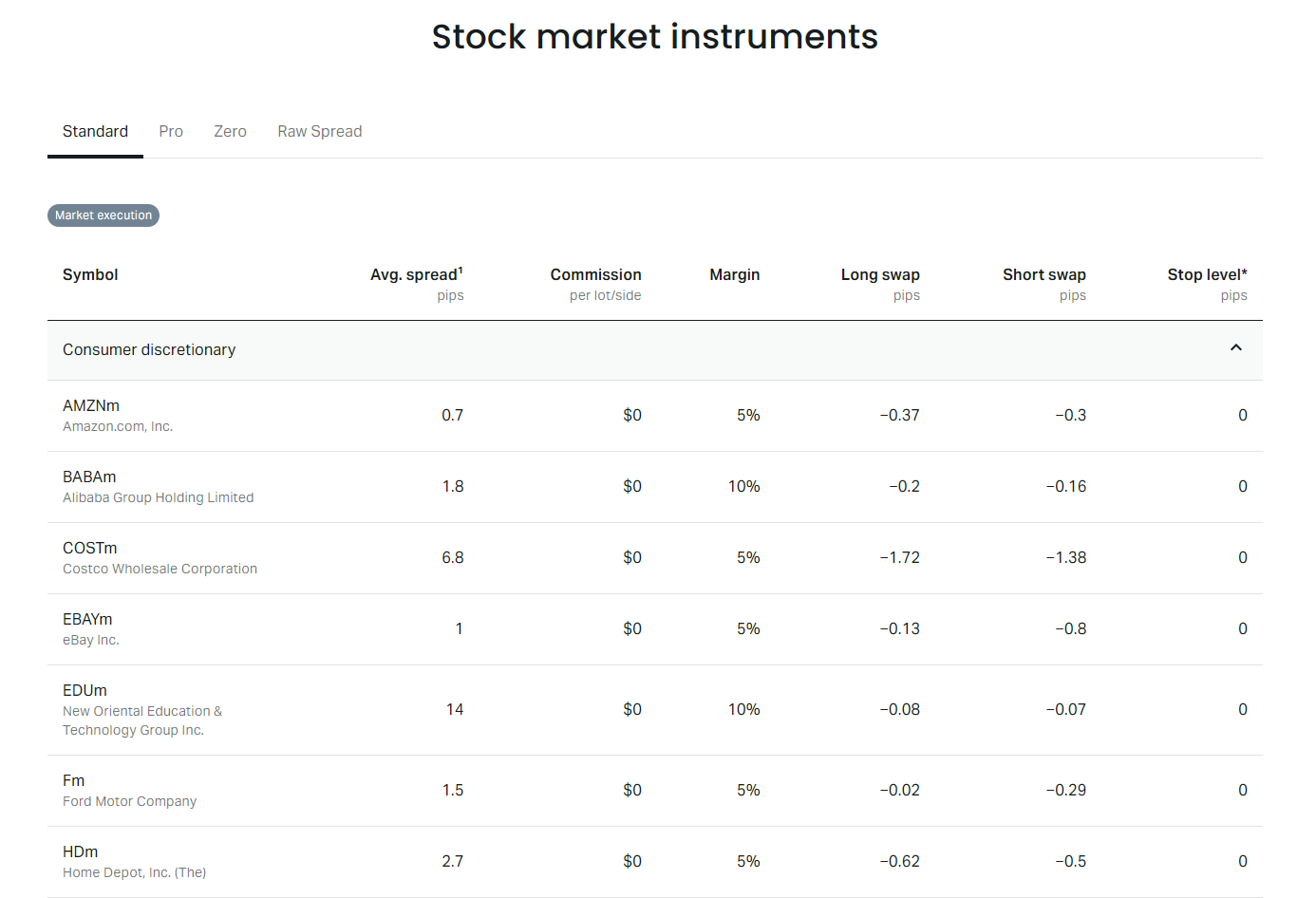
The image shows the swap rates for selected stock CFDs. Notice that rates are expressed in the account currency per lot per night. For US stocks, a typical long swap might be -0.02% annually, which translates to a small daily charge. High-profile technology stocks like Apple, Microsoft, and Tesla generally have similar financing costs because they share the same benchmark rate. However, stocks with high short interest or limited availability for borrowing can carry significantly higher short swap rates.
- Long stock CFDs: pay benchmark rate + markup
- Short stock CFDs: receive benchmark rate - spread (minus borrow fees)
- Dividend adjustments applied on ex-dividend date
- Triple swap charged on Friday for weekend
- Rates vary by exchange and currency denomination
Index CFD Overnight Fees
Index CFD swap rates follow a similar financing model to stock CFDs but reference the benchmark rate for the index's currency zone. For example, US index CFDs (US30, US500, USTEC) use the SOFR rate, European indices (DE40, FR40, EU50) use €STR, and UK indices (UK100) use SONIA. The swap rate for a long index CFD position equals the relevant benchmark rate plus the broker's markup. Short index CFD positions receive the benchmark rate minus a spread. Because indices are baskets of stocks, they do not have individual dividend adjustments; instead, the index price itself adjusts for constituent dividends.
Exness provides CFDs on major global indices including the Dow Jones (US30), S&P 500 (US500), Nasdaq 100 (USTEC), DAX 40 (DE40), FTSE 100 (UK100), CAC 40 (FR40), and others. Each index CFD has a defined contract size (e.g., $10 per point for US500) and a swap rate expressed in points per lot per night. The financing cost is generally lower than for individual stocks because index components diversify borrowing risk. However, during periods of market stress, index swap rates can widen as liquidity providers increase their risk premiums.
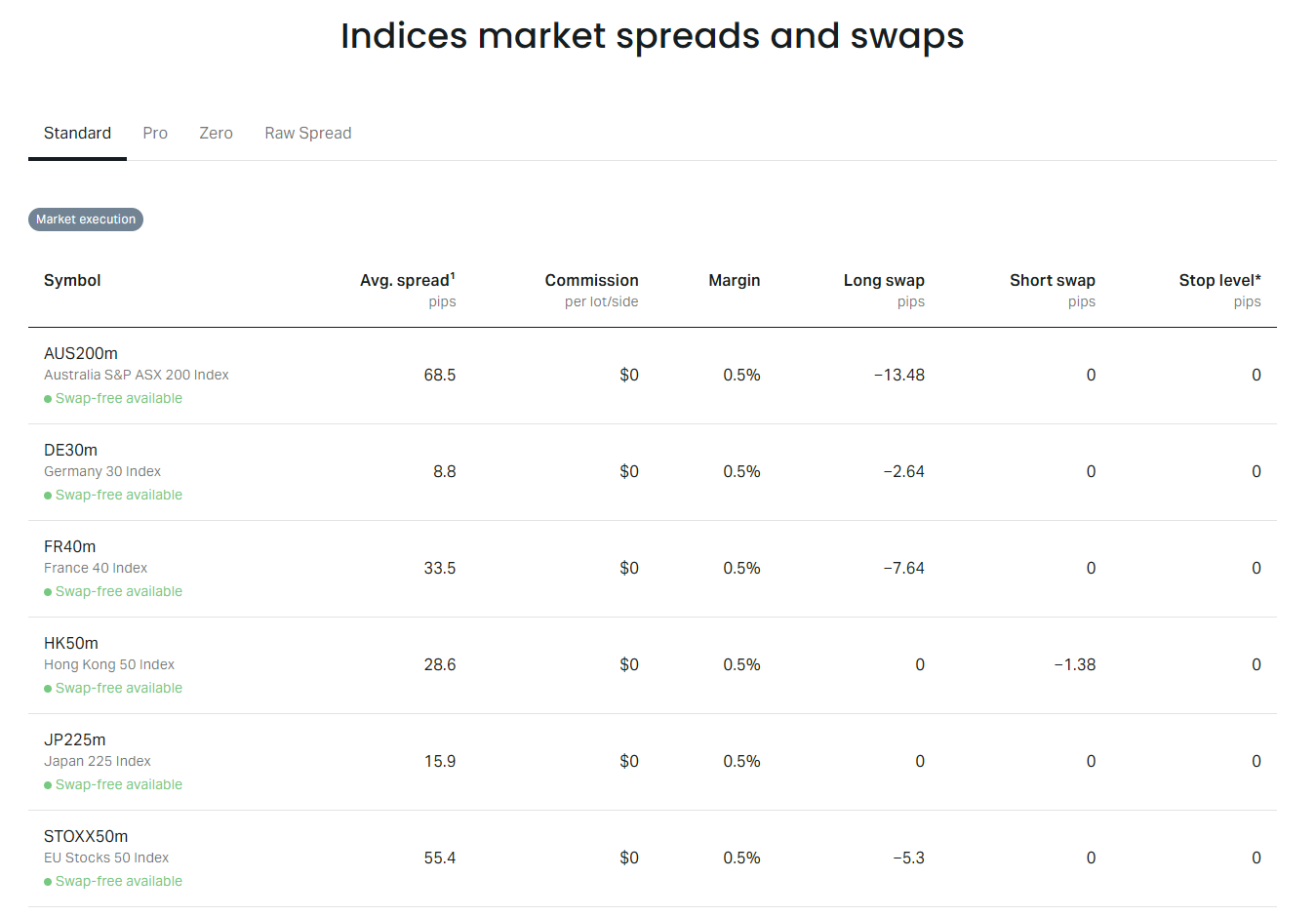
The image displays swap rates for popular index CFDs. US indices typically show similar rates since they share the same underlying benchmark. European and Asian indices reflect their respective regional interest rate environments. Traders holding index positions for extended periods should monitor central bank policy meetings, as rate decisions directly impact the benchmark rates used in swap calculations.
Scroll horizontally to see all columns
| Index Symbol | Region | Benchmark Rate | Long Swap (Annual %) | Short Swap (Annual %) |
|---|---|---|---|---|
| US500 | United States | SOFR | -5.5% | 4.8% |
| USTEC | United States | SOFR | -5.5% | 4.8% |
| US30 | United States | SOFR | -5.5% | 4.8% |
| DE40 | Germany | €STR | -3.8% | 3.1% |
| UK100 | United Kingdom | SONIA | -5.0% | 4.3% |
| FR40 | France | €STR | -3.8% | 3.1% |
| JP225 | Japan | TONAR | -0.1% | -0.5% |
| AU200 | Australia | RBA Cash Rate | -4.2% | 3.5% |
The table shows approximate annualized swap percentages for major index CFDs. Negative long swap indicates a cost to hold long positions; positive short swap indicates a credit for holding short positions. Japanese indices historically show near-zero or negative rates on both sides due to Japan's prolonged low-interest-rate environment. These figures are indicative and change with monetary policy.
Cryptocurrency Swap Considerations
Cryptocurrency CFD swap rates at Exness are generally higher than forex or traditional CFDs due to the unique characteristics of digital asset markets. Crypto markets operate 24/7 without a traditional weekend close, but brokers still apply financing charges for leveraged positions. The swap rate for crypto CFDs reflects the cost of borrowing the underlying cryptocurrency or the synthetic financing cost created by the liquidity provider. Bitcoin (BTCUSD), Ethereum (ETHUSD), and other major crypto pairs typically carry annualized swap rates ranging from 10% to 30% or more depending on market conditions and borrowing demand.
Long crypto CFD positions incur a daily financing charge. Short crypto CFD positions may receive a credit, but this is often reduced by the high borrowing costs associated with shorting volatile digital assets. During periods of extreme volatility or strong directional trends, crypto swap rates can spike as liquidity providers adjust for increased risk. Exness updates crypto swap rates frequently to reflect current market conditions. Traders should be aware that holding leveraged crypto positions for weeks or months can accumulate substantial financing costs that may exceed the initial margin.
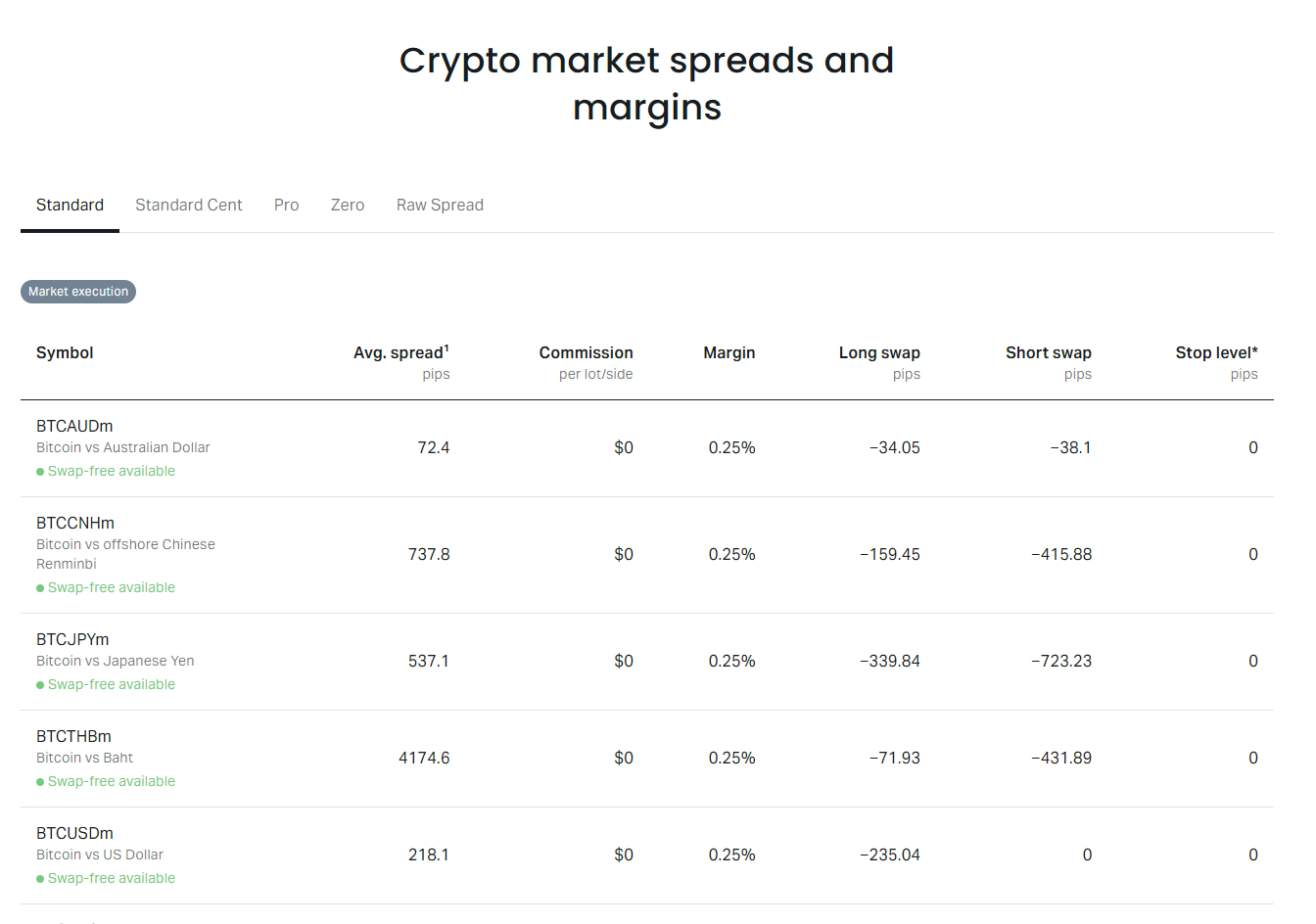
The image illustrates the notably higher swap rates for cryptocurrency CFDs compared to forex or traditional CFDs. Bitcoin and Ethereum typically have the deepest liquidity and therefore the lowest crypto swap rates among digital assets. Altcoin CFDs often carry even higher financing costs due to lower liquidity and higher borrowing demand. The triple-swap convention for crypto CFDs at Exness applies on Friday, covering the weekend period even though crypto markets remain open.
- Crypto swap rates significantly higher than forex or stocks
- Long positions: pay financing cost (typically 10-30% annually)
- Short positions: may receive credit but often reduced by borrow fees
- Rates spike during high volatility or strong trends
- Triple swap applied on Friday despite 24/7 market operation
Commodity and Energy Swap Rates
Commodity and energy CFD swap rates at Exness incorporate the cost of carry, which includes storage, insurance, and financing components. For precious metals like gold (XAUUSD) and silver (XAGUSD), the swap rate reflects the gold lease rate or silver lease rate plus a markup. These rates are typically lower than crypto but higher than major forex pairs. Energy CFDs such as crude oil (USOIL, UKOIL) and natural gas (NGAS) have swap rates driven by the futures curve structure (contango or backwardation) and the financing cost of holding the synthetic position.
Gold swap rates are of particular interest to many traders because gold is often held as a longer-term position. The gold lease rate has historically been low, sometimes even negative, meaning long gold positions can occasionally earn a small positive swap. However, the broker's markup usually ensures a net cost for retail traders. Silver follows a similar pattern but with higher volatility in lease rates. Energy swap rates can flip between positive and negative depending on whether the futures curve is in contango (future prices higher than spot) or backwardation (future prices lower than spot).
The image shows swap rates for gold, silver, crude oil, and natural gas CFDs. Gold typically shows a small negative long swap and a small negative short swap. Oil swap rates vary significantly with the futures curve; during contango, long positions pay more, while during backwardation, short positions may pay more. Natural gas exhibits the highest seasonal variability in swap rates due to weather-driven demand patterns.
Scroll horizontally to see all columns
| Instrument | Primary Rate Driver | Typical Long Swap | Typical Short Swap | Seasonal Variation |
|---|---|---|---|---|
| XAUUSD (Gold) | Gold lease rate | -0.1% to -0.5% | -0.1% to -0.3% | Low |
| XAGUSD (Silver) | Silver lease rate | -0.2% to -0.8% | -0.2% to -0.5% | Low |
| USOIL (WTI) | Futures curve + financing | Variable | Variable | Moderate |
| UKOIL (Brent) | Futures curve + financing | Variable | Variable | Moderate |
| NGAS (Natural Gas) | Futures curve + financing | Highly variable | Highly variable | High (winter/summer) |
Commodity swap rates require more frequent monitoring than forex rates because they respond to physical market fundamentals, not just interest rate policy. Traders holding commodity positions through seasonal transitions (e.g., natural gas into winter) should anticipate significant swap rate changes. Exness updates these rates daily based on liquidity provider feeds.
Swap-Free Islamic Account Options
Exness offers swap-free accounts, also known as Islamic accounts, for traders who cannot pay or receive interest due to religious beliefs. These accounts eliminate overnight swap charges on all instruments, replacing them with a fixed administration fee or commission structure that complies with Sharia principles. The swap-free option is available to clients who meet eligibility requirements and submit a request through their Personal Area. Once approved, the account is converted to swap-free status, and all open and future positions are exempt from daily rollover charges.
The swap-free account at Exness applies to forex, metals, energies, indices, stocks, and cryptocurrencies. Instead of variable swap rates, traders pay a fixed commission per lot or a daily administration fee for positions held overnight. The fee schedule is transparent and published in the account specifications. This structure provides certainty for traders who hold positions for extended periods, as they know the exact cost regardless of interest rate movements. However, the fixed fee may be higher or lower than the variable swap would have been depending on market conditions.
- Available for all account types upon request and approval
- Eliminates all overnight swap charges
- Replaces swap with fixed commission or daily fee
- Applies to forex, metals, energies, indices, stocks, crypto
- Fee schedule published in account specifications
- No triple-swap charges on weekends
Managing Swap Costs in Trading Strategy
Effective swap management begins with awareness. Day traders who close all positions before the daily rollover avoid swap entirely. Swing traders and position traders must factor swap into their profit targets and risk calculations. A position with a 50-pip target but a -1.5 pip daily swap held for 10 days loses 15 pips to financing, reducing the effective reward-to-risk ratio. Exness provides the trading calculator to estimate total swap costs for any holding period, allowing traders to make informed decisions before entry.
Several strategies can mitigate negative swap impact. First, favor instruments with positive or neutral swap for the intended direction. Long USDJPY or USDCHF positions often earn positive swap. Second, limit holding periods for high-negative-swap instruments. Third, consider hedging with correlated instruments that have opposite swap profiles, though this introduces correlation risk. Fourth, use the swap-free account if eligible and the fixed fee is lower than projected variable swap. Fifth, monitor central bank calendars; rate decisions can flip swap from positive to negative or vice versa.
A 2-pip daily negative swap held for 30 days equals 60 pips in costs. On a standard lot, that's $600. Always project swap over your expected holding period before committing capital.
- Close positions before rollover to avoid swap (day trading)
- Select instruments with favorable swap for your direction
- Use Exness trading calculator to project total financing cost
- Consider swap-free account for long-term positions
- Monitor central bank rate decisions for swap regime changes
- Hedge swap exposure only with clear correlation understanding
Exness Trading Calculator for Swap Estimation
The Exness trading calculator is a free tool accessible from the broker's website and within the Personal Area. It allows traders to calculate margin requirements, pip value, profit potential, and swap costs for any instrument, position size, and holding period. The calculator uses current contract specifications including the live swap rates, making it the most accurate way to project overnight financing costs before opening a position. Traders can input the symbol, account type, lot size, leverage, and expected holding days to receive a detailed breakdown.
The calculator displays swap as a separate line item in both the account currency and in points. It automatically applies the triple-swap convention for the relevant day of the week. For example, a 10-day holding period starting Monday includes one Wednesday triple-swap charge. The tool also shows the total cost including spread, commission (if applicable), and swap, providing a complete picture of the all-in trading cost. This transparency helps traders compare instruments and account types on a total-cost basis.
The image shows the trading calculator interface with a swap estimation example. The calculator breaks down the swap cost per day and the total for the holding period. Traders can adjust the number of days to see how swap accumulates over time. This tool is especially valuable for comparing the cost of holding the same position on different account types (Standard vs Raw Spread vs Zero) where commission structures differ but swap rates may be similar.
Scroll horizontally to see all columns
| Input Parameter | Description | Output Field | Description |
|---|---|---|---|
| Symbol | Trading instrument | Swap (Points) | Daily swap in points |
| Account Type | Standard, Pro, Raw, Zero | Swap (Currency) | Daily swap in account currency |
| Lot Size | Position volume | Total Swap | Cumulative swap for holding period |
| Leverage | Margin ratio | Total Cost | Spread + commission + swap |
| Holding Days | Expected duration | Triple Swap Days | Number of triple-swap charges |
The calculator also supports reverse engineering: traders can input a maximum acceptable swap cost and solve for the maximum holding period or position size. This feature is useful for risk management frameworks that cap financing costs as a percentage of account equity. The tool is available without login, though logged-in users see rates specific to their account type and region.
Comparing Exness Swap Rates with Industry
Exness swap rates are generally competitive with other major forex and CFD brokers. The broker's markup over institutional tom-next rates is transparent and consistent. For major forex pairs, Exness long and short swap rates typically fall within the middle range of the industry. Some brokers offer tighter swap spreads on specific pairs as a competitive differentiator, while others charge higher markups. Exness does not engage in swap manipulation; rates are derived from liquidity provider feeds and updated automatically.
For CFD instruments, Exness swap rates reflect the underlying benchmark rates plus a standard markup. The broker's large client base and deep liquidity relationships allow it to negotiate favorable financing terms with providers. Traders comparing brokers should evaluate total cost of ownership: spread + commission + swap. A broker with lower spreads but higher swap may be more expensive for swing traders, while a broker with higher spreads but lower swap may suit day traders. Exness offers multiple account types precisely to let traders choose the cost structure that matches their holding horizon.
Total cost analysis requires adding spread, commission, and projected swap. Exness provides all three components transparently, enabling genuine comparison across account types and brokers.
Swap Rate Monitoring and Alerts
Exness provides several ways to monitor swap rates in real time. The Market Watch window in MetaTrader 4 and MetaTrader 5 displays current long and short swap for each symbol when the specification details are expanded. The Exness Terminal and mobile app show swap in the instrument information panel. The broker's website maintains a contract specifications page with a searchable table of all instruments and their current swap rates. Rates update automatically when liquidity providers publish new values, typically once per day.
Traders who hold positions overnight should check swap rates daily, especially around central bank meetings, month-end, quarter-end, and year-end when funding markets can exhibit unusual behavior. Exness does not currently offer automated swap rate alerts, but traders can set up custom indicators in MetaTrader to notify them when swap exceeds a threshold. The trading calculator can also be used periodically to re-estimate costs for open positions as rates change.
- Check swap in Market Watch specification details
- View rates in Exness Terminal instrument info
- Consult website contract specifications page
- Monitor around central bank policy dates
- Re-calculate with trading calculator weekly
- Consider custom MT4/MT5 indicators for alerts
Impact of Leverage on Swap Costs
Leverage does not directly change the swap rate per lot, but it determines how much notional exposure a trader can control with a given margin. Higher leverage allows larger positions for the same capital, which amplifies the absolute swap cost in currency terms. For example, a trader with $1,000 equity using 1:2000 leverage can control 20 lots of EURUSD, incurring 20 times the swap of a 1-lot position. The swap rate in points remains identical, but the total financing charge scales with position size. This relationship means leverage indirectly magnifies swap impact on account equity.
Exness offers dynamic leverage that adjusts based on account equity and instrument. For forex majors, leverage up to 1:2000 is available for accounts below certain equity thresholds. As equity grows, maximum leverage decreases. This structure means swap costs as a percentage of equity can vary over the life of an account. Traders using high leverage for large positions should be especially vigilant about swap accumulation, as a few days of negative swap on a highly leveraged position can trigger margin calls even if the price hasn't moved adversely.
Tax Implications of Swap Income and Expense
Swap payments and receipts may have tax implications depending on the trader's country of residence and tax status. In many jurisdictions, negative swap (interest paid) is treated as a trading expense deductible against trading profits. Positive swap (interest received) may be classified as interest income or trading income, subject to different tax rates. Some countries treat forex swap as capital in nature, while others treat it as revenue. Exness does not provide tax advice and does not withhold tax on swap credits or debits. Traders are responsible for maintaining records and consulting a qualified tax professional.
The trading platform history and account statements show swap as a separate line item for each closed position and as a daily accrual for open positions. This granularity facilitates tax reporting. Exness provides annual statements that summarize total swap paid and received by instrument. Traders should download and retain these statements for their records. The tax treatment of swap on CFDs (stocks, indices, commodities, crypto) may differ from forex swap in some jurisdictions, adding complexity for multi-asset traders.
Tax treatment of swap varies globally. Some jurisdictions allow full deduction of financing costs; others classify swap as interest income. Professional tax guidance is essential for accurate filing.
Key Takeaways About Exness Swap
Exness swap rates are a transparent, formula-driven component of trading costs that affect any position held past the daily rollover. The broker publishes live rates for all instruments, provides a calculator for precise estimation, and offers a swap-free alternative for eligible clients. Forex swap reflects central bank rate differentials; CFD swap reflects financing benchmarks plus markup. Crypto and commodity swaps carry unique drivers including borrowing demand and cost of carry. Traders who understand these mechanics can make informed decisions about holding periods, instrument selection, and account type to optimize total cost of ownership.
The most important practices are: check current swap rates before entering overnight positions, use the trading calculator to project total financing cost for your expected holding period, monitor central bank calendars for rate changes that shift swap regimes, consider the swap-free account if you hold positions for weeks or months, and always include swap in your risk management calculations. Exness provides the tools and transparency needed to manage swap effectively; the responsibility lies with the trader to use them.
Frequently Asked Questions
When does Exness charge swap on forex positions?
Exness charges forex swap at the daily rollover, which occurs at 22:00 UTC during winter and 21:00 UTC during summer. Positions open at that time incur the swap charge for that night.
Why is Wednesday swap triple the normal amount?
Wednesday swap is tripled to account for Saturday and Sunday when the interbank forex market is closed. The rollover from Wednesday to Thursday settles on Monday, covering three days of financing.
Can I avoid swap charges entirely on Exness?
Yes, you can avoid swap by closing all positions before the daily rollover time, or by applying for a swap-free Islamic account which replaces variable swap with a fixed administration fee.
Do all Exness account types have the same swap rates?
Swap rates are generally consistent across Standard, Standard Cent, Pro, Raw Spread, and Zero accounts. The main cost differences between account types are spreads and commissions, not swap.
How can I check the current swap rate for a specific symbol?
You can view current long and short swap rates in the Market Watch specification details in MT4/MT5, in the instrument information panel in Exness Terminal and the mobile app, or on the Exness website contract specifications page.
Does Exness charge swap on demo accounts?
Yes, demo accounts replicate live trading conditions including swap charges. This allows traders to practice with realistic cost structures before committing real capital.
Are cryptocurrency CFD swap rates higher than forex swap rates?
Yes, cryptocurrency CFD swap rates are typically significantly higher than forex rates, often ranging from 10% to 30% annually, due to higher borrowing costs and volatility risk premiums in digital asset markets.
What happens to swap when a stock CFD pays a dividend?
Long stock CFD positions receive a dividend credit on the ex-dividend date, while short positions are charged the dividend amount. This adjustment is separate from the daily swap accrual.