

Forex Trading Accounts
Exness Cent Account: Features, Benefits, and Trading Conditions
Complete guide to Exness cent and micro accounts with trading conditions, platform access, and account opening steps.

Forex Analyst
Forex Analyst specializing in currency markets, market trends, technical and fundamental analysis, and providing clear insights to help traders make informed decisions.
The Exness Cent Account provides traders with a low-barrier entry point into live forex and CFD markets by denominating balances in cents rather than dollars. This structure allows participants to experience real market conditions with significantly reduced financial exposure, making it a practical choice for those transitioning from demo environments or testing strategies with genuine execution. Unlike simulated accounts, cent accounts process orders through the same liquidity pools and execution engines as standard accounts, preserving the psychological aspects of live trading while limiting nominal risk.
Contents
- What Is an Exness Cent Account
- Key Features of the Cent Account
- Exness Cent Account Minimum Deposit and Requirements
- Trading Conditions: Spreads, Commissions, and Leverage
- Available Trading Instruments on Cent Account
- Exness Micro Account vs Cent Account Comparison
- Platform Access: MT4, MT5, and Web Terminal
- Opening an Exness Cent Account Step by Step
- Risk Management Considerations for Cent Accounts
- Advantages and Limitations of Cent Account Trading
- Final Assessment of Exness Cent Account
Exness offers the Standard Cent account as part of its standard account lineup, distinct from professional-tier options such as Raw Spread, Zero, and Pro accounts. The cent denomination means a deposit of $10 appears as 1,000 cents in the trading terminal, and position sizes are calculated in micro-lots where 1 lot equals 1,000 units of base currency rather than 100,000. This scaling affects margin requirements, pip values, and profit calculations proportionally, giving traders a granular view of account fluctuations without the volatility of full-sized lots.
Traders often search for terms like does Exness have a cent account or Exness micro account minimum deposit when evaluating brokers for small-capital trading. The broker's cent account addresses both queries by providing a genuine micro-lot environment with no commission on standard cent accounts and floating spreads starting from 0.3 pips on major pairs. The account supports all major platform variants including MetaTrader 4, MetaTrader 5, the Exness Web Terminal, and mobile applications, ensuring feature parity with higher-tier accounts.
What Is an Exness Cent Account
An Exness Cent Account is a live trading account where the base currency is displayed in cents (USDc, EURc, or other supported cent-denominated currencies) instead of whole currency units. This means a $10 deposit reflects as 1,000 cents in the platform, and the smallest tradable volume is 0.01 lots, equivalent to 1,000 units of the base currency — a micro-lot. The account type is categorized under Standard accounts and is designed for traders who want real-market execution with minimal capital commitment.
The cent account operates on the same pricing feed and execution model as other Standard accounts. Orders are filled via market execution with no requotes, and the broker applies a markup on raw spreads rather than charging separate commissions. This cost structure simplifies expense tracking for newer traders who may find commission-based models less transparent. The account also supports hedging, scalping, and expert advisors without restrictions, provided trading activity complies with the broker's terms of service.
One common misconception is that cent accounts offer inferior trading conditions. In reality, the spread markup, execution speed, and available leverage are identical to the Standard account. The only structural differences are the account denomination and the resulting position sizing granularity. This parity ensures that strategies tested on a cent account behave similarly when scaled to a standard dollar-denominated account, assuming equivalent risk parameters.
Key Features of the Cent Account
The Exness Cent Account includes several features that distinguish it from both demo accounts and standard dollar-denominated live accounts. These features are designed to replicate the full trading experience while maintaining the risk profile appropriate for smaller capital bases.
- Account denominated in cents (USDc, EURc, GBPc, CHFc, JPYc, PLNc, CNYc, ZARc, THBc, VNDc, IDRc, MYRc, PHPc, INRc, BRLc, MXNc, NGNc, KES, EGPC, AEDc, BDTc, SGDc, PHPc, PKRc, CLPc, COPc, ARSc)
- Minimum deposit of $1 (100 cents) for most payment methods
- Maximum leverage up to 1:2000 (subject to regulatory jurisdiction and equity thresholds)
- Floating spreads from 0.3 pips on EURUSD with no commission
- Market execution with no dealing desk intervention
- Support for all order types: market, pending, stop, and trailing stops
- Full compatibility with MT4, MT5, Web Terminal, and Exness mobile apps
- Access to forex majors, minors, exotics, metals, energies, indices, stocks, and cryptocurrencies
- Negative balance protection and stop-out at 0% margin level
- Instant withdrawal processing for most electronic payment methods
The leverage offering deserves particular attention. While Exness advertises leverage up to 1:2000, this maximum applies only to accounts with equity below $200 (20,000 cents) and is dynamically reduced as account equity grows. Traders should verify the applicable leverage tier for their account size and jurisdiction, as regulatory caps in regions such as the EU, UK, Australia, and South Africa limit retail leverage to 1:30 for major forex pairs regardless of account type.
Exness Cent Account Minimum Deposit and Requirements
The Exness cent account minimum deposit is $1 for most electronic payment methods, which translates to 100 cents in the trading terminal. This low threshold makes the account accessible to virtually any trader wishing to test live conditions. However, practical considerations suggest depositing at least $10–$20 (1,000–2,000 cents) to provide sufficient margin for meaningful position sizing and to absorb normal market fluctuations without immediate stop-out risk.
Account opening requires standard Know Your Customer (KYC) verification including proof of identity (passport, national ID, or driver's license) and proof of residence (utility bill, bank statement, or government-issued document dated within the last three months). The verification process typically completes within a few hours during business days, though delays can occur during high-volume periods. Once verified, deposits via cards, e-wallets (Skrill, Neteller, WebMoney, Perfect Money), and local payment methods are credited instantly.
Scroll horizontally to see all columns
| Method | Min Deposit | Processing Time | Fees |
|---|---|---|---|
| Visa / Mastercard | $1 (100 cents) | Instant | None |
| Skrill / Neteller | $1 (100 cents) | Instant | None |
| WebMoney / Perfect Money | $1 (100 cents) | Instant | None |
| Bank Transfer | $10 (1,000 cents) | 1–3 business days | Bank dependent |
| Local Payment Methods | Varies by region | Instant to 1 hour | Usually none |
Withdrawals follow the same method priority rule: funds must be returned to the original deposit source up to the deposited amount before profits can be withdrawn to an alternative method. Exness processes withdrawal requests automatically 24/7 for electronic methods, with most completing within minutes. Bank transfers may take 1–3 business days depending on the receiving institution. There are no broker-imposed withdrawal fees, though payment processors or intermediary banks may apply their own charges.
Trading Conditions: Spreads, Commissions, and Leverage
The Standard Cent account uses a spread-only pricing model with no round-turn commissions. Spreads are floating and vary by instrument, time of day, and market volatility. During peak liquidity hours (London/New York overlap), major pairs such as EURUSD typically trade between 0.3 and 0.7 pips above raw interbank spreads. Exotic pairs and less liquid instruments carry wider spreads reflecting higher liquidity provider costs.
Scroll horizontally to see all columns
| Instrument Category | Example Symbols | Typical Spread Range |
|---|---|---|
| Major Forex Pairs | EURUSD, GBPUSD, USDJPY | 0.3 – 1.0 pips |
| Minor Forex Pairs | EURGBP, AUDJPY, CADCHF | 0.8 – 2.5 pips |
| Exotic Forex Pairs | USDTRY, USDZAR, USDMXN | 3.0 – 15.0+ pips |
| Metals | XAUUSD, XAGUSD | 0.5 – 3.0 pips |
| Energies | USOIL, UKOIL, NGAS | 2.0 – 6.0 pips |
| Indices | US30, US500, USTEC | 0.4 – 2.0 points |
| Cryptocurrencies | BTCUSD, ETHUSD | 0.1% – 0.5% of price |
Swap rates (overnight financing charges) apply to positions held past 23:59 server time and vary by instrument and direction (long vs short). Exness publishes swap values in the trading platform specifications and on its website. Traders holding positions for extended periods should factor swap costs into profitability calculations, particularly for high-swap instruments such as exotic currency pairs or certain cryptocurrencies. Islamic (swap-free) accounts are available upon request for eligible clients.
Spread-only pricing on cent accounts eliminates commission complexity, but traders must monitor spread widening during news events and low-liquidity sessions.
Available Trading Instruments on Cent Account
The Exness Cent Account provides access to the full instrument catalog available to Standard accounts, encompassing over 200 trading symbols across multiple asset classes. This breadth allows cent account holders to diversify strategies across uncorrelated markets without upgrading account types. Instrument specifications such as contract size, margin requirements, and trading hours are identical to standard accounts; only the account denomination and resulting position scaling differ.
- Forex: 100+ currency pairs including majors, minors, and exotics
- Metals: Gold (XAUUSD), Silver (XAGUSD), Platinum (XPTUSD), Palladium (XPDUSD)
- Energies: US Crude (USOIL), UK Brent (UKOIL), Natural Gas (NGAS)
- Indices: 15+ global indices including US30, US500, USTEC, GER40, UK100, JPN225
- Stocks: 100+ major US and EU equities via CFDs (Apple, Tesla, Amazon, etc.)
- Cryptocurrencies: 20+ crypto pairs including BTCUSD, ETHUSD, LTCUSD, XRPUSD
Contract specifications for cent accounts reflect the micro-lot scaling. For forex, 1 standard lot on a cent account equals 1,000 units of base currency (0.01 standard lots). For metals, 1 lot of XAUUSD represents 10 troy ounces rather than 100. Index and stock CFD contract sizes are similarly scaled. Traders should always verify the contract size in the platform's symbol specifications before placing trades, as incorrect position sizing is a common error when switching between account denominations.
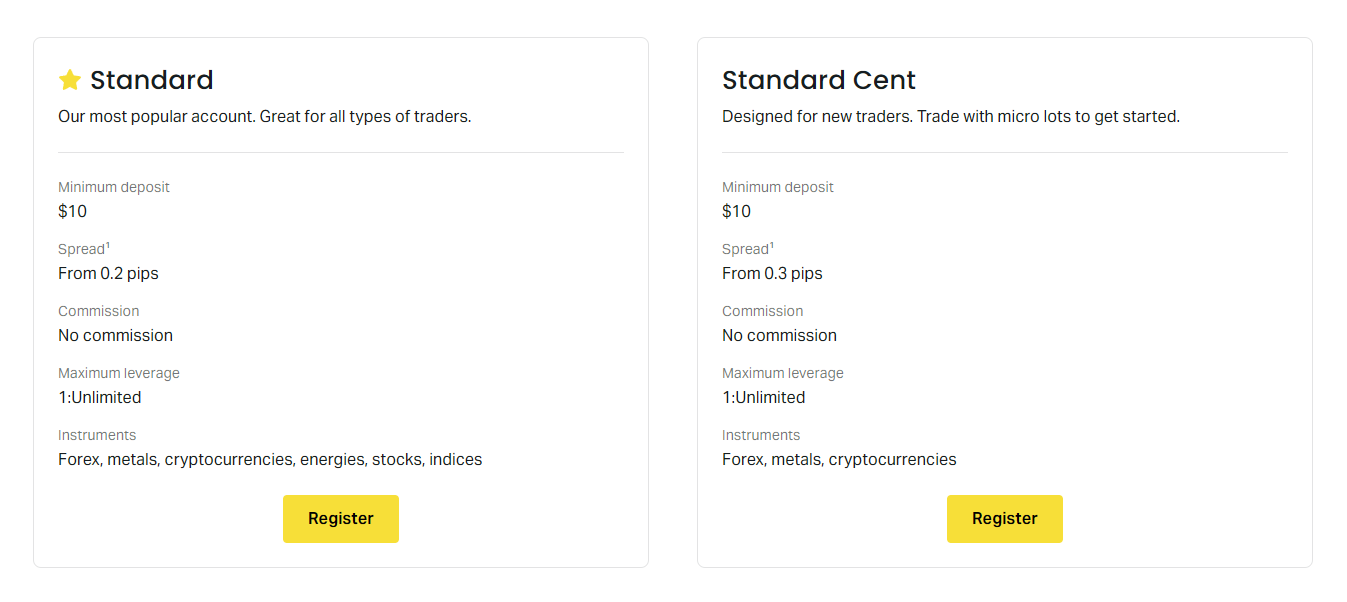
The availability of cryptocurrency CFDs on cent accounts is notable, as many brokers restrict crypto trading to higher-tier accounts. Exness offers crypto with leverage up to 1:400 (subject to regulatory caps) and spreads expressed as a percentage of the mid-price. Crypto markets operate 24/7 with brief maintenance windows, providing continuous trading opportunities for cent account holders who prefer weekend or holiday sessions when forex markets are closed.
Exness Micro Account vs Cent Account Comparison
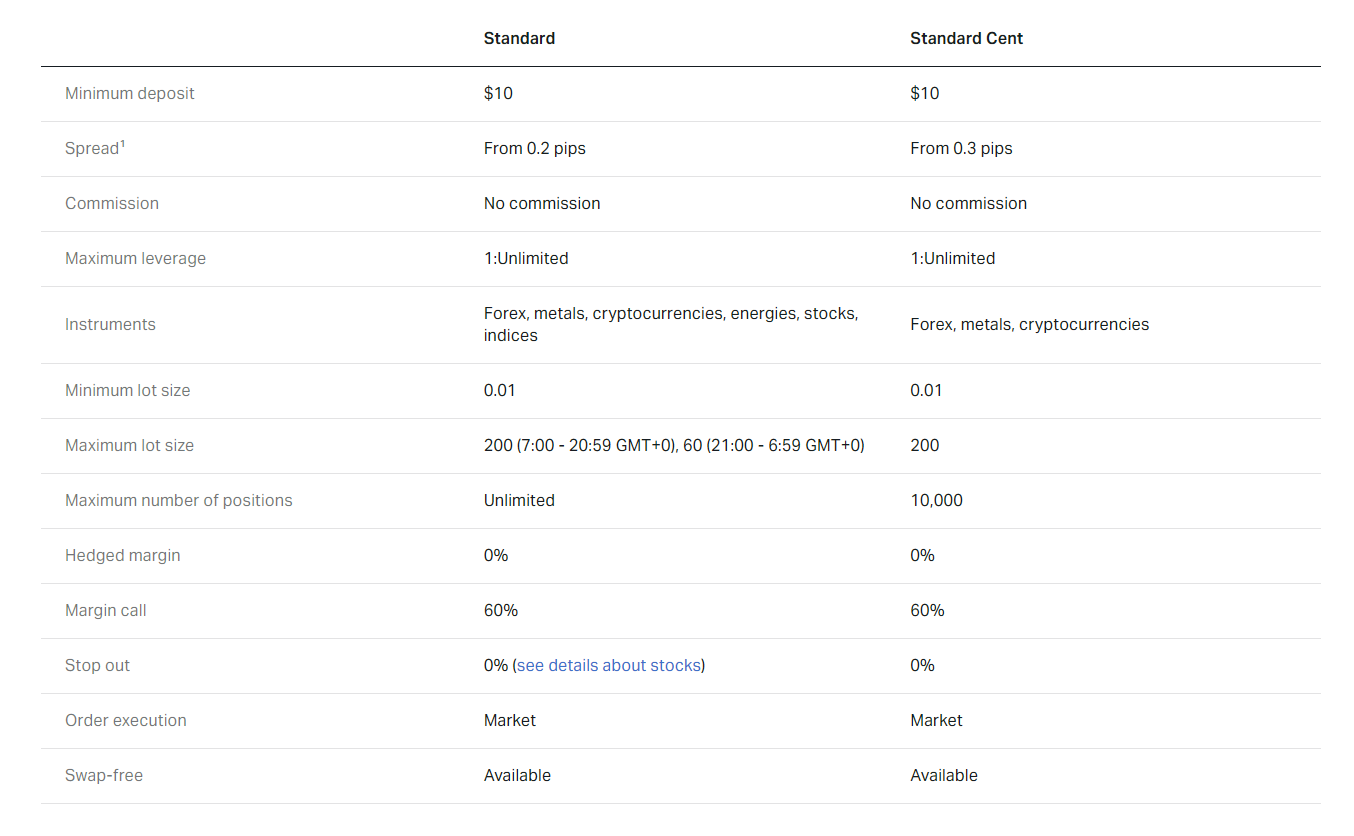
The terms micro account and cent account are sometimes used interchangeably, but they refer to different concepts. A micro account typically denotes an account where the minimum lot size is 0.01 standard lots (1,000 units), while a cent account specifically refers to the account currency denomination. Exness Standard Cent Account combines both attributes: it is a cent-denominated account with micro-lot minimum sizing. The broker does not offer a separate dollar-denominated micro account; the Standard account uses standard lots (100,000 units) with 0.01 lot minimum, while the Standard Cent uses micro-lots (1,000 units) with 0.01 lot minimum.
Scroll horizontally to see all columns
| Feature | Standard Account | Standard Cent Account |
|---|---|---|
| Account Currency | USD, EUR, GBP, etc. | USDc, EURc, GBPc, etc. |
| 1 Lot Size (Forex) | 100,000 units | 1,000 units |
| Min Trade Size | 0.01 lots (1,000 units) | 0.01 lots (10 units) |
| Pip Value (EURUSD, 1 lot) | $10 | $0.10 |
| Min Deposit | $1 | $1 |
| Spreads | From 0.3 pips | From 0.3 pips |
| Commission | None | None |
| Max Leverage | 1:2000 | 1:2000 |
| Platforms | MT4, MT5, Web, Mobile | MT4, MT5, Web, Mobile |
This comparison highlights why the cent account is preferred for strategy development and low-capital trading. A 10-pip move on EURUSD with 0.01 lots yields $1 on a Standard account but only $0.01 on a Cent account. Conversely, the same move risks only $0.01 per 0.01 lot on the cent account versus $1 on the standard account. This 100:1 scaling allows traders to experience identical percentage returns and drawdowns with two decimal places less capital at risk.
Platform Access: MT4, MT5, and Web Terminal
Cent account holders enjoy unrestricted access to all Exness trading platforms. MetaTrader 4 remains popular for its extensive expert advisor ecosystem and custom indicator library. MetaTrader 5 adds more timeframes, additional order types, an integrated economic calendar, and improved strategy tester capabilities. The Exness Web Terminal provides browser-based trading without installation, supporting full charting, one-click trading, and account management. Mobile applications for iOS and Android replicate desktop functionality with touch-optimized interfaces.
Platform choice does not affect trading conditions. Spreads, execution, leverage, and instrument availability are identical across MT4, MT5, Web Terminal, and mobile apps. Traders can simultaneously log into multiple platforms using the same credentials, though concurrent trading from different platforms on the same account requires careful position management to avoid unintended hedging or over-leveraging. The Exness Personal Area serves as the central hub for deposits, withdrawals, verification, and account settings across all platforms.
The Exness Trade mobile app deserves specific mention for cent account users. Its streamlined interface emphasizes quick order entry, real-time quotes, and integrated analytical tools from Trading Central. The app supports biometric login, push notifications for price alerts and margin calls, and seamless switching between demo and live cent accounts. For traders who monitor positions throughout the day without desktop access, the mobile app provides sufficient functionality for complete trade management.
Opening an Exness Cent Account Step by Step
The account opening process is designed for completion within minutes, though full verification may take longer. Following these steps ensures a smooth onboarding experience:
- Visit the Exness website and click Register or Open Account
- Enter email address, country of residence, and create a secure password
- Verify email via the confirmation link sent to your inbox
- Log into the Personal Area and select Open New Account
- Choose Standard Cent as the account type
- Select account currency (USDc recommended for most traders)
- Set account leverage (default 1:2000, adjustable later)
- Create a trading password distinct from your Personal Area password
- Complete the Economic Profile questionnaire (regulatory requirement)
- Upload identity and address documents for KYC verification
- Make first deposit of at least $1 via preferred payment method
- Download preferred platform and log in with trading credentials
During registration, traders must accurately complete the Economic Profile, which assesses trading experience, financial knowledge, and risk tolerance. This assessment determines eligibility for certain leverage tiers and product access under regulatory suitability requirements. Providing inaccurate information may result in account restrictions or closure. The trading password created during account setup is used exclusively for platform login (MT4/MT5/Web Terminal) and differs from the Personal Area password used for financial operations.
Risk Management Considerations for Cent Accounts
While cent accounts reduce nominal risk, they do not eliminate the fundamental risks of leveraged trading. The psychological comfort of seeing 10,000 cents instead of $100 can lead to overtrading or excessive position sizing relative to the actual capital at risk. Traders should apply the same risk management principles used on standard accounts: define maximum risk per trade (typically 1–2% of equity), use stop-loss orders consistently, and avoid revenge trading after losses.
- Calculate position size based on dollar-equivalent risk, not cent-denominated balance
- Set stop-loss distance in pips before entering each trade
- Limit total open exposure to 5–10% of account equity
- Monitor margin level; stop-out occurs at 0% on Exness
- Avoid scaling into losing positions without a defined plan
- Track performance in percentage terms, not absolute cent amounts
- Treat cent account trading as preparation for standard account scaling
The stop-out level of 0% margin means Exness will automatically close positions only when equity falls to zero or below, providing maximum staying power for positions. However, this also means traders can lose their entire deposit if the market moves sharply against them without adequate stops. Negative balance protection ensures losses cannot exceed deposited funds, but this protection applies at the account level, not per trade. Responsible use of stop-losses remains essential regardless of the broker's stop-out policy.
A cent account teaches position sizing discipline better than a demo account because real money — however small — is at stake.
Advantages and Limitations of Cent Account Trading
Understanding both the strengths and constraints of cent accounts helps traders set realistic expectations and determine whether this account type aligns with their objectives.
The cent account excels as a learning and development tool. Traders can validate strategies under real market conditions — including slippage, spread widening, and execution latency — without risking meaningful capital. Once a strategy demonstrates consistent profitability over a statistically significant sample (typically 50–100 trades minimum), the transition to a standard account involves only a change in position sizing, not strategy logic. This continuity is the cent account's greatest value proposition.
Final Assessment of Exness Cent Account
The Exness Cent Account delivers on its core promise: a genuine live trading environment with micro-lot precision and cent-denominated balances that reduce financial barriers to entry. Its trading conditions mirror the Standard account exactly, ensuring that skills and strategies developed here transfer directly to larger accounts. The $1 minimum deposit, instant electronic funding, and full platform parity make it one of the most accessible cent accounts in the industry. Traders should approach it as a serious development tool rather than a casual experiment, applying rigorous risk management and performance tracking from the first trade. For those seeking to bridge the gap between simulation and standard live trading, the Exness Cent Account represents a well-structured, cost-transparent option backed by a broker with established regulatory standing and reliable execution infrastructure.
Frequently Asked Questions
Does Exness have a cent account for forex trading?
Yes, Exness offers the Standard Cent account, a live trading account denominated in cents with micro-lot position sizing (1 lot = 1,000 units). It provides the same spreads, leverage, instruments, and execution as the Standard dollar-denominated account.
What is the Exness cent account minimum deposit?
The minimum deposit for the Exness Standard Cent account is $1 (100 cents) for most electronic payment methods including cards, Skrill, Neteller, WebMoney, and Perfect Money. Bank transfers may require a higher minimum depending on the region.
Does Exness have a micro account separate from the cent account?
Exness does not offer a separate dollar-denominated micro account. The Standard Cent Account is the only micro-lot option, combining cent denomination with 1,000-unit minimum trade sizes. The Standard account uses standard lots (100,000 units) with 0.01 lot minimums.
What is the Exness micro account minimum deposit?
Since the Standard Cent Account serves as the micro-lot offering, its minimum deposit of $1 (100 cents) applies. This allows trading with position sizes as small as 0.01 lots (10 units of base currency) on forex pairs.
Can I trade cryptocurrencies on an Exness cent account?
Yes, the Exness Cent Account provides access to 20+ cryptocurrency CFD pairs including BTCUSD, ETHUSD, LTCUSD, and XRPUSD with leverage up to 1:400 (subject to regulatory limits) and spreads quoted as a percentage of price.
What platforms support the Exness cent account?
The cent account works on MetaTrader 4, MetaTrader 5, the Exness Web Terminal, the Exness Trade mobile app (iOS/Android), and MT4/MT5 mobile apps. All platforms offer identical trading conditions and instrument access.
How does leverage work on the Exness cent account?
Maximum leverage is 1:2000 for accounts with equity below $200 (20,000 cents). Leverage tiers decrease automatically as equity grows. Regulatory restrictions in many jurisdictions cap retail forex leverage at 1:30 for major pairs regardless of account type.
Are there commissions on the Exness cent account?
No, the Standard Cent account uses a spread-only pricing model with no round-turn commissions. Spreads start from 0.3 pips on major forex pairs during peak liquidity hours.