

Forex Broker Guides
Exness Deposit Methods: Complete Funding Guide
Comprehensive overview of payment methods, limits, and step-by-step deposit process for Exness traders.

Forex Analyst
Forex Analyst specializing in currency markets, market trends, technical and fundamental analysis, and providing clear insights to help traders make informed decisions.
Funding a trading account efficiently stands as a critical first step for every market participant. Exness deposit methods provide a diverse range of payment solutions designed to accommodate traders across different regions, currencies, and preferences. Understanding the available options, their processing times, associated costs, and regional availability helps traders make informed decisions that align with their trading strategies and financial workflows.
Contents
- Available Exness Deposit Methods Overview
- Electronic Payment Systems
- Bank Transfer Options
- Cryptocurrency Deposits
- Exness Funding Wallet Features
- Multi-Currency Support
- Internal Transfers
- Deposit Processing Times and Limits
- Step-by-Step Deposit Process
- Regional Payment Solutions
- Deposit Fees and Currency Conversion
- Troubleshooting Common Deposit Issues
- Security Measures for Fund Protection
- Key Takeaways on Exness Deposit Methods
The broker has invested significantly in building a payment infrastructure that emphasizes speed, security, and accessibility. Most deposit methods process instantly or within minutes, allowing traders to capitalize on market opportunities without unnecessary delays. The platform supports multiple base currencies, reducing conversion costs for international clients. This comprehensive guide examines every aspect of the funding ecosystem, from electronic wallets and bank transfers to cryptocurrency options and regional payment gateways.
Traders should note that deposit method availability varies by country of residence and account verification status. Regulatory requirements in certain jurisdictions may restrict specific payment processors or impose additional compliance checks. The personal area dashboard displays only the methods permitted for each verified profile, ensuring compliance while maintaining a streamlined user experience. Regular updates to the payment roster reflect the broker's commitment to expanding access in emerging markets.
Available Exness Deposit Methods Overview
The payment ecosystem encompasses several categories, each offering distinct advantages for different trader profiles. Electronic payment systems dominate in terms of speed and convenience, while traditional bank transfers remain essential for large-volume transactions. Cryptocurrency deposits have gained traction among tech-savvy users seeking borderless, pseudonymous funding. Regional solutions address specific market needs where global processors face limitations.
Electronic wallets such as Skrill, Neteller, WebMoney, and Perfect Money provide near-instant crediting with minimal friction. These services act as intermediaries, shielding banking details from the broker while enabling rapid fund movement. Most e-wallet deposits reflect in the trading account within minutes, subject to the wallet provider's internal processing. Traders should verify that their e-wallet account currency matches the trading account base currency to avoid conversion spreads.
Electronic Payment Systems
Electronic payment systems represent the most popular funding category due to their speed, global reach, and user-friendly interfaces. Skrill and Neteller, both operated by Paysafe Group, support deposits in numerous currencies and offer dedicated mobile applications for on-the-go funding. WebMoney provides a mature ecosystem popular in Eastern Europe and CIS countries, featuring multiple purse types for different currencies. Perfect Money caters to users in regions with restricted access to Western financial infrastructure.
Each e-wallet imposes its own fee structure, typically ranging from 0.5% to 3% per transaction depending on the funding source (bank card, bank transfer, or internal balance). Exness itself does not charge deposit fees for most electronic methods, though traders should confirm current terms in their personal area. Minimum deposit thresholds vary by method but generally start at $1 or equivalent, making these options accessible to beginners testing the platform with small amounts.
- Skrill: Instant crediting, supports 40+ currencies, mobile app available
- Neteller: Instant crediting, VIP program reduces fees for high-volume users
- WebMoney: Multiple purse types (WMZ, WME, WMR), popular in CIS region
- Perfect Money: Anonymous funding, supports USD and EUR purses
- Sticpay: Asian market focus, integrates with local bank networks
- FasaPay: Indonesian market leader, supports IDR deposits directly
Regional e-wallets extend coverage to markets underserved by global processors. Sticpay serves Asian traders with local bank integration in countries like Vietnam, Thailand, and Malaysia. FasaPay dominates the Indonesian market, enabling direct IDR deposits without currency conversion. These specialized processors often provide customer support in local languages and comply with regional financial regulations, reducing friction for traders in those jurisdictions.
Bank Transfer Options
Bank wire transfers remain the backbone for institutional clients and high-net-worth individuals moving substantial capital. SWIFT transfers support virtually any currency and country, though processing takes 1-5 business days depending on intermediary banks. Local bank transfers, available in select jurisdictions, leverage domestic payment rails (SEPA in Europe, Faster Payments in UK, ACH in US) for same-day or next-day crediting at lower cost than international wires.
The broker provides dedicated beneficiary details for each supported currency, including intermediary bank information where required. Traders must include their unique reference code in the transfer description to ensure automatic matching and crediting. Omitting this reference delays processing as the finance team must manually reconcile the transaction. Minimum bank transfer amounts typically start at $500 or equivalent, reflecting the higher operational costs of wire processing.
Scroll horizontally to see all columns
| Transfer Type | Processing Time | Typical Fees | Best For |
|---|---|---|---|
| SWIFT International | 1-5 business days | $15-50 + intermediary fees | Large amounts, unsupported currencies |
| SEPA (EUR) | Same/next business day | €0-5 | Eurozone residents |
| Faster Payments (GBP) | Minutes to 2 hours | £0-1 | UK residents |
| ACH (USD) | 1-3 business days | $0-3 | US residents |
| Local Bank Transfer | Same/next business day | Varies by country | Supported jurisdictions |
Internet banking integration streamlines the deposit process by redirecting traders to their bank's authentication portal. This method combines the security of direct bank authorization with faster settlement than manual wire transfers. Supported banks vary by region, with extensive coverage in Southeast Asia, Latin America, and Eastern Europe. The exness internet banking withdrawal process mirrors deposit convenience, allowing funds to return to the originating account efficiently.
Cryptocurrency Deposits
Cryptocurrency funding appeals to traders prioritizing privacy, speed, and independence from traditional banking hours. Bitcoin (BTC), Tether (USDT ERC-20 and TRC-20), Ethereum (ETH), and USD Coin (USDC) represent the primary supported assets. Blockchain confirmations determine crediting speed: USDT TRC-20 typically confirms within minutes, while Bitcoin may require 30-60 minutes during network congestion. The broker credits deposits after the required confirmation threshold, protecting against double-spend risks.
Crypto deposits bypass geographic restrictions inherent in fiat payment rails, enabling participation from jurisdictions with limited financial infrastructure. However, traders must send funds from wallets they control — exchange withdrawal addresses often batch transactions, causing delays or mismatched amounts. The personal area generates unique deposit addresses for each transaction, enhancing privacy and simplifying reconciliation. Minimum crypto deposits equate to approximately $10-20 depending on the asset.
Exness Funding Wallet Features
The funding wallet functions as a centralized hub within the personal area, consolidating all deposit, withdrawal, and internal transfer operations. This unified interface displays real-time balances across all trading accounts, pending transactions, and historical activity. Traders can move funds between their own accounts instantly without re-entering payment details, facilitating rapid allocation to different strategies or risk profiles.
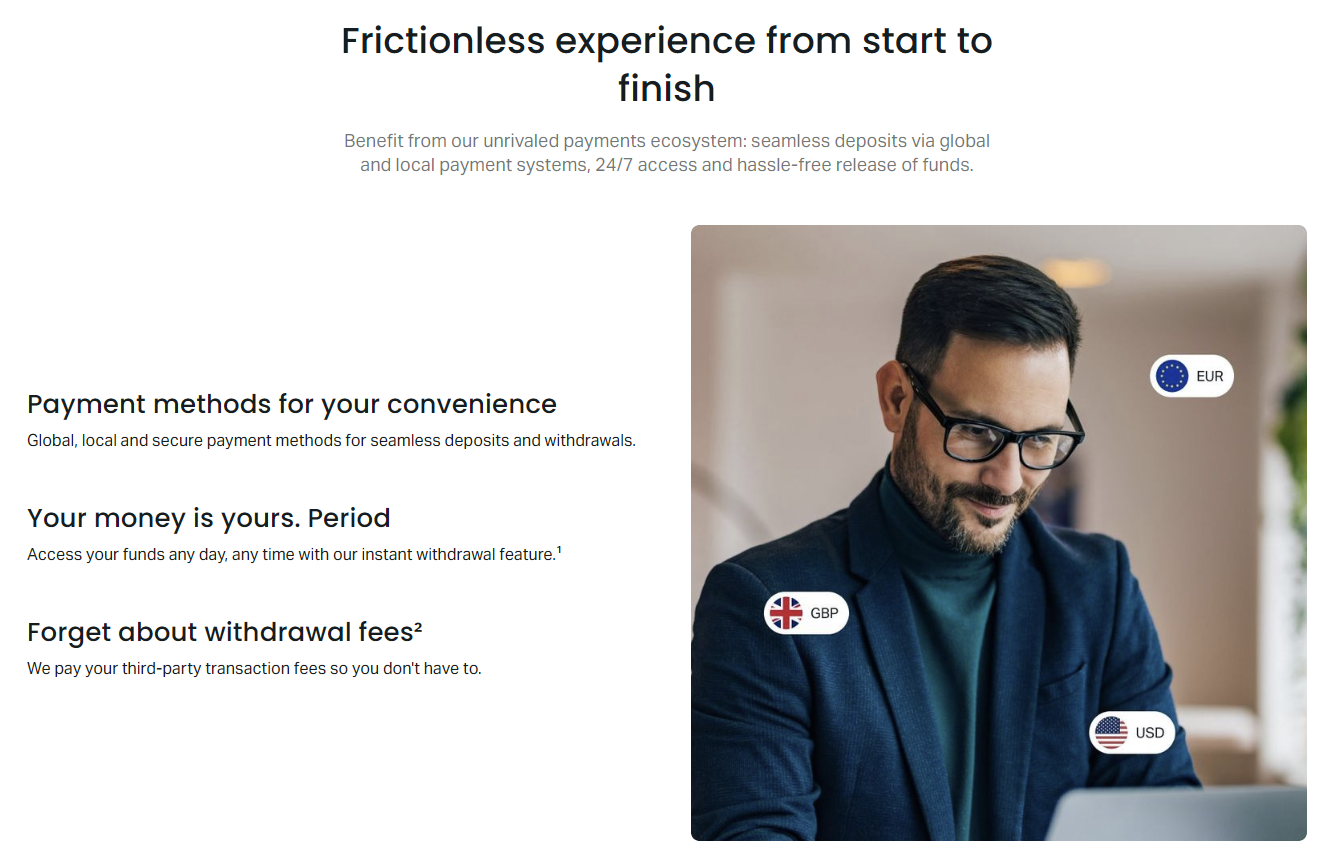
Multi-currency support eliminates forced conversions when depositing in one currency and trading in another. The wallet maintains separate sub-balances for each currency, applying conversion only when the trader initiates it. This transparency allows precise cost tracking and avoids hidden spreads embedded in automatic conversions. Supported fiat currencies include USD, EUR, GBP, CHF, JPY, AUD, CAD, PLN, ZAR, and numerous others depending on the entity serving the client.
Multi-Currency Support
Holding multiple currencies simultaneously benefits traders operating diverse strategies across different markets. A EUR-denominated account trading European indices avoids USD conversion costs, while a USD account focusing on major forex pairs maintains natural alignment. The wallet displays exchange rates for internal conversions, which typically track mid-market rates with a small markup. Traders can time conversions strategically during favorable rate movements.
Currency conversion within the funding wallet processes instantly during market hours. Weekend conversions may use Friday close rates or reopen Monday with updated pricing. The interface shows the exact amount received before confirmation, preventing surprises. Conversion history remains accessible for tax reporting and performance analysis, showing rates, timestamps, and fees for each operation.
Internal Transfers
Internal transfers between a trader's own accounts execute instantly and free of charge. This feature proves invaluable for risk management — profits from a successful strategy can be moved to a conservative account within seconds. The transfer interface validates that both accounts belong to the same verified identity, preventing unauthorized movement. No minimum amount applies, and transfers remain available 24/7 regardless of market hours.
Transfers between different entities (e.g., Exness SC Ltd to Exness VG Ltd) may require additional verification or follow specific routing rules due to regulatory separation. The system guides users through any extra steps automatically. Traders managing accounts under different regulatory jurisdictions should plan transfers during business hours when compliance teams can process cross-entity requests if needed.
Deposit Processing Times and Limits
Processing speed varies significantly across payment methods, directly impacting a trader's ability to react to market developments. Electronic wallets and cryptocurrencies lead with near-instant crediting, while bank transfers introduce delays proportional to the complexity of the routing path. Understanding these timelines helps traders plan funding around economic events, weekend gaps, or anticipated volatility periods.
Scroll horizontally to see all columns
| Method Category | Examples | Typical Crediting | Availability |
|---|---|---|---|
| E-Wallets | Skrill, Neteller, WebMoney | Instant to 15 minutes | 24/7 |
| Cryptocurrencies | BTC, USDT, ETH, USDC | 5-60 minutes (network dependent) | 24/7 |
| Local Bank Transfer | SEPA, Faster Payments, Pix | Minutes to 24 hours | Business hours |
| SWIFT Wire | International bank transfer | 1-5 business days | Business days only |
| Card Payments | Visa, Mastercard (where available) | Instant to 24 hours | 24/7 |
| Regional Gateways | FasaPay, Sticpay, local processors | Instant to 1 hour | 24/7 mostly |
Deposit limits serve both regulatory compliance and operational risk management. Unverified accounts face strict caps — often $2,000 total lifetime deposits — until identity and address verification completes. Fully verified profiles enjoy significantly higher or unlimited deposit ceilings, subject to payment processor limits. Single-transaction maximums vary: e-wallets may cap at $10,000-50,000 per transaction, while bank wires accommodate millions for qualified clients.
Step-by-Step Deposit Process
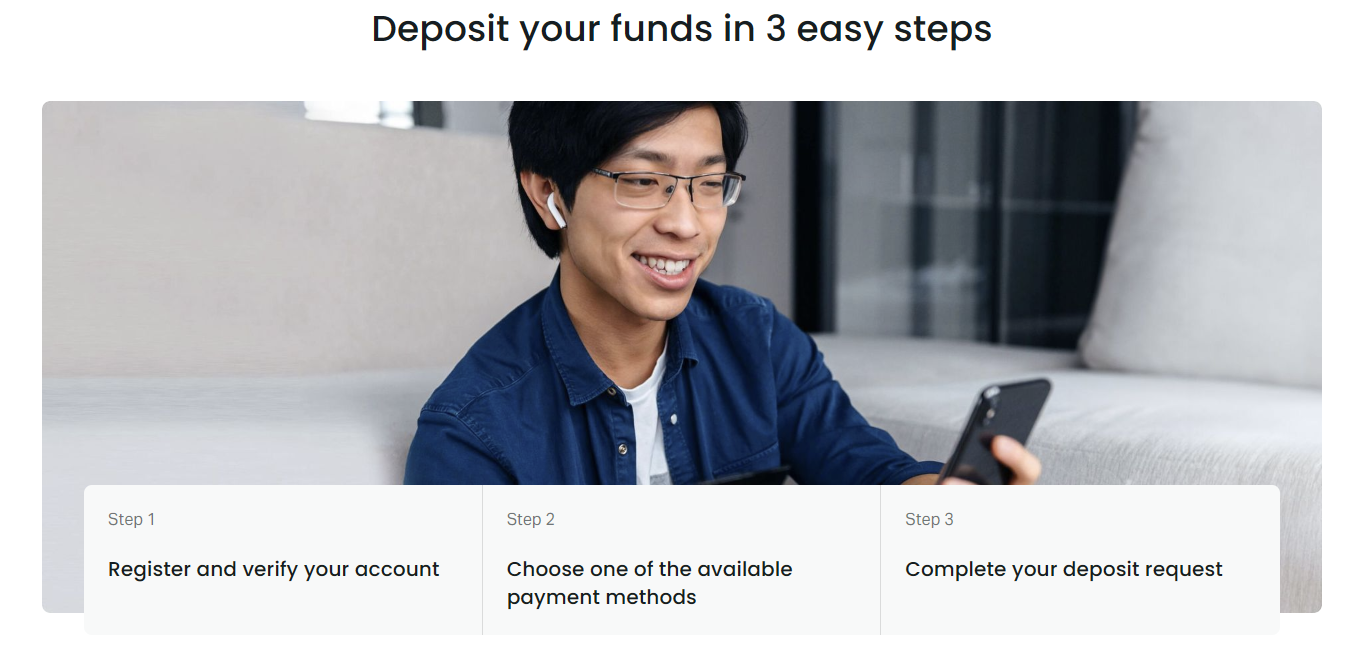
Executing a deposit follows a consistent workflow regardless of the chosen method. The process begins in the personal area's deposit section, where the trader selects a payment method from the filtered list. Each method displays its specific limits, processing time, and any applicable fees before commitment. After entering the amount and confirming, the system either redirects to the payment provider's portal or displays banking/crypto details for manual completion.
- Log into the Exness personal area and navigate to the Deposit section
- Select the target trading account if multiple accounts exist
- Choose a payment method from the available options list
- Enter the deposit amount in the account base currency or select alternative
- Review limits, fees, and estimated crediting time displayed on screen
- Confirm the transaction and follow provider-specific instructions
- For bank/crypto: copy beneficiary details exactly as shown
- Complete authorization on the payment provider's platform
- Return to personal area to monitor transaction status
- Verify funds appear in the trading account balance
First-time users of a specific payment method may encounter additional verification steps. Card deposits often require 3D Secure authentication and may request a photo of the card (with middle digits masked) for anti-fraud compliance. E-wallet deposits redirect to the provider's login page, where the trader authorizes the payment. Cryptocurrency deposits display a QR code and address — sending funds from a mobile wallet simplifies the process by scanning the code.
Regional Payment Solutions
Localized payment methods address the unique financial landscapes of specific countries where global processors lack penetration or face regulatory barriers. These solutions integrate with domestic banking networks, mobile money platforms, and popular local e-wallets. The broker continuously expands this roster based on client demand and partnership opportunities, reflecting a commitment to financial inclusion across emerging markets.
In Southeast Asia, methods like Help2Pay, DragonPay, and local bank QR codes enable instant deposits from domestic bank apps. Latin American traders access PIX in Brazil, SPEI in Mexico, and PSE in Colombia — all settling in local currency within minutes. African markets benefit from mobile money integrations (M-Pesa, Airtel Money) and regional processors like Paystack and Flutterwave. Each integration undergoes rigorous security and compliance review before deployment.
Scroll horizontally to see all columns
| Region | Key Methods | Settlement Currency | Typical Speed |
|---|---|---|---|
| Southeast Asia | Help2Pay, DragonPay, QR Banking | Local currencies (THB, VND, IDR, MYR) | Instant to 15 min |
| Latin America | PIX, SPEI, PSE, Webpay | BRL, MXN, COP, CLP | Instant to 1 hour |
| Africa | M-Pesa, Airtel Money, Paystack | KES, NGN, ZAR, GHS | Instant to 30 min |
| CIS/Eastern Europe | WebMoney, Perfect Money, local cards | USD, EUR, RUB, UAH | Instant to 1 hour |
| Middle East | Local bank transfers, regional wallets | AED, SAR, QAR, KWD | Same/next day |
Traders relocating or traveling should note that payment method availability follows the account's registered country, not the current physical location. Using a VPN to access methods from another jurisdiction violates terms of service and may trigger compliance holds. The system detects IP mismatches and may request additional verification. Maintaining accurate residency information ensures uninterrupted access to appropriate payment channels.
Deposit Fees and Currency Conversion
Exness maintains a zero-deposit-fee policy for the vast majority of payment methods, absorbing processor costs as part of its client acquisition and retention strategy. However, third-party fees from payment providers, issuing banks, or blockchain networks remain the trader's responsibility. These external charges vary widely: e-wallets may charge 1-3% for funding from cards, banks impose wire fees of $15-50 plus intermediary deductions, and crypto networks require miner/validator fees that fluctuate with congestion.
Currency conversion represents a hidden cost often overlooked. When depositing in a currency different from the trading account base currency, conversion occurs either at the payment processor, the broker, or the trader's bank. Each intermediary applies a spread over the mid-market rate. The funding wallet's internal conversion typically offers competitive rates, but traders should compare total cost across the full chain — deposit fee plus conversion spread — before choosing a funding path.
The exness to redotpay integration exemplifies emerging fintech partnerships bridging traditional brokerage with modern payment rails. Redotpay provides virtual and physical cards funded from crypto balances, enabling traders to deposit via card while holding assets in cryptocurrency. This hybrid approach combines crypto's borderless nature with card payment ubiquity. Similar partnerships continue expanding the deposit ecosystem's versatility.
Troubleshooting Common Deposit Issues
Despite robust infrastructure, deposit issues occasionally arise from user error, provider delays, or compliance checks. The most frequent cause of delayed crediting is missing or incorrect reference codes on bank transfers. The finance team cannot automatically match funds without this identifier, requiring manual investigation that adds 24-48 hours. Traders should double-check the reference format before initiating any wire transfer.
- Missing reference code: Contact support with transaction receipt (MT103 for SWIFT)
- Wrong amount sent: Excess funds credited; shortfalls require supplemental deposit
- E-wallet payment declined: Verify wallet balance, limits, and KYC status
- Crypto transaction unconfirmed: Wait for required confirmations; check network status
- Card deposit rejected: Confirm 3D Secure enrollment, card validity, and issuer policies
- Regional method unavailable: Ensure account country matches method availability
Compliance holds may temporarily freeze deposits flagged by automated risk systems. Common triggers include deposits from third-party accounts, rapid successive deposits from new payment methods, or amounts inconsistent with the trader's profile. The compliance team typically resolves reviews within 24 hours during business days. Providing source-of-funds documentation proactively (bank statements, salary slips, crypto wallet screenshots) accelerates clearance for large or unusual transactions.
Security Measures for Fund Protection
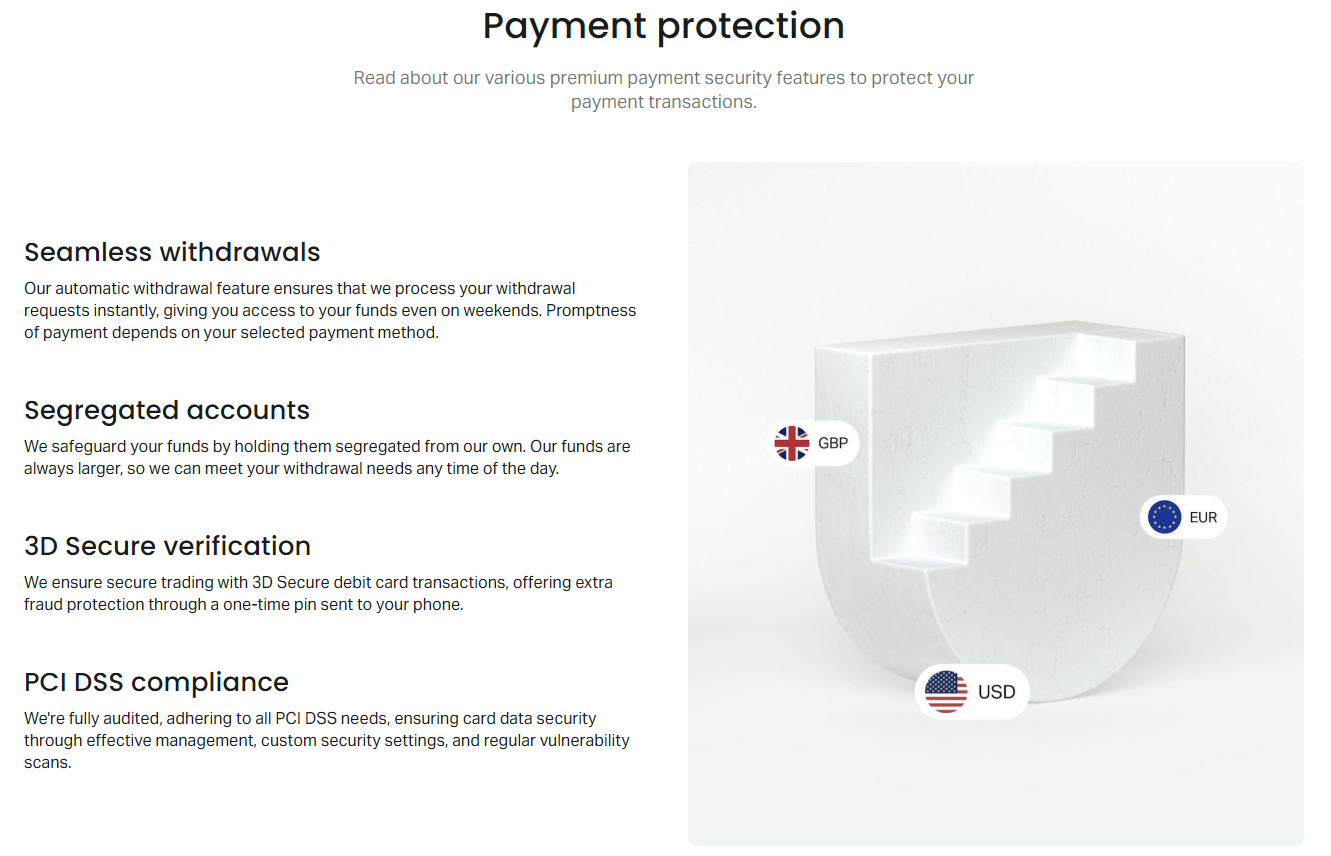
Payment security operates at multiple layers: transport encryption (TLS 1.2+), payment processor certifications (PCI DSS Level 1 for card handlers), and internal fraud detection models analyzing transaction patterns. The broker segregates client funds from operational capital at top-tier banks, ensuring deposits remain protected even in unlikely insolvency scenarios. Two-factor authentication (2FA) on the personal area adds a critical barrier against unauthorized deposit initiation or withdrawal requests.
Segregated accounts and regulated entity structures provide the foundational safety net; payment-level security controls build the daily operational defense.
Anti-money laundering (AML) protocols require monitoring for structuring (splitting large deposits to avoid reporting thresholds), unusual geographic patterns, and velocity anomalies. The system may request source-of-funds evidence for deposits exceeding typical profile activity. This protects both the trader and the broader financial ecosystem. Traders should maintain records of fund origins — especially for crypto deposits where blockchain analysis can trace provenance.
Key Takeaways on Exness Deposit Methods
The Exness deposit ecosystem balances breadth, speed, and security to serve a global clientele with diverse financial access. Electronic wallets and cryptocurrencies offer the fastest path to market participation, while bank transfers accommodate institutional-scale funding. Regional payment gateways bridge gaps in emerging markets, and the unified funding wallet simplifies multi-account, multi-currency management. Zero broker fees on most methods reduce friction, though traders must account for third-party and conversion costs.
Verification status unlocks the full payment roster and higher limits, making early KYC completion a practical priority for serious traders. Understanding processing timelines enables strategic funding around market events. Security hygiene — 2FA, accurate references, source-of-funds readiness — prevents avoidable delays. As the payment landscape evolves, the broker continues integrating new rails and partnerships, expanding access without compromising compliance or safety.
Frequently Asked Questions
What is the minimum deposit amount for Exness?
Minimum deposits start at $1 for most electronic payment methods and cryptocurrencies. Bank transfers typically require $500 or equivalent. Exact minimums display in the personal area for each available method.
Does Exness charge fees on deposits?
Exness does not charge deposit fees for most payment methods. However, payment processors, banks, and blockchain networks may impose their own fees which are the trader's responsibility.
How long does a deposit take to reach my trading account?
E-wallets and crypto deposits typically credit within minutes. Local bank transfers take minutes to 24 hours. International SWIFT wires require 1-5 business days depending on intermediary banks.
Can I deposit in a currency different from my account base currency?
Yes, the funding wallet supports multi-currency balances. Funds can be held in the deposit currency or converted internally at competitive rates. Conversion occurs only when you initiate it.
Why is my bank transfer deposit not showing yet?
Most common cause is a missing or incorrect reference code. Contact support with the bank receipt (MT103 for SWIFT) for manual reconciliation. Processing also pauses on weekends and bank holidays.
Are cryptocurrency deposits safe on Exness?
Crypto deposits use unique addresses per transaction and credit after required network confirmations. The broker employs cold storage for custody and maintains segregated client funds. Always send from a wallet you control.
Can I use someone else's payment method to fund my account?
No. Anti-money laundering regulations require deposits to originate from accounts in the same name as the verified trading account. Third-party deposits trigger compliance holds and potential rejection.
What happens if I send the wrong cryptocurrency or network?
Sending an unsupported asset or wrong network (e.g., USDT ERC-20 to a TRC-20 address) may result in permanent loss. Always verify the asset and network match exactly what the deposit window displays.