

Trading Education
Exness CFD Trading: Platforms, Markets, and Conditions
A detailed guide to CFD markets, account types, execution, and tools on Exness.

Forex Analyst
Forex Analyst specializing in currency markets, market trends, technical and fundamental analysis, and providing clear insights to help traders make informed decisions.
Contract for difference trading lets participants speculate on price movements without owning the underlying asset. Exness CFD trading provides access to a broad range of markets through industry-standard platforms and proprietary technology. The broker serves retail and professional clients globally with a focus on low costs, fast execution, and transparent pricing. This guide examines the available instruments, account structures, trading platforms, cost components, and risk management features that define the Exness CFD offering.
Contents
- What Is CFD Trading on Exness
- Available CFD Markets and Instruments
- Exness Trading Platforms for CFDs
- Account Types and Trading Conditions
- Spreads, Commissions, and Swaps
- Execution Quality and Order Types
- Risk Management Tools and Features
- Mobile Trading Experience
- Analytical Resources and Trading Signals
- Security and Client Protection
- Getting Started with Exness CFDs
- Final Assessment of Exness CFD Trading
CFDs cover forex pairs, equities, stock indices, commodities, and cryptocurrencies. Each asset class carries distinct characteristics such as trading hours, margin requirements, and swap rates. Exness aggregates liquidity from multiple providers to deliver competitive spreads and deep order books. The broker operates under several regulatory licenses, which impose capital adequacy, segregation, and reporting obligations. Understanding how these elements interact helps traders choose the right configuration for their strategy and risk tolerance.
The following sections break down every major component of Exness CFD trading. We cover market coverage, platform choices, account tiers, pricing models, execution policies, analytical tools, mobile access, security measures, and the account opening process. Tables compare key specifications side by side. Callouts highlight practical considerations. A final assessment summarizes the strengths and limitations for different trader profiles.
What Is CFD Trading on Exness
A contract for difference is an agreement to exchange the difference in an asset's price between opening and closing a position. No physical delivery occurs. Profits or losses reflect the full notional value multiplied by the price change, adjusted for leverage. Exness offers CFDs on over 200 instruments across five asset classes. Traders can go long or short, use leverage up to regulatory limits, and hold positions overnight subject to swap charges or credits.
Leverage amplifies both gains and losses. Exness provides dynamic leverage that adjusts based on account equity and instrument tier. Major forex pairs may offer higher ratios than exotic pairs or volatile cryptocurrencies. Margin requirements follow a tiered schedule: larger positions attract higher margin percentages. Stop-out levels protect accounts from negative equity by automatically closing positions when margin falls below a threshold. The broker does not offer negative balance protection for professional clients in certain jurisdictions.
- No ownership of underlying assets required
- Long and short positions supported on all instruments
- Dynamic leverage adjusts with account equity
- Tiered margin schedule for larger exposures
- Automatic stop-out prevents negative balance for retail clients
CFD pricing derives from the underlying market plus a spread markup or commission. Exness uses market execution for most accounts, meaning orders fill at the best available price from liquidity providers. Requotes are rare under normal conditions. Slippage can occur during high volatility or low liquidity. The broker publishes execution statistics quarterly, showing fill rates, slippage distribution, and rejection percentages. These metrics help traders evaluate execution quality objectively.
Available CFD Markets and Instruments
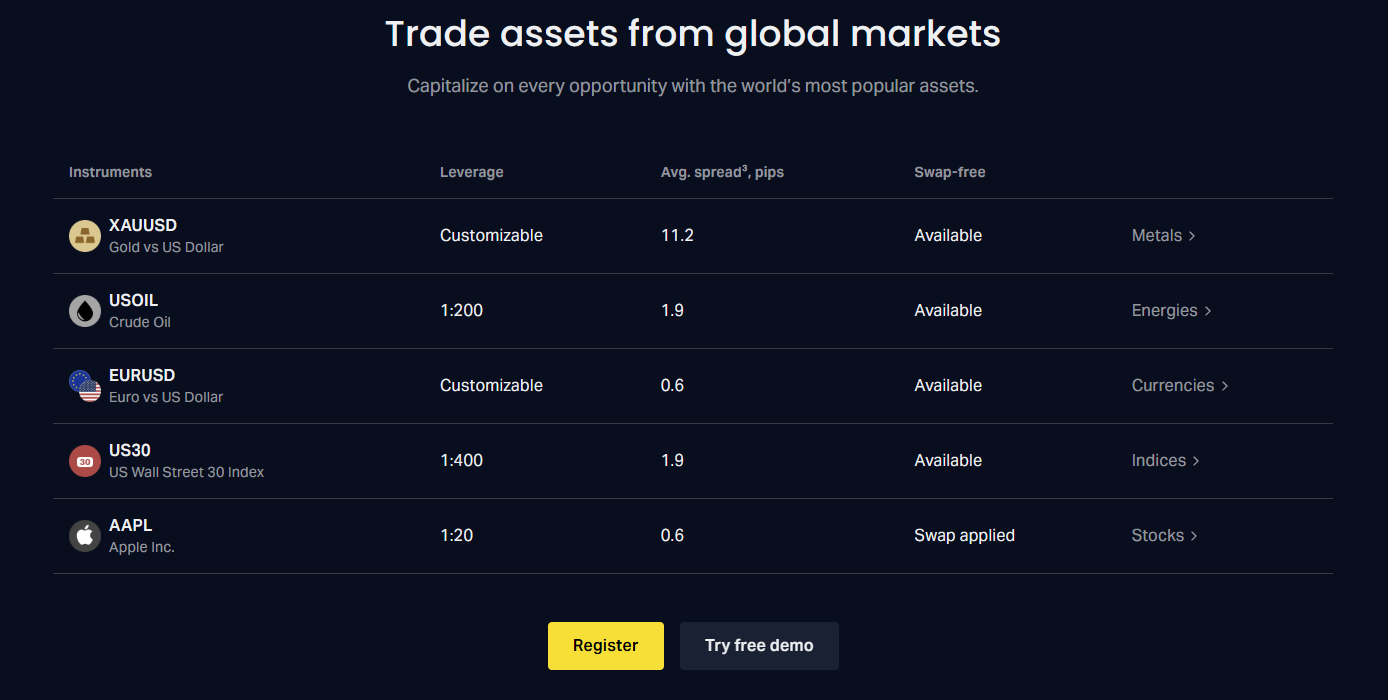
Exness groups CFD instruments into five categories. Forex includes major, minor, and exotic currency pairs with tight spreads on EURUSD, GBPUSD, and USDJPY. Stocks cover large-cap shares from US, EU, and Asian exchanges. Indices track major benchmarks like the S&P 500, Nasdaq 100, FTSE 100, and DAX 40. Commodities encompass precious metals, energies, and agricultural products. Cryptocurrencies include Bitcoin, Ethereum, and select altcoins with 24/7 trading.
Each instrument has specific contract specifications. Forex lots represent 100,000 units of base currency. Stock CFDs typically equal one share. Index CFDs use a multiplier per point. Commodity contracts vary: gold is 100 troy ounces, crude oil is 1,000 barrels. Crypto contracts represent one coin or a fraction. Trading hours follow the underlying exchange, with forex running 24/5 and crypto 24/7. Swap rates differ by instrument and direction; long and short swaps are published daily in the trading platform and on the website.
Scroll horizontally to see all columns
| Asset Class | Examples | Typical Spread | Trading Hours |
|---|---|---|---|
| Forex | EURUSD, GBPUSD, USDJPY | From 0.0 pips | 24/5 |
| Stocks | Apple, Tesla, Amazon | From 0.1% notional | Exchange hours |
| Indices | US30, US500, USTEC | From 0.4 points | Near 24/5 |
| Commodities | XAUUSD, USOIL, XAGUSD | From 0.3 pips | Near 24/5 |
| Cryptocurrencies | BTCUSD, ETHUSD, LTCUSD | From 0.5% notional | 24/7 |
Instrument availability may vary by regulatory entity and client classification. Professional clients often access higher leverage and a wider symbol list. Some jurisdictions restrict crypto CFDs or limit leverage on specific assets. Traders should verify the exact symbol list in their Personal Area or trading platform after login. New instruments are added periodically based on demand and liquidity conditions.
Exness Trading Platforms for CFDs
Exness supports MetaTrader 4, MetaTrader 5, a proprietary web terminal, and mobile applications for iOS and Android. Each platform connects to the same pricing engine and liquidity pool. MetaTrader 4 remains popular for its extensive expert advisor ecosystem and familiar interface. MetaTrader 5 adds more timeframes, order types, a built-in economic calendar, and native hedging and netting modes. The web terminal requires no installation and works in any modern browser. Mobile apps replicate core desktop functionality with touch-optimized charts and push notifications.
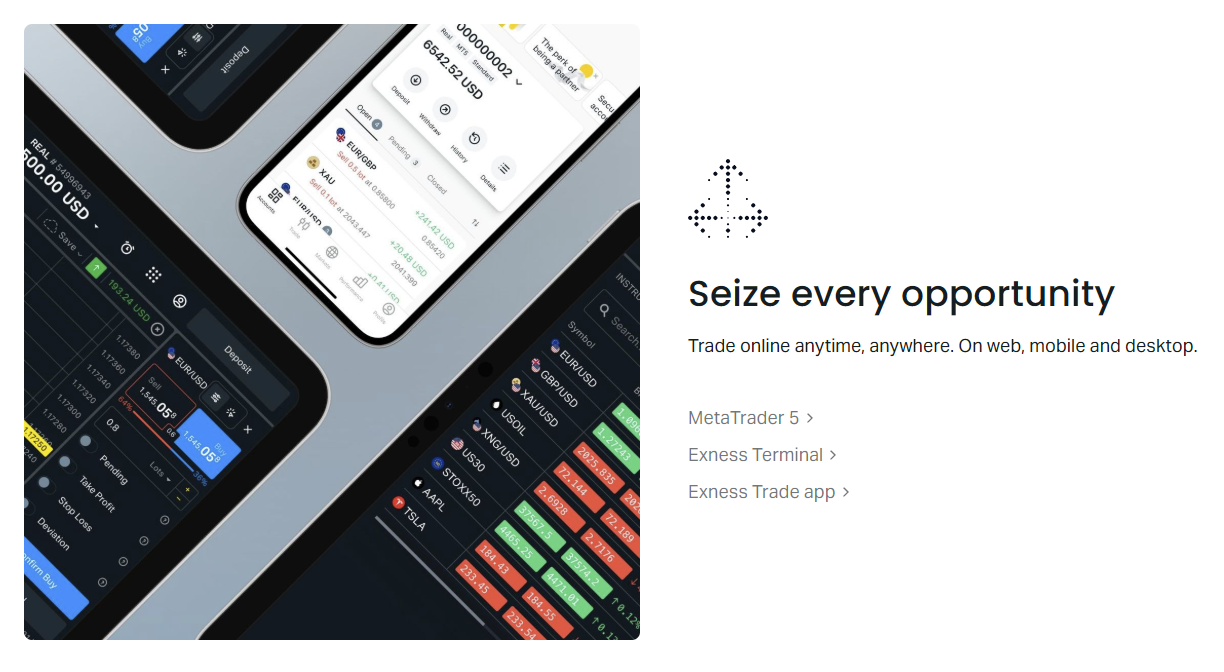
The proprietary Exness Terminal integrates directly with the Personal Area for seamless deposits, withdrawals, and account management. It features one-click trading, customizable workspaces, and advanced charting with over 50 indicators. The web version supports multiple chart layouts, drawing tools, and real-time news from FXStreet. Mobile apps provide price alerts, economic calendar integration, and biometric login. All platforms support automated trading via expert advisors on MT4 and MT5, while the web terminal and mobile apps focus on manual execution.
Scroll horizontally to see all columns
| Feature | MT4 | MT5 | Web Terminal | Mobile App |
|---|---|---|---|---|
| Timeframes | 9 | 21 | 15+ | 15+ |
| Order Types | 4 pending | 6 pending | Market + pending | Market + pending |
| Economic Calendar | No | Yes | Yes | Yes |
| Expert Advisors | Full support | Full support | No | No |
| Hedging/Netting | Hedging only | Both modes | Hedging only | Hedging only |
Platform choice often depends on trading style. Algorithmic traders favor MT4 or MT5 for expert advisor compatibility. Discretionary traders may prefer the web terminal for its clean interface and zero-install access. Mobile apps suit position monitoring and quick reactions to news. All platforms synchronize account data in real time. Traders can run multiple platforms simultaneously on the same account, though concurrent expert advisors on the same symbol may conflict.
Platform reliability during high-volatility events separates adequate brokers from excellent ones. Exness invests heavily in server infrastructure to maintain uptime and low latency.
Account Types and Trading Conditions
Exness offers Standard and Professional account families. Standard accounts include Standard and Standard Cent. Professional accounts include Pro, Raw Spread, and Zero. Each tier targets a different trader profile with distinct spread, commission, and minimum deposit structures. Standard accounts use spread-only pricing with no commission. Professional accounts charge commissions per lot but offer tighter raw spreads. The Cent account denominates balance in cents, allowing micro-lot trading with minimal capital.
Minimum deposits start at $1 for Standard and Standard Cent accounts. Professional accounts typically require $200 or equivalent. Leverage limits follow regulatory tiers: retail clients face caps such as 30:1 on major forex, 20:1 on minors, 10:1 on commodities and indices, 5:1 on stocks, and 2:1 on cryptocurrencies. Professional clients can access up to 1:2000 on forex and 1:200 on other classes, subject to eligibility verification. Margin calls occur at 100% margin level; stop-out triggers at 0% for Standard and 20% for Professional accounts.
Scroll horizontally to see all columns
| Account | Min Deposit | Pricing Model | Commission | Max Leverage (Retail) |
|---|---|---|---|---|
| Standard | $1 | Spread only | None | Up to 1:2000 |
| Standard Cent | $1 | Spread only | None | Up to 1:2000 |
| Pro | $200 | Spread + commission | $3.5 per lot side | Up to 1:2000 |
| Raw Spread | $200 | Raw spread + commission | $3.5 per lot side | Up to 1:2000 |
| Zero | $200 | Zero spread + commission | $3.5 per lot side | Up to 1:2000 |
Islamic swap-free accounts are available for all types upon request and approval. These accounts replace overnight swaps with a fixed administration fee per lot held overnight. The fee varies by instrument and is disclosed before activation. Demo accounts mirror live conditions with virtual funds and no expiration. Traders can open multiple accounts under one Personal Area to test strategies across different conditions. Account currency options include USD, EUR, GBP, CHF, JPY, AUD, CAD, and several others.
Spreads, Commissions, and Swaps
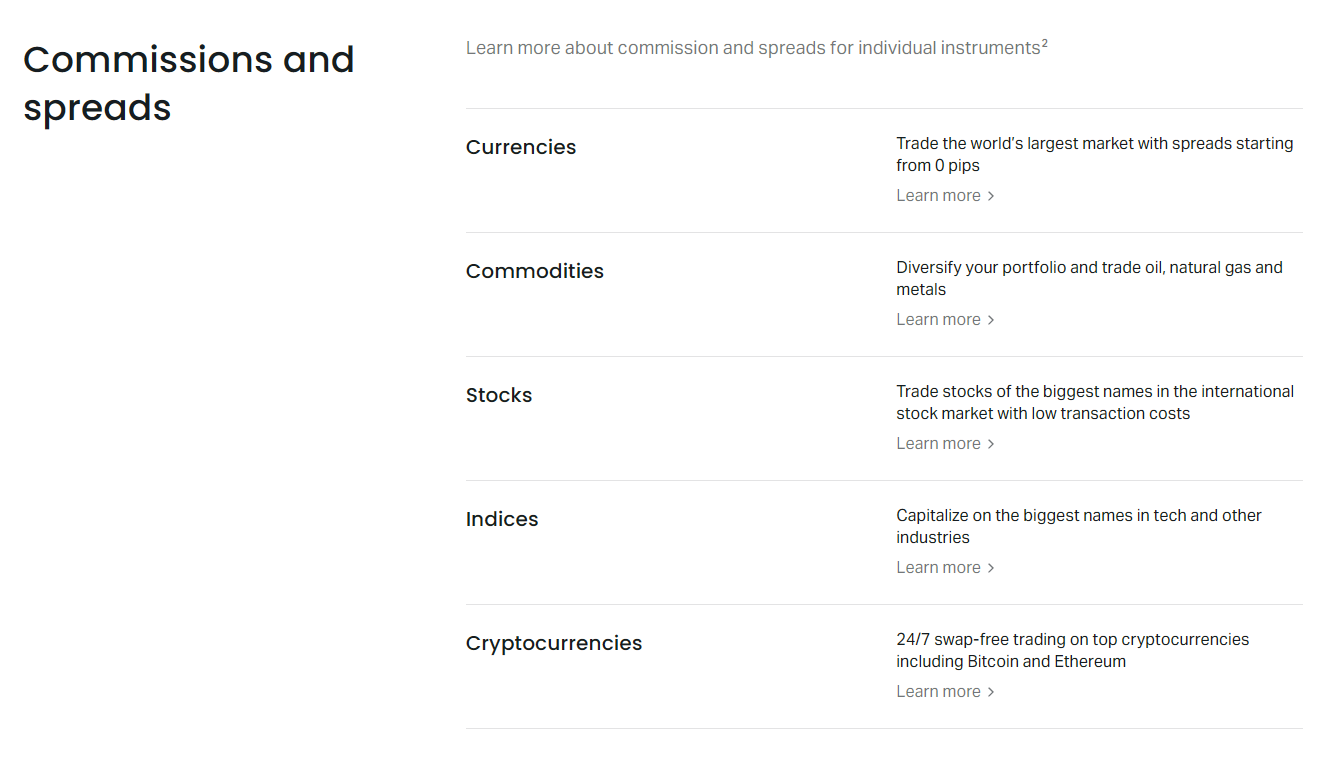
Trading costs on Exness consist of spreads, commissions, and overnight swap rates. Spreads are variable and widen during low liquidity periods such as market open, major news releases, or weekend gaps. The Zero account offers fixed zero spreads on top forex pairs during core trading hours with a per-lot commission. Raw Spread and Pro accounts charge commission per side per lot. Standard accounts embed all costs in the spread. Swap rates reflect interest rate differentials between currencies plus a broker markup; they can be positive or negative depending on direction and instrument.
The broker publishes typical and minimum spreads for each instrument on its website and in the platform specification window. Typical spreads represent average conditions; minimum spreads occur under optimal liquidity. Commission on Professional accounts is $3.5 per lot per side ($7 round turn) for forex and metals, with different rates for stocks, indices, and crypto. Volume rebates are available through the Premier program for high-frequency traders. All costs are transparent with no hidden fees for deposits, withdrawals, or inactivity.
Scroll horizontally to see all columns
| Account | Typical Spread | Commission (Round Turn) | Effective Cost |
|---|---|---|---|
| Standard | 1.0 pips | $0 | 1.0 pips |
| Pro | 0.1 pips | $7 | ~0.8 pips |
| Raw Spread | 0.0 pips | $7 | ~0.7 pips |
| Zero | 0.0 pips (fixed hours) | $7 | ~0.7 pips |
Swap rates are tripled on Wednesdays to account for weekend rollover (T+2 settlement). Crypto CFDs may have different rollover conventions. Traders holding positions long-term should factor swaps into profitability calculations. The Exness trading calculator in the Personal Area estimates margin, pip value, and swap for any position size and instrument. Long-term strategies on positive-swap pairs can generate carry income; negative-swap pairs erode returns over time.
Effective cost analysis must combine spreads, commissions, and expected slippage. A tighter spread with commission often beats a wider spread-only model for active traders.
Execution Quality and Order Types
Exness operates a no-dealing-desk model with market execution. Orders route to a pool of liquidity providers including banks, prime brokers, and non-bank market makers. The broker does not act as counterparty. Execution speed averages under 100 milliseconds for most instruments under normal conditions. VPS hosting is available free for qualifying accounts to reduce latency further. Order types include market, limit, stop, stop-limit, and trailing stops on MT5. Partial fills are possible on large orders; remaining volume stays active.
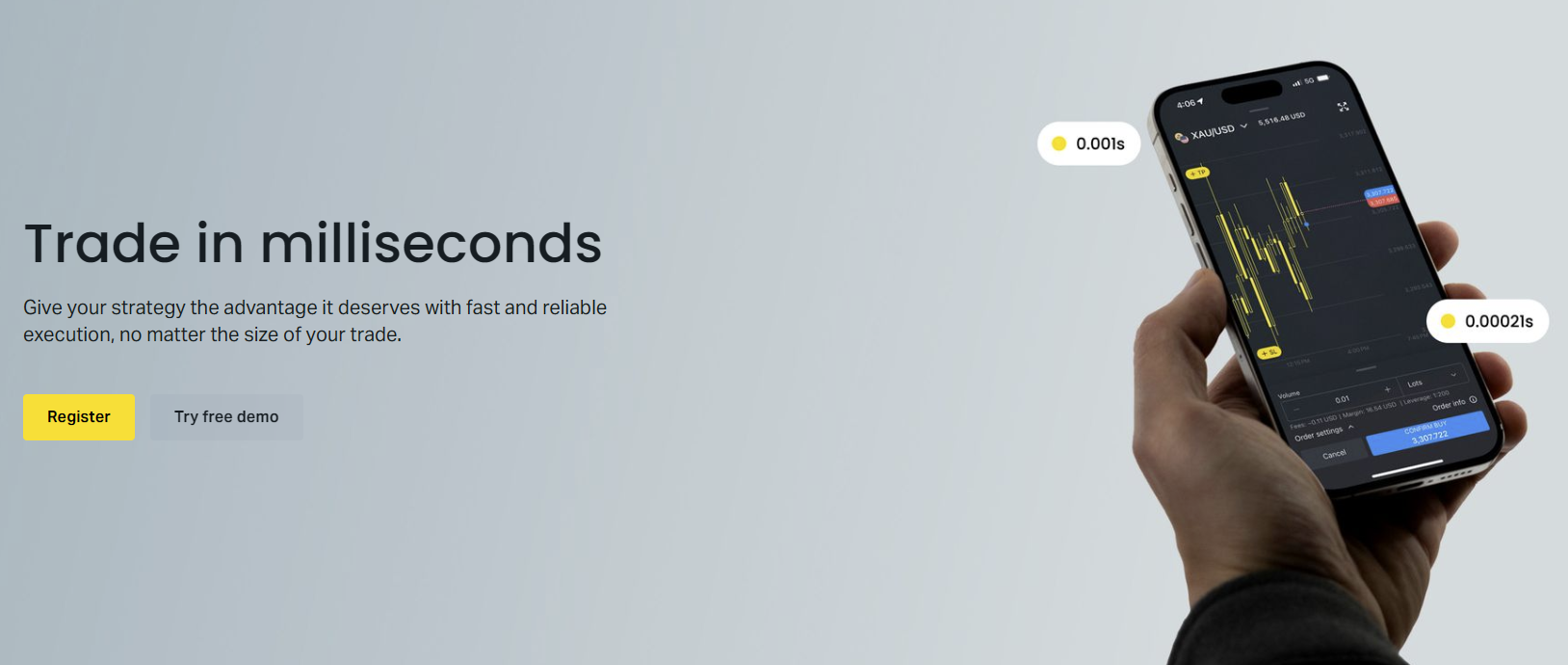
Requotes are not issued under market execution; orders fill at the best available price or are rejected if price moves beyond tolerance. Slippage can be positive or negative. The broker's execution policy prohibits last-look practices. Quarterly execution reports disclose median execution speed, slippage distribution, fill rate, and rejection rate by instrument class. These reports allow independent verification of execution claims. Traders can also review their own execution history in the platform journal.
- Market execution with no requotes
- Average execution speed under 100 ms
- Free VPS for accounts meeting volume thresholds
- Quarterly execution quality reports published
- Positive and negative slippage both possible
During extreme volatility, spreads widen and liquidity thins. Stop-loss and take-profit orders execute at the next available price, which may differ from the specified level. Guaranteed stop-loss orders are not offered. Traders should consider wider stops or reduced position sizes around major economic events. The economic calendar in MT5 and the web terminal highlights high-impact releases. News trading strategies face wider spreads and potential slippage; some traders avoid the window entirely.
Risk Management Tools and Features
Exness provides several built-in risk management features. Stop-loss and take-profit orders can be set at position entry or modified later. Trailing stops lock in profits by moving the stop level as price advances. Margin level displays in real time in all platforms. The margin calculator in the Personal Area computes required margin for hypothetical positions. Position size calculators help determine lot size based on risk percentage and stop distance. These tools support disciplined position sizing.
The broker offers negative balance protection for retail clients under applicable regulations. This ensures losses cannot exceed deposited funds. Professional clients may not receive this protection depending on the regulatory entity. Stop-out levels differ by account type: Standard accounts stop out at 0% margin level, Professional at 20%. The stop-out process closes the largest losing position first until margin recovers. Traders receive margin call notifications at 100% margin level via platform alert, email, and push notification.
Scroll horizontally to see all columns
| Parameter | Standard / Cent | Professional (Pro, Raw, Zero) |
|---|---|---|
| Margin Call Level | 100% | 100% |
| Stop-Out Level | 0% | 20% |
| Negative Balance Protection | Yes (retail) | Varies by entity |
| Max Leverage (Retail) | Per ESMA/ASIC/FSCA | Per ESMA/ASIC/FSCA |
| Max Leverage (Pro) | Up to 1:2000 | Up to 1:2000 |
The Exness trading calculator integrates margin, pip value, profit, and swap calculations in one tool. Traders input account currency, instrument, lot size, leverage, and direction to see required margin and projected outcomes. The calculator supports multiple positions simultaneously for portfolio-level analysis. It is accessible from the Personal Area and the web terminal. Regular use before entering trades helps avoid unexpected margin calls and ensures position sizing aligns with risk rules.
Consistent position sizing based on fixed risk per trade is the single most effective risk control. Tools that automate the math reduce emotional errors.
Mobile Trading Experience
Exness mobile apps for iOS and Android deliver full trading functionality on smartphones and tablets. The apps support market and pending orders, real-time charts with multiple timeframes, technical indicators, and drawing tools. Price alerts push notifications for level breaches. The economic calendar filters events by impact and currency. Account management features include deposits, withdrawals, transfers between accounts, and verification document upload. Biometric login secures access.
The Exness Trade app is a streamlined alternative focused on essential functions: quick order entry, watchlist management, and portfolio overview. It loads faster on older devices and consumes less data. Both apps synchronize with desktop platforms; chart templates, indicators, and drawings persist across devices. Push notifications cover margin calls, order fills, price alerts, and deposit confirmations. Offline mode caches recent charts for viewing without connectivity.
- Full charting with indicators and drawings
- Market and pending order support
- Price alerts with push notifications
- Deposit and withdrawal from app
- Biometric and PIN login options
- Cross-device synchronization of workspaces
Mobile execution uses the same pricing engine as desktop. Latency depends on device connection quality; Wi-Fi or 4G/5G is recommended for active trading. The apps support both hedging and netting modes on MT5 accounts. One-tap trading from the chart or watchlist speeds entry. Landscape mode expands chart area for analysis. Traders managing multiple accounts can switch instantly without re-login. The apps receive regular updates with feature parity improvements.
Analytical Resources and Trading Signals
Exness integrates Trading Central signals directly into MT4, MT5, and the web terminal. These signals provide technical analysis-based entry, stop-loss, and take-profit levels for major instruments. Signals update throughout the session and include rationale such as pattern recognition, trend analysis, and key levels. The economic calendar covers global macro events with consensus forecasts, previous values, and actual releases. Market news from FXStreet streams in real time with filtering by currency and impact.
The broker's analytics portal offers daily market outlooks, technical analysis articles, and educational webinars. Video tutorials cover platform features, strategy concepts, and risk management. The Exness blog publishes broker updates, new instrument announcements, and regulatory changes. Traders can access Trading Central's Alpha Generation and Featured Ideas modules for deeper research. All resources are free for registered clients. No premium research tier exists; the same tools serve all account types.
Custom indicators and expert advisors extend analytical capacity on MT4 and MT5. The MQL5 marketplace offers thousands of free and paid tools. Exness does not restrict third-party add-ons. The web terminal includes a built-in strategy tester for visual backtesting on historical data. Mobile apps display Trading Central signals but lack the strategy tester. Traders should validate any signal or tool with independent analysis before risking capital. Past performance of signals does not guarantee future results.
Third-party signals are a starting point, not a substitute for personal analysis. Combine signal levels with your own risk parameters and market context.
Security and Client Protection
Exness employs multiple layers of security to protect client funds and data. Client funds are segregated from operational funds in top-tier banks. The broker maintains capital reserves exceeding regulatory minimums. Two-factor authentication secures Personal Area access. SSL encryption protects data in transit. Regular penetration testing and security audits are conducted by independent firms. The broker participates in investor compensation schemes where required by regulators.
Regulatory oversight varies by entity. Exness (SC) Ltd is licensed by the Seychelles FSA. Exness B.V. is authorized by the Curaçao Gaming Control Board. Exness (VG) Ltd operates under the BVI FSC. Exness ZA (PTY) Ltd is regulated by the South African FSCA. Exness (CY) Ltd holds a CySEC license for the European Economic Area. Each entity imposes specific leverage caps, protection measures, and reporting standards. Clients are onboarded under the entity matching their residence. The website discloses the applicable regulator before account opening.
- Client funds segregated in Tier-1 banks
- Capital reserves above regulatory minimums
- Two-factor authentication mandatory
- Regular independent security audits
- Multiple regulatory licenses by region
- Investor compensation scheme participation where applicable
The Personal Area includes security settings for login history, device management, and API key control. Withdrawal requests require email or SMS confirmation. Anti-phishing guides educate clients on common scams. The broker does not request passwords or 2FA codes via email or chat. Suspicious activity triggers temporary account locks pending verification. A dedicated security team monitors for unauthorized access attempts 24/7. Clients can request account statements and audit trails at any time.
Getting Started with Exness CFDs
Opening an Exness account begins with registration on the website or mobile app. Email verification activates the Personal Area. Identity verification (KYC) requires a government-issued ID and proof of address. The process typically completes within minutes for automated checks; manual review may take up to 24 hours. Once verified, clients can deposit via bank transfer, credit/debit card, electronic wallets, or local payment methods depending on region. Minimum deposit is $1 for Standard accounts.
After funding, traders download their chosen platform or launch the web terminal. Login credentials are the account number and trading password set during registration. The server field auto-populates based on account type. Demo accounts are available instantly without verification for platform familiarization. The Personal Area manages all accounts, deposits, withdrawals, transfers, and settings. Leverage can be adjusted per account within allowed limits. Account currency is fixed at creation; multi-currency wallets are not supported.
- Register with email and set trading password
- Complete KYC with ID and address proof
- Deposit from $1 via multiple methods
- Download platform or use web terminal
- Adjust leverage in Personal Area
- Start with demo to test conditions risk-free
Withdrawals process back to the original deposit method where possible. Electronic withdrawals are often instant; bank transfers take 1-3 business days. No withdrawal fees are charged by Exness, though payment providers may apply their own. The Premier loyalty program offers priority support, reduced commissions, and exclusive events for high-volume traders. Tiers are based on monthly traded volume and account tenure. Partners and introducing brokers earn rebates on referred client volume through a separate program.
Final Assessment of Exness CFD Trading
Exness CFD trading delivers a comprehensive package for retail and professional participants. The instrument range spans all major asset classes with competitive specifications. Multiple account types accommodate different cost preferences: spread-only simplicity or raw spreads with commission. Platform choice covers the full spectrum from algorithmic-friendly MT4/MT5 to zero-install web terminal and capable mobile apps. Execution quality is transparent with published metrics. Risk management tools are built into every platform. Security measures meet or exceed industry standards across multiple regulatory jurisdictions.
Strengths include ultra-low minimum deposits, instant withdrawals on electronic methods, free VPS for qualifying traders, and a broad symbol list including 24/7 crypto CFDs. The Premier program rewards volume with tangible cost reductions. Trading Central integration adds actionable research at no extra cost. The broker's focus on execution speed and stability benefits short-term and algorithmic strategies. Educational resources support developing traders without upselling premium tiers.
Limitations exist. Guaranteed stop-loss orders are unavailable. Professional clients may lose negative balance protection depending on entity. Swap-free accounts carry administration fees that can exceed standard swaps on some instruments. Spread widening during news can be significant on Standard accounts. The web terminal lacks expert advisor support. Some regions face restricted instrument lists or leverage caps due to local regulation. Traders should verify the exact conditions applicable to their onboarding entity before funding.
Scroll horizontally to see all columns
| Strengths | Limitations |
|---|---|
| Broad multi-asset CFD selection | No guaranteed stop-loss feature |
| Multiple account types for all styles | Pro clients may lack negative balance protection |
| Transparent execution reporting | Swap-free admin fees can be high |
| Free VPS for active traders | Web terminal lacks EA support |
| Instant electronic withdrawals | Regional restrictions on leverage and symbols |
For cost-sensitive scalpers and high-frequency traders, Raw Spread or Zero accounts with commission pricing minimize effective costs. Swing traders and position holders benefit from stable swap rates and the ability to hold through weekends on most instruments. Beginners appreciate the $1 entry point, cent account option, and extensive free education. Algorithmic traders gain full MT4/MT5 support with low-latency VPS access. The broker's multi-jurisdictional regulation allows global access while maintaining appropriate protections per region. Overall, Exness presents a well-rounded CFD offering suitable for a wide spectrum of trading approaches.
Frequently Asked Questions
What is the minimum deposit for Exness CFD trading?
The minimum deposit is $1 for Standard and Standard Cent accounts. Professional accounts (Pro, Raw Spread, Zero) require a minimum of $200 or equivalent currency.
Does Exness offer guaranteed stop-loss orders?
No, Exness does not offer guaranteed stop-loss orders. Stop-loss orders execute at the next available price during gaps or high volatility, which may differ from the specified level.
Which platforms support automated trading on Exness?
MetaTrader 4 and MetaTrader 5 fully support expert advisors and custom indicators. The proprietary web terminal and mobile apps do not support automated trading.
Are swap-free accounts available for all instruments?
Islamic swap-free accounts are available for all account types upon request. They replace overnight swaps with a fixed administration fee per lot, which varies by instrument.
What leverage is available for retail clients on Exness?
Retail leverage follows regulatory caps: up to 30:1 on major forex, 20:1 on minor forex, 10:1 on commodities and indices, 5:1 on stocks, and 2:1 on cryptocurrencies.
How fast are withdrawals processed on Exness?
Electronic withdrawals (cards, e-wallets, local methods) are often instant. Bank transfers typically take 1-3 business days. Exness charges no withdrawal fees.
Can I trade crypto CFDs on weekends with Exness?
Yes, cryptocurrency CFDs trade 24/7 including weekends and holidays. Other asset classes follow their underlying exchange hours with a daily break.
Does Exness charge inactivity fees?
No, Exness does not charge inactivity fees or account maintenance fees. There are no hidden charges for deposits, withdrawals, or dormant accounts.