

Forex Broker Execution
Exness Execution: Speed, Technology, and Trading Performance
A detailed look at Exness execution quality, speed, and the technology behind order processing.

Forex Analyst
Forex Analyst specializing in currency markets, market trends, technical and fundamental analysis, and providing clear insights to help traders make informed decisions.
Exness execution is a core component of the trading experience offered by the broker. It determines how quickly orders are filled, at what price, and under what market conditions. For traders who rely on precise entry and exit points, understanding the mechanics behind order processing can make a meaningful difference in overall results. This article examines the execution models, technology infrastructure, and practical implications for different trading styles.
Contents
- How Exness Execution Works
- Execution Models Offered by Exness
- Market Execution Details
- Technology Behind Exness Execution
- Server Infrastructure and Latency
- Order Routing and Liquidity Providers
- Execution Advantages for Traders
- Execution Speed and Performance Metrics
- Risk Management and Execution Protection
- Negative Balance Protection
- Stop Out and Margin Call Handling
- Comparing Execution Across Exness Account Types
- Trader Feedback and Execution Quality
- Optimizing Your Trading with Exness Execution
- Final Assessment of Exness Execution
The broker operates a no-dealing-desk model, meaning client orders are routed directly to liquidity providers without internal intervention. This structure aims to reduce conflicts of interest and provide transparent pricing. Execution quality is influenced by several factors: server proximity to liquidity hubs, the depth of the liquidity pool, and the efficiency of the order-matching engine. Exness has invested in co-located servers and high-speed connectivity to minimize latency.
Traders often evaluate execution by looking at slippage, requotes, and fill rates. Exness publishes execution statistics that show the percentage of orders filled at the requested price or better, as well as average execution speed. While past performance does not guarantee future results, these metrics offer a benchmark for comparing brokers. The following sections break down each element in detail.
How Exness Execution Works
When a trader places an order on the Exness platform, the request travels from the client terminal to the broker's trade server. The server then matches the order against available liquidity from multiple providers, including banks, prime brokers, and non-bank market makers. The matching engine selects the best available price based on the order type and current market depth. If the requested price is no longer available, the order may be filled at the next best price (slippage) or rejected, depending on the execution model chosen.
The broker offers two primary execution modes: Market Execution and Instant Execution. Market Execution fills orders at the best available price in the market, which means the final fill price may differ from the price seen when the order was placed. Instant Execution attempts to fill at the exact price requested; if that price is unavailable, the broker sends a requote. Each mode suits different strategies, and traders can select the appropriate one when opening an account or changing account settings.
Execution Models Offered by Exness
Exness provides Market Execution on most account types, including Standard, Standard Cent, Pro, Raw Spread, and Zero accounts. Instant Execution is available on Standard and Standard Cent accounts for traders who prefer price certainty over guaranteed fill. The choice affects how orders behave during volatile conditions, news events, and low-liquidity periods.
- Market Execution: Orders filled at best available price; no requotes; potential slippage.
- Instant Execution: Orders filled at requested price or requoted; no slippage on filled orders; possible rejection during fast moves.
- ECN-style execution on Raw Spread and Zero accounts: Direct access to liquidity pool with commission-based pricing.
- No dealing desk across all models: Orders not internalized by the broker.
Traders using automated strategies or scalping often prefer Market Execution because it guarantees a fill even during rapid price changes. Those who trade larger positions or require exact entry prices for risk calculations may lean toward Instant Execution. The broker allows switching between models by opening a new account with the desired execution type.
Market Execution Details
Under Market Execution, the order is sent to the liquidity pool and filled at the prevailing market price. This price is determined by the best bid or ask available from liquidity providers at the moment the order reaches the matching engine. Because the forex market is decentralized, prices can vary slightly between providers. Exness aggregates quotes to present a consolidated feed, and the execution engine selects the most favorable price for the client.
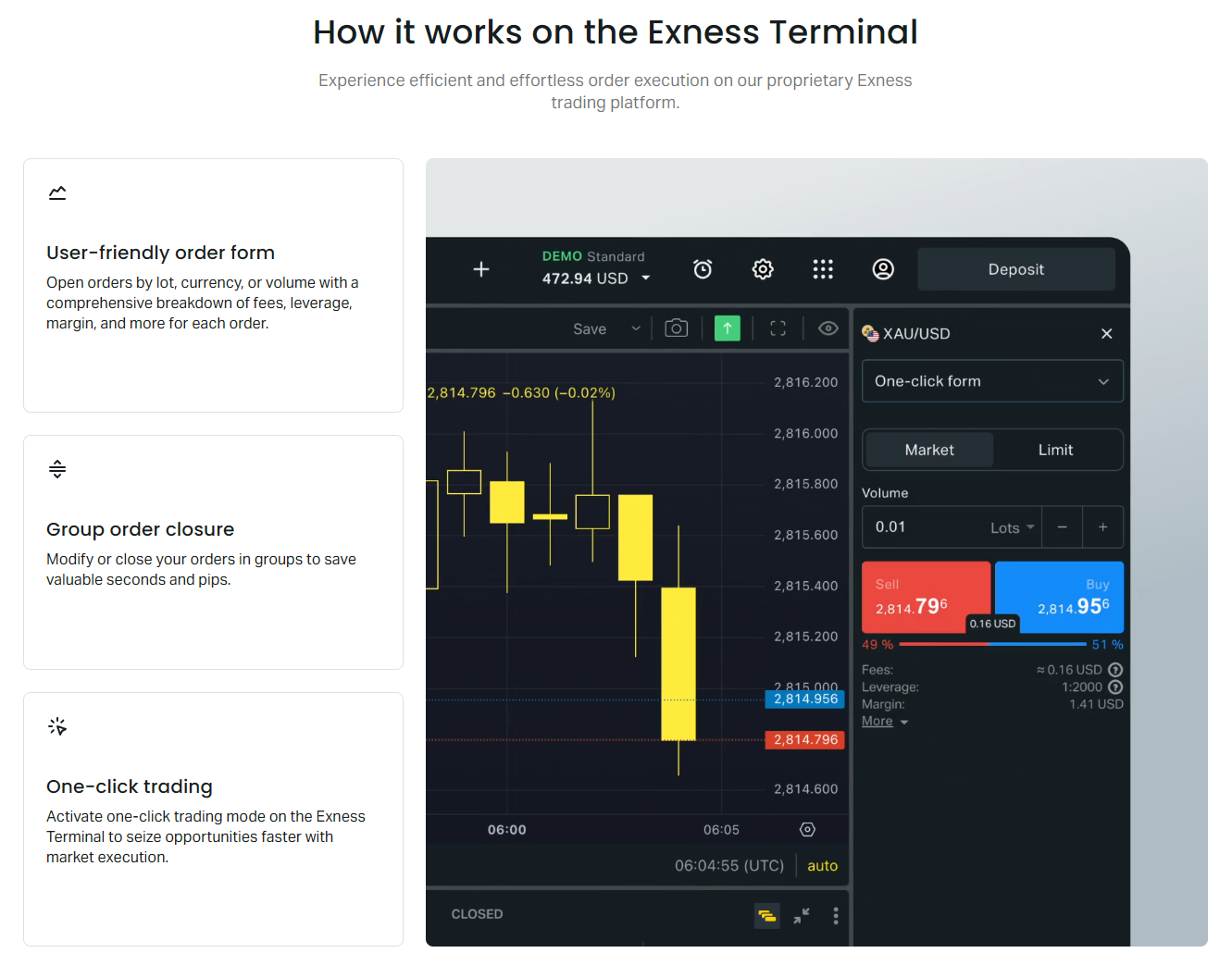
Slippage can be positive or negative. Positive slippage occurs when the fill price is better than the requested price, which can happen during price improvements. Negative slippage means the fill is worse. Exness does not artificially restrict positive slippage, allowing traders to benefit from price improvements. The broker also offers a slippage control feature on some platforms, letting traders set a maximum acceptable deviation in points.
Technology Behind Exness Execution
Execution speed depends heavily on the physical and logical infrastructure connecting traders to liquidity. Exness operates data centers in major financial hubs, including London, New York, and Tokyo. These facilities house trade servers co-located with liquidity providers, reducing the round-trip time for order messages. The network uses fiber-optic links and optimized routing protocols to achieve low latency.
The matching engine is built to handle high order throughput with minimal processing delay. It supports multi-threaded order processing, allowing thousands of orders per second to be evaluated against the liquidity book. The system also incorporates smart order routing logic that can split large orders across multiple providers to minimize market impact and achieve better average fill prices.
Server Infrastructure and Latency
Latency is measured as the time between a trader's order leaving the terminal and the confirmation returning. Exness reports average execution speeds in milliseconds, often citing figures below 100 ms for major currency pairs under normal conditions. Traders using VPS services located near the broker's data centers can further reduce latency. The broker offers a free VPS for qualifying accounts, which can be especially valuable for algorithmic traders.
Order Routing and Liquidity Providers
Exness connects to a diverse pool of liquidity providers, including tier-1 banks, prime-of-prime brokers, and electronic communication networks. This diversification reduces reliance on any single source and improves fill rates during periods of market stress. The routing algorithm evaluates provider quotes in real time, considering price, depth, and historical fill quality. Orders are directed to the provider offering the best combination of price and execution probability.
Execution Advantages for Traders
The combination of no-dealing-desk execution, deep liquidity, and low-latency infrastructure translates into several practical advantages. Traders experience fewer requotes, tighter spreads during peak hours, and reliable fill rates even for large order sizes. These benefits are most noticeable in high-frequency strategies, news trading, and when trading less liquid instruments such as exotic currency pairs or commodities.
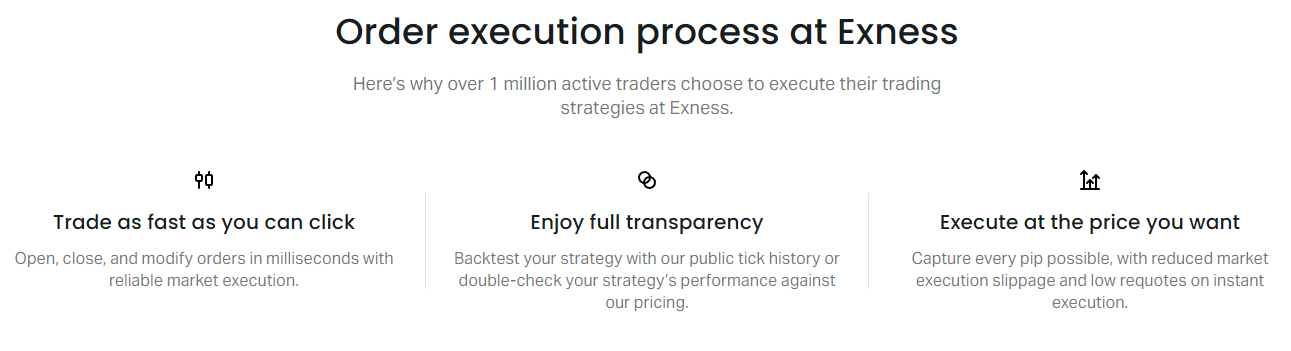
Another advantage is the absence of restrictions on trading styles. Exness permits scalping, hedging, and the use of expert advisors without imposing minimum holding periods or distance requirements for stop-loss and take-profit orders. This flexibility allows traders to implement a wide range of strategies without worrying about broker-imposed limitations.
- No requotes on Market Execution accounts.
- Positive slippage passed through to clients.
- Support for all trading styles including scalping and hedging.
- No minimum stop-loss or take-profit distance.
- Free VPS for eligible accounts to reduce latency.
- Transparent execution statistics published regularly.
Execution Speed and Performance Metrics
Exness publishes execution quality reports that include average execution speed, percentage of orders executed at requested price or better, and slippage distribution. These reports are updated periodically and cover major instrument groups. While the data reflects historical performance, it provides a useful reference for setting expectations.
Scroll horizontally to see all columns
| Account Type | Execution Model | Avg Execution Speed | Fill Rate at Requested Price or Better |
|---|---|---|---|
| Standard | Market / Instant | < 100 ms | ~95% |
| Standard Cent | Market / Instant | < 100 ms | ~95% |
| Pro | Market | < 80 ms | ~97% |
| Raw Spread | Market (ECN) | < 70 ms | ~98% |
| Zero | Market (ECN) | < 70 ms | ~98% |
The table above illustrates typical figures; actual speeds vary based on market conditions, instrument, and client connection quality. Raw Spread and Zero accounts benefit from commission-based pricing and direct liquidity access, which often results in faster fills and lower slippage. Traders should monitor real-time performance on their specific setup.
Risk Management and Execution Protection
Execution quality is not only about speed; it also involves safeguards that protect traders from extreme market events. Exness implements several risk management features at the execution level, including negative balance protection, margin call and stop-out logic, and price validation mechanisms.
Negative balance protection ensures that a trader cannot lose more than the funds deposited in the account. If a sudden price gap causes the account equity to go negative, the broker absorbs the loss and resets the balance to zero. This protection applies to all retail clients under applicable regulations and is enforced at the execution engine level.
Negative Balance Protection
The feature activates automatically when an account's equity falls below zero due to a stop-out event that cannot close positions fast enough. Exness covers the deficit, preventing the client from owing money to the broker. This is a standard safeguard among regulated brokers and is particularly important during events like the Swiss franc unpegging in 2015 or the COVID-19 market crash in 2020.
Stop Out and Margin Call Handling
Exness uses a margin call level of 100% and a stop-out level of 0% for most account types. When equity drops to 100% of used margin, the trader receives a margin call warning. If equity reaches 0%, the system begins closing positions automatically, starting with the largest losing position. The execution engine processes these closures at the best available market price, which may result in slippage during fast moves. Traders can monitor margin levels in real time via the terminal and mobile app.
Comparing Execution Across Exness Account Types
Each account type at Exness is designed with a specific execution profile. Standard and Standard Cent accounts offer both Market and Instant Execution, making them versatile for beginners and those who want price certainty. Pro, Raw Spread, and Zero accounts use Market Execution exclusively, with tighter spreads and commission structures suited for high-volume and professional traders.
Scroll horizontally to see all columns
| Account | Execution Mode | Spread Type | Commission | Typical Use Case |
|---|---|---|---|---|
| Standard | Market / Instant | Floating from 0.3 pips | None | General trading, beginners |
| Standard Cent | Market / Instant | Floating from 0.3 pips | None | Micro-lot practice, low capital |
| Pro | Market | Floating from 0.1 pips | None | Experienced traders, no commission |
| Raw Spread | Market (ECN) | Floating from 0.0 pips | Per lot (varies by instrument) | Scalpers, high frequency |
| Zero | Market (ECN) | Fixed 0.0 pips on top 30 instruments | Per lot (fixed) | Algorithmic, precise cost calculation |
Choosing the right account type aligns execution characteristics with trading goals. For example, a scalper benefits from Raw Spread's near-zero spreads and commission transparency, while a swing trader may prefer Pro's commission-free model with slightly wider spreads. The broker allows multiple accounts under one profile, so traders can test different execution environments simultaneously.
Trader Feedback and Execution Quality
Independent reviews and community forums often highlight Exness execution as a strong point. Traders frequently mention consistent fill speeds, minimal requotes on Market Execution accounts, and the broker's willingness to pass positive slippage. Negative feedback typically centers on slippage during major news releases, which is an industry-wide challenge rather than a broker-specific issue.
Execution quality is the invisible foundation of every trade; when it works well, you hardly notice it, but when it fails, it can undermine even the best strategy.
The broker's transparency in publishing execution statistics adds credibility. Many brokers do not disclose such data, making it difficult for traders to compare. Exness updates its reports quarterly, showing metrics across instrument classes and account types. This openness allows traders to make informed decisions based on empirical evidence rather than marketing claims.
Optimizing Your Trading with Exness Execution
Traders can take several steps to maximize execution quality on Exness. Using a VPS located near the broker's data centers reduces network latency. Selecting the appropriate account type and execution model for the strategy avoids mismatches. Monitoring the economic calendar and avoiding large market orders during high-impact news can reduce adverse slippage. Finally, using limit orders instead of market orders when precision is critical gives more control over fill price.
- Use a VPS for automated or high-frequency strategies.
- Match account type to trading style (e.g., Raw Spread for scalping).
- Set slippage tolerance in the platform if available.
- Avoid market orders during major news events; use limit or stop orders.
- Monitor execution statistics published by the broker.
- Keep trading platform and VPS software updated.
Regularly reviewing execution performance on your own trades helps identify patterns. If you notice consistent negative slippage on a specific instrument or time of day, adjusting order types or trading hours may improve outcomes. The broker's customer support can also provide guidance on optimizing settings for your account type.
Final Assessment of Exness Execution
Exness execution stands out for its transparency, speed, and flexibility. The no-dealing-desk model, combined with co-located servers and a diverse liquidity pool, delivers reliable fills across a wide range of market conditions. Multiple execution modes cater to both discretionary and algorithmic traders, while risk protections like negative balance protection add a layer of safety. Traders who prioritize execution quality will find a robust infrastructure backed by published performance data. As with any broker, individual experience may vary, but the overall framework supports professional-grade trading.
Frequently Asked Questions
What execution models does Exness offer?
Exness offers Market Execution and Instant Execution. Market Execution fills at the best available price with no requotes. Instant Execution fills at the requested price or provides a requote if that price is unavailable.
Does Exness charge commissions on all account types?
No. Standard, Standard Cent, and Pro accounts are commission-free with spreads covering costs. Raw Spread and Zero accounts charge a per-lot commission in exchange for tighter spreads.
How fast is Exness order execution on average?
Exness reports average execution speeds below 100 milliseconds for major pairs under normal conditions. Raw Spread and Zero accounts often see speeds under 70 ms. Actual speed depends on client connection and market conditions.
Is positive slippage passed to clients at Exness?
Yes. Exness does not restrict positive slippage. If the market moves in the trader's favor between order placement and fill, the improved price is applied.
Can I use a VPS with Exness?
Yes. Exness provides a free VPS for clients who meet certain equity and trading volume requirements. Traders can also use their own VPS located near Exness data centers for lower latency.
What happens if my account goes negative during a market gap?
Exness offers negative balance protection for retail clients. If a stop-out cannot prevent a negative balance, the broker covers the loss and resets the account to zero.
Are there restrictions on scalping or hedging?
Exness does not restrict scalping, hedging, or the use of expert advisors. There are no minimum holding periods or minimum stop-loss/take-profit distances.
Where can I find Exness execution statistics?
Exness publishes execution quality reports on its website, typically updated quarterly. The reports include average execution speed, fill rates, and slippage distribution by instrument and account type.