

Trading Education
Exness Stock Trading: Platform Features and Market Access
Trade major company shares with leverage on MT4, MT5, and Exness Terminal.

Forex Analyst
Forex Analyst specializing in currency markets, market trends, technical and fundamental analysis, and providing clear insights to help traders make informed decisions.
Exness stock trading provides access to global equity markets through contracts for difference (CFDs), allowing traders to speculate on price movements of major company shares without owning the underlying assets. The broker offers a wide selection of stocks from leading exchanges across the United States, Europe, and Asia, combined with competitive trading conditions that include tight spreads, flexible leverage, and multiple platform options. This comprehensive guide examines the key aspects of trading stock CFDs with Exness, from available instruments and platform features to cost structures and risk management tools.
Contents
- How Exness Stock Trading Works
- Available Stock Markets and Instruments
- Trading Platforms for Stock CFDs
- Account Types and Stock Trading Conditions
- Trading Costs: Spreads, Commissions, and Swaps
- Risk Management Tools and Features
- Mobile Trading Experience
- Educational Resources and Market Analysis
- Deposit, Withdrawal, and Account Management
- Trading Strategies for Stock CFDs
- Platform Tools: Calculator, VPS, and Social Trading
- Customer Support and Service Quality
- Comparing Exness Stock Trading with Alternatives
- Final Assessment of Exness Stock Trading
The popularity of stock CFD trading has grown significantly as retail traders seek exposure to equity markets without the capital requirements of traditional share ownership. Exness addresses this demand by providing access to hundreds of individual stocks across major indices such as the S&P 500, NASDAQ 100, Dow Jones Industrial Average, FTSE 100, DAX 40, and Nikkei 225. Traders can take both long and short positions, enabling potential profit opportunities in rising and falling markets alike. The ability to trade with leverage amplifies market exposure, though it also increases risk proportionally.
Understanding the mechanics of stock CFDs is essential before committing capital. Unlike physical share ownership, CFD positions do not confer voting rights or dividend entitlements in the traditional sense. However, Exness adjusts positions for corporate actions such as dividend payments and stock splits through cash adjustments to trading accounts. This mechanism ensures that CFD holders experience the economic equivalent of corporate events without the administrative complexity of physical settlement. The following sections detail the specific features, platforms, and conditions that define the Exness stock trading experience.
Regulatory oversight and fund security form the foundation of any broker evaluation. Exness operates under multiple regulatory licenses, including authorization from the Financial Services Authority (FSA) in Seychelles, the Cyprus Securities and Exchange Commission (CySEC), the Financial Conduct Authority (FCA) in the United Kingdom, and the Financial Sector Conduct Authority (FSCA) in South Africa. Client funds are held in segregated accounts with top-tier banks, and the broker participates in investor compensation schemes where applicable. These safeguards provide a framework of protection that supports trader confidence when engaging in stock CFD trading.
How Exness Stock Trading Works
Stock CFD trading on Exness operates on a straightforward principle: traders enter into a contract to exchange the difference in a stock's price between the opening and closing of a position. When a trader buys a stock CFD, they profit if the share price rises and incur a loss if it falls. Conversely, selling a stock CFD (going short) generates profit when the price declines. This bidirectional capability distinguishes CFD trading from traditional investing, where short selling often involves borrowing shares and additional complexity.
The pricing of stock CFDs on Exness derives from the underlying exchange prices during market hours, with the broker adding a spread markup as its primary compensation. For U.S. stocks, pricing follows the NYSE and NASDAQ sessions, typically 9:30 AM to 4:00 PM Eastern Time. European stocks track their respective exchange hours, such as the London Stock Exchange (8:00 AM to 4:30 PM GMT) and Xetra for German equities (9:00 AM to 5:30 PM CET). Asian market hours apply to Japanese, Hong Kong, and Australian listings. Outside regular sessions, some stocks may be available for extended-hours trading with wider spreads reflecting lower liquidity.
- No ownership of underlying shares required
- Long and short positions available on all instruments
- Leverage up to 1:20 for major stocks (varies by jurisdiction)
- Dividend adjustments applied as cash credits or debits
- Corporate actions automatically reflected in positions
- No stamp duty or exchange fees in most jurisdictions
Order execution on Exness follows a market execution model for most account types, meaning orders are filled at the best available price in the market at the moment of execution. This model eliminates requotes but may result in slippage during periods of high volatility, such as earnings announcements or major economic releases. The broker publishes execution statistics regularly, providing transparency on fill rates, slippage distribution, and execution speed. For stock CFDs, the typical execution speed is measured in milliseconds, supported by the broker's investment in low-latency infrastructure and multiple liquidity providers.
Available Stock Markets and Instruments
Exness offers an extensive catalog of stock CFDs covering major global exchanges. The U.S. market represents the largest selection, with hundreds of listings from the NYSE and NASDAQ including technology giants like Apple, Microsoft, Amazon, Tesla, and NVIDIA, alongside financial sector leaders such as JPMorgan Chase, Bank of America, and Goldman Sachs. European coverage spans the UK, Germany, France, Netherlands, Spain, Italy, and Switzerland, providing access to companies like ASML, LVMH, SAP, Siemens, and major banking groups. Asian markets include Japan's Nikkei 225 constituents, Hong Kong listings, and select Australian securities.
The instrument selection prioritizes liquidity and trader demand, focusing on large-cap and mid-cap stocks with sufficient trading volume to support tight spreads and reliable execution. Small-cap and penny stocks are generally excluded due to wider spreads and execution challenges that could disadvantage clients. The broker periodically reviews and updates its instrument list, adding newly listed companies after they establish adequate market history and liquidity. Seasonal adjustments may occur around major IPOs or index rebalancing events.
Scroll horizontally to see all columns
| Region | Exchange | Example Companies | Trading Hours (Local) |
|---|---|---|---|
| United States | NYSE, NASDAQ | AAPL, MSFT, TSLA, NVDA, AMZN | 9:30 AM - 4:00 PM ET |
| United Kingdom | London Stock Exchange | HSBC, BP, GSK, AZN, SHEL | 8:00 AM - 4:30 PM GMT |
| Germany | Xetra (Deutsche Börse) | SAP, SIE, DTE, VOW3, BMW | 9:00 AM - 5:30 PM CET |
| France | Euronext Paris | MC, OR, AIR, BNP, SAN | 9:00 AM - 5:30 PM CET |
| Japan | Tokyo Stock Exchange | 7203, 6758, 9984, 8306, 6861 | 9:00 AM - 3:00 PM JST |
| Hong Kong | HKEX | 0700, 0941, 0005, 0388, 1299 | 9:30 AM - 4:00 PM HKT |
Sector diversification within the Exness stock CFD offering enables traders to build exposure across technology, healthcare, financials, consumer discretionary, industrials, energy, and materials. This breadth supports various trading strategies, from sector rotation based on economic cycles to pairs trading within industries. The broker also provides access to major index CFDs, which can complement individual stock positions for hedging or broader market exposure. Traders should verify the current instrument list in their trading platform, as availability may vary by account type and regulatory jurisdiction.
Corporate actions represent an important consideration for stock CFD holders. When a company pays a dividend, long positions receive a cash credit equivalent to the dividend amount per share, while short positions incur a cash debit. Stock splits and reverse splits adjust the position size and entry price proportionally, preserving the notional value. Rights issues and spin-offs are handled through cash adjustments or equivalent position modifications. Exness publishes a corporate actions calendar, and traders should monitor positions around ex-dividend dates and other event deadlines to understand the impact on their accounts.
Trading Platforms for Stock CFDs
Exness provides three primary platforms for stock CFD trading: MetaTrader 4 (MT4), MetaTrader 5 (MT5), and the proprietary Exness Terminal (web and mobile). Each platform offers distinct advantages, and traders can use multiple platforms simultaneously with the same account credentials. The choice often depends on preferred analysis tools, automation requirements, and device preferences. All platforms deliver real-time pricing, charting capabilities, and order management functions essential for active stock trading.
MetaTrader 5 represents the most feature-rich option for stock CFD traders. As the newer generation of the MetaTrader suite, MT5 includes native support for exchange-traded instruments, an expanded timeframe selection (21 timeframes versus MT4's 9), a built-in economic calendar, and enhanced order types including market depth (Level 2) data for supported instruments. The platform's MQL5 programming language enables more sophisticated algorithmic trading strategies compared to MQL4. For stock traders who rely on technical analysis, MT5 provides 38 built-in indicators and 44 analytical objects, plus access to the MetaTrader Market for additional tools.
- MT5: 21 timeframes, market depth, economic calendar, MQL5
- MT4: 9 timeframes, extensive EA library, familiar interface
- Exness Terminal: Browser-based, no installation, modern UI
- Mobile apps: Full functionality for iOS and Android
- Web Terminal: Access from any device with internet
- All platforms: One-click trading, trailing stops, alerts
MetaTrader 4 remains popular among traders who value its extensive ecosystem of custom indicators and expert advisors (EAs) developed over more than a decade. While MT4 was originally designed for forex, it supports stock CFDs adequately for most trading styles. The platform's simplicity and stability appeal to traders who prefer a lightweight interface. However, MT4 lacks native market depth display and has fewer timeframe options, which may limit certain analytical approaches for equity trading. Exness continues to support MT4 alongside MT5, allowing traders to choose based on their established workflows.
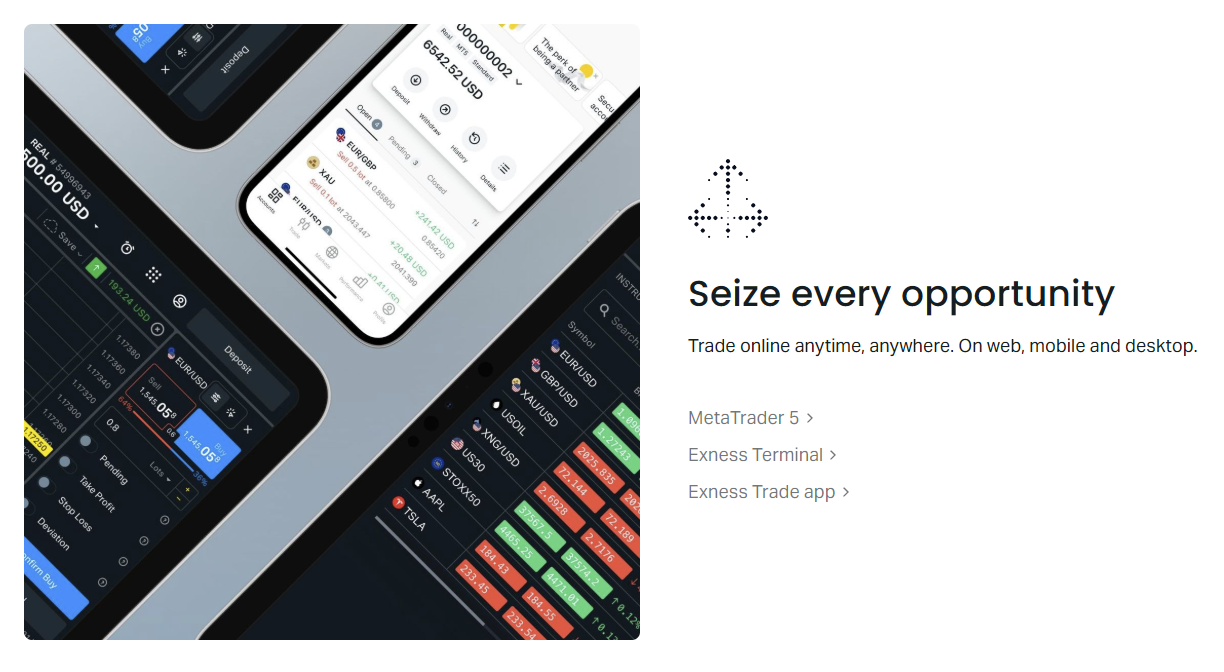
The Exness Terminal offers a modern, browser-based alternative that requires no software installation. Designed with a clean interface, it provides essential charting tools, technical indicators, and order management features optimized for web and mobile use. The terminal integrates seamlessly with the Exness Personal Area, enabling quick account management, deposits, and withdrawals without switching applications. For traders who prioritize accessibility and simplicity, the Exness Terminal delivers a competent experience, though it lacks the deep customization and algorithmic capabilities of the MetaTrader platforms.
Account Types and Stock Trading Conditions
Exness offers several account types, each with distinct trading conditions that affect stock CFD trading. The Standard and Standard Cent accounts operate on a spread-only pricing model with no commission, making them straightforward for beginners. The spread markup on stock CFDs for these accounts is typically wider than on professional accounts, reflecting the all-in cost structure. Professional accounts — Pro, Raw Spread, and Zero — introduce commission-based pricing with tighter raw spreads, which can reduce total costs for high-volume traders. The choice between account types should align with trading frequency, position sizing, and cost sensitivity.
The Standard Cent account deserves special mention for traders new to stock CFDs. By denominating the account balance in cents rather than dollars (or equivalent), it allows meaningful position sizing with very small deposits. A $10 deposit appears as 1,000 cents, enabling micro-lot trading that mimics real-money risk management without substantial capital exposure. This account type uses the same spreads as the Standard account but provides a psychological and practical bridge between demo and live trading. However, cent accounts may have limitations on maximum position sizes and available instruments.
Scroll horizontally to see all columns
| Account Type | Pricing Model | Typical Stock Spread | Commission | Min Deposit |
|---|---|---|---|---|
| Standard | Spread only | From 0.3% of price | None | $1 |
| Standard Cent | Spread only | From 0.3% of price | None | $1 |
| Pro | Spread + commission | From 0.1% of price | From $3.5 per lot | $200 |
| Raw Spread | Raw spread + commission | From 0.0% (raw) | From $3.5 per lot | $200 |
| Zero | Zero spread + commission | 0.0% (fixed zero) | From $3.5 per lot | $200 |
Leverage for stock CFDs varies by regulatory jurisdiction and account equity. Under CySEC and FCA regulations, retail clients typically access maximum leverage of 1:5 for individual stocks and 1:10 for major indices. Professional clients and those under FSA (Seychelles) or FSCA (South Africa) regulation may access higher leverage, up to 1:20 for major stocks. Leverage tiers often adjust dynamically based on account equity — higher balances may face reduced maximum leverage as a risk management measure. Traders should verify current leverage limits in their Personal Area, as these can change in response to market conditions or regulatory updates.
Trading Costs: Spreads, Commissions, and Swaps
The total cost of trading stock CFDs on Exness comprises three main components: the spread (difference between bid and ask prices), commission (on professional accounts), and swap charges for positions held overnight. Understanding how these costs interact is crucial for strategy profitability, particularly for short-term traders where transaction costs represent a larger proportion of potential returns. Exness publishes typical spread ranges for each instrument, though actual spreads fluctuate with market liquidity and volatility.
Stock CFD spreads are typically quoted as a percentage of the share price rather than in absolute points. For example, a 0.1% spread on a $150 stock equals $0.15 per share. During regular market hours for highly liquid U.S. large-caps, spreads on Raw Spread and Zero accounts can approach the underlying market spread, with the broker's commission added separately. Standard accounts incorporate the broker's markup into a wider all-in spread. Extended-hours trading generally features significantly wider spreads due to reduced liquidity provider participation.
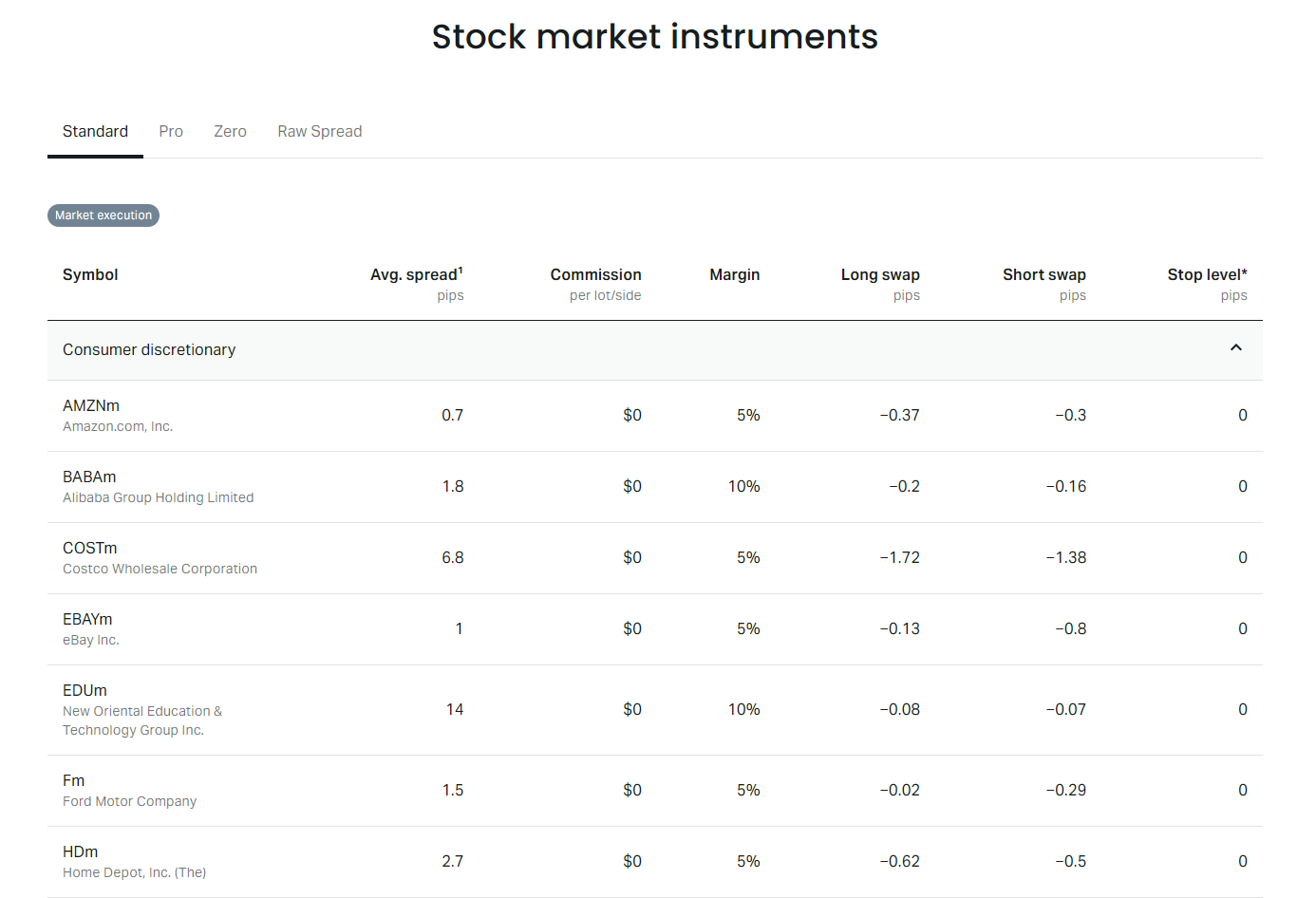
Swap charges (also called rollover or overnight financing) apply to positions held past the daily cutoff time (typically 22:00 or 23:00 server time). For long stock CFD positions, the swap is usually a debit reflecting the cost of financing the leveraged exposure. For short positions, the swap may be a credit or debit depending on the interest rate differential and borrow costs for the underlying shares. Exness calculates swaps based on interbank rates plus a markup, with triple swaps applied on Wednesdays to account for weekend financing. Traders holding positions for extended periods should factor cumulative swap costs into their trade planning.
- Spreads: Percentage-based, tighter during core market hours
- Commissions: Per lot (100 shares), charged open and close on pro accounts
- Swaps: Daily financing cost, triple on Wednesdays for weekend
- No deposit or withdrawal fees for most payment methods
- Inactivity fee: $10/month after 12 months of no trading
- Currency conversion fees apply for non-USD denominated accounts
Cost comparison between account types reveals that the breakeven volume for commission-based accounts depends on the spread differential. For instance, if the Standard account spread is 0.3% and the Raw Spread account offers 0.1% plus $3.50 per lot commission, a trader executing 10 lots per month ($150,000 notional on $150 stock) would pay $450 in spreads on Standard versus $150 in spreads plus $70 commission on Raw Spread — a $230 saving. Higher volumes increase the advantage of commission-based pricing. Traders should model their expected volume against current spread and commission schedules to optimize account selection.
Risk Management Tools and Features
Effective risk management is paramount in leveraged stock CFD trading. Exness provides a comprehensive suite of tools to help traders control exposure and protect capital. The foundation consists of standard order types: market orders for immediate execution, limit orders for entry at specified prices, stop orders for breakout entries, and stop-loss/take-profit orders for exit management. These can be set at position opening or modified afterward. Trailing stops automatically adjust the stop-loss level as the price moves favorably, locking in profits while allowing room for normal fluctuations.
Margin requirements for stock CFDs follow a tiered structure based on position size and instrument volatility. Major large-cap stocks typically require 5% margin (1:20 leverage) for the first tier, with higher margin percentages applied to larger positions. The margin calculator in the Exness Personal Area and trading platforms allows traders to compute required margin before entering positions. Margin calls occur when equity falls below 100% of required margin, and stop-outs execute automatically at 50% margin level (varies by jurisdiction). These thresholds provide a buffer but require active monitoring during volatile periods.
Risk management is not about avoiding losses entirely — it's about ensuring that no single trade or series of trades can critically damage your trading capital.
Negative balance protection is a critical safeguard provided by Exness under its regulatory obligations. This feature ensures that clients cannot lose more than their deposited funds, even in extreme market events where gaps or slippage could theoretically produce negative equity. The protection applies automatically to all retail clients and cannot be waived. For professional clients who opt out of certain retail protections, negative balance protection may not apply, making it essential to understand the implications of professional categorization.
Mobile Trading Experience
Mobile trading has become essential for stock CFD traders who need to monitor positions and execute trades away from their desks. Exness offers native mobile applications for both iOS and Android, supporting MT4, MT5, and the Exness Terminal. The apps provide full charting capabilities with multiple timeframes, technical indicators, and drawing tools. Push notifications alert traders to price levels, margin calls, and economic events. The mobile experience mirrors desktop functionality for core trading tasks, though screen size naturally limits multi-chart layouts and complex analysis.
The Exness mobile app (distinct from the MetaTrader mobile apps) integrates trading with account management, allowing deposits, withdrawals, and verification document uploads directly from the app. This unified experience reduces friction for traders who primarily use mobile devices. The app's design emphasizes speed and clarity, with a customizable watchlist, one-tap trading from charts, and quick access to trading history. Biometric authentication (Face ID, fingerprint) secures access without repeated password entry.
- Native iOS and Android apps for MT4, MT5, and Exness Terminal
- Full charting with 9+ timeframes and 30+ indicators on mobile
- Push notifications for price alerts, margin calls, news
- One-tap trading from charts and watchlists
- Integrated account management: deposits, withdrawals, KYC
- Biometric login and two-factor authentication support
Synchronization across devices ensures that chart templates, indicators, and drawing objects created on desktop appear on mobile and vice versa when using the same MetaTrader account. The Exness Terminal web version also syncs preferences via cloud storage. This continuity allows traders to analyze markets on a large screen, set alerts, and then manage positions from a phone during market hours. For stock traders tracking earnings releases or news-driven moves, this cross-device workflow provides meaningful operational flexibility.
Educational Resources and Market Analysis
Exness invests in educational content and analytical tools to support trader development. The broker's website hosts a learning center with articles, video tutorials, and webinars covering stock CFD mechanics, technical analysis, fundamental analysis, and risk management. Content ranges from beginner guides explaining basic concepts to advanced strategy discussions. Regular webinars feature market analysts discussing current equity market themes, earnings season preparation, and sector outlooks. These resources are freely accessible to registered clients.
Technical analysis tools within the trading platforms form the primary analytical workspace for most stock CFD traders. Both MT4 and MT5 include comprehensive indicator libraries, drawing tools, and customizable chart templates. MT5 adds the economic calendar directly in the platform, displaying upcoming earnings reports, dividend dates, and macroeconomic events that affect stock prices. The Exness Terminal provides a streamlined set of popular indicators and drawing tools sufficient for most discretionary trading approaches. Third-party indicators and EAs from the MetaTrader Market extend analytical capabilities further.
Fundamental analysis support comes through integrated news feeds from providers like FXStreet and MarketPulse, delivering real-time headlines, earnings summaries, and analyst commentary directly in the platforms. The economic calendar highlights high-impact events such as Federal Reserve decisions, employment reports, and inflation data that drive broad market moves affecting all stocks. For company-specific research, traders typically supplement platform resources with external sources: SEC filings, earnings call transcripts, analyst reports, and financial news services. Exness does not provide proprietary equity research reports but facilitates access to third-party analysis through platform integrations.
Deposit, Withdrawal, and Account Management
Funding and withdrawing from an Exness trading account is designed for speed and convenience, with most methods offering instant processing. Supported payment options vary by region but typically include bank cards (Visa, Mastercard), electronic wallets (Skrill, Neteller, WebMoney, Perfect Money), bank transfers, and local payment systems in specific countries. The broker does not charge deposit or withdrawal fees, though payment providers may apply their own charges. Minimum deposit starts at $1 for Standard and Standard Cent accounts, while professional accounts require $200 minimum.
Withdrawal processing times depend on the method: electronic wallets and cards typically process within minutes to a few hours, while bank transfers may take 1-3 business days. Exness promotes instant withdrawals for eligible methods and regions, a feature that distinguishes it from brokers with longer mandatory processing windows. Withdrawal requests are processed 24/7, including weekends for automated methods. The Personal Area provides a clear transaction history with status tracking for all financial operations.
- Minimum deposit: $1 (Standard/Cent), $200 (Pro/Raw/Zero)
- No Exness fees on deposits or withdrawals
- Instant withdrawals for e-wallets and cards (where available)
- Bank transfers: 1-3 business days
- 24/7 withdrawal processing including weekends
- Multiple base currencies: USD, EUR, GBP, CHF, JPY, more
Account verification (KYC) follows standard regulatory requirements: proof of identity (passport, national ID, driver's license) and proof of address (utility bill, bank statement) dated within three months. The verification process typically completes within a few hours during business days. Unverified accounts face restrictions on withdrawal amounts and may have limited access to certain features. Completing verification promptly after registration avoids delays when withdrawing profits. The Exness mobile app streamlines document upload with camera capture and automatic validation checks.
Trading Strategies for Stock CFDs
Stock CFDs on Exness accommodate a wide range of trading strategies, from intraday scalping to multi-week position trading. Day traders focus on highly liquid large-cap stocks with tight spreads, using 1-minute to 15-minute charts and technical setups such as breakouts, pullbacks, and volume-weighted average price (VWAP) strategies. The low commissions on Raw Spread and Zero accounts support high-frequency approaches, though traders must account for the pattern day trading rule implications if holding U.S. residency. Swing traders hold positions for days to weeks, combining technical analysis with earnings catalysts and sector momentum.
Pairs trading represents a popular market-neutral strategy for stock CFDs. Traders identify two historically correlated stocks (e.g., two major banks or two tech giants) and take opposing positions when their price relationship diverges, expecting mean reversion. This approach reduces directional market risk while exploiting relative value discrepancies. Exness's broad instrument selection across sectors facilitates pairs trading implementation. The ability to short sell easily via CFDs makes this strategy more accessible than with physical shares, where borrowing constraints and costs can be prohibitive.
The flexibility to go long or short with equal ease is one of the most powerful features of stock CFDs — it transforms every market condition into a potential opportunity.
Earnings season presents unique opportunities and risks for stock CFD traders. Volatility typically expands significantly around earnings announcements, creating potential for large directional moves. Some traders specialize in pre-earnings momentum or post-earnings drift strategies. However, widened spreads, gapping risk, and unpredictable reactions make earnings trades inherently high-risk. Exness's guaranteed stop-loss orders (where available) can cap downside, though they carry a premium. Traders should reduce position sizes and widen stops during earnings periods, or avoid holding through announcements entirely unless specifically trading the event.
Platform Tools: Calculator, VPS, and Social Trading
Exness provides several auxiliary tools that enhance the stock trading experience. The trading calculator, accessible in the Personal Area and platforms, computes margin requirements, pip values, swap charges, and profit/loss projections for hypothetical positions. This tool helps traders plan position sizing and assess risk-reward ratios before execution. The calculator supports all account types and instruments, automatically applying current spreads, leverage tiers, and swap rates. For stock CFDs, it converts percentage-based spreads into monetary values per lot, clarifying the cost structure.
Virtual Private Server (VPS) hosting is available free of charge for clients meeting minimum trading volume thresholds (typically 5 lots per month). A VPS provides a stable, low-latency environment for running expert advisors and maintaining persistent platform connections, which is valuable for algorithmic stock trading strategies that require 24/5 uptime. The Exness VPS runs on enterprise-grade hardware in data centers proximate to the broker's trade servers, minimizing execution latency. Traders who do not meet the volume requirement can rent a VPS for a monthly fee.
- Trading calculator: Margin, profit, swap, pip value computation
- Free VPS for active traders (5+ lots/month)
- VPS latency: <1ms to Exness trade servers
- Social trading: Copy successful stock traders
- Copy trading: Automatic replication with risk controls
- Signal providers: Verified performance statistics
Social trading and copy trading features allow clients to replicate the trades of experienced stock CFD traders automatically. The Exness Social Trading platform (accessible via web and mobile app) displays provider profiles with verified performance metrics, risk scores, and trading history. Followers can allocate a portion of their capital to copy selected providers, with controls for maximum drawdown, position sizing, and stop-loss overrides. This feature appeals to traders who want equity market exposure without conducting their own analysis, though it carries the same market risks as self-directed trading plus the additional risk of provider strategy changes.
Customer Support and Service Quality
Exness provides multilingual customer support through live chat, email, and phone, operating 24/7 for live chat and email, with phone support during business hours in major regions. The support team handles account inquiries, technical issues, verification questions, and trading condition clarifications. Response times for live chat typically range from immediate to a few minutes during peak hours. The broker also maintains a comprehensive help center with searchable articles covering common topics from account opening to platform troubleshooting.
For stock CFD traders specifically, support can assist with instrument availability questions, corporate action explanations, dividend adjustment queries, and platform configuration for equity trading. The broker's website includes a dedicated section for stock trading conditions, though the most current spreads and specifications are always found in the trading platform's market watch or specification window. Exness publishes quarterly execution quality reports detailing fill rates, slippage statistics, and price improvement frequency, demonstrating a commitment to transparency that benefits all traders.
Reliable customer support becomes critically important when real money is at stake and technical issues arise during market hours. Exness's 24/7 live chat sets a high standard for accessibility.
Comparing Exness Stock Trading with Alternatives
When evaluating Exness for stock CFD trading, comparison with alternative brokers reveals distinct positioning. Exness differentiates through its combination of ultra-low spreads on professional accounts, instant withdrawal capability, high leverage availability (where permitted), and zero minimum deposit on standard accounts. Competitors may offer larger stock universes (some brokers provide 5,000+ global stocks versus Exness's several hundred), direct market access (DMA) pricing, or physical share dealing alongside CFDs. Traders prioritizing instrument breadth over cost efficiency may prefer brokers with wider equity coverage.
Commission structures vary significantly across brokers. Some charge per-share commissions with minimum tickets (e.g., $0.02 per share, $1 minimum), while others use per-lot commissions like Exness. Spread markups on standard accounts also differ. Traders should compute total round-trip costs for their typical position sizes across several brokers. Exness's Raw Spread and Zero accounts are competitive for high-volume traders, while the Standard account's all-in spread suits lower-volume participants who prefer simplicity. The absence of inactivity fees for the first 12 months and no deposit/withdrawal fees are additional cost advantages.
Scroll horizontally to see all columns
| Feature | Exness | Typical Competitor Range |
|---|---|---|
| Stock CFD Count | 200+ major global stocks | 500 - 5,000+ |
| Min Deposit (Standard) | $1 | $50 - $500 |
| Retail Leverage (Stocks) | 1:5 (major jurisdictions) | 1:5 - 1:10 |
| Pro Account Commission | From $3.5/lot | $3 - $10/lot |
| Withdrawal Speed | Instant (eligible methods) | 1 - 5 business days |
| Negative Balance Protection | Yes (retail) | Varies by regulator |
Platform ecosystem represents another comparison dimension. Brokers offering proprietary platforms alongside MT4/MT5 may provide better integration of research, screening tools, and order types tailored for equities. Exness's proprietary Terminal is capable but less feature-dense than some competitor platforms that include advanced screeners, fundamental data terminals, and options analytics. However, the MetaTrader dominance in the retail space means a vast library of third-party tools exists for MT4/MT5, partially offsetting proprietary platform advantages. Traders heavily invested in the MetaTrader ecosystem may find Exness's dual-platform support (MT4 and MT5) more accommodating than brokers offering only one.
Final Assessment of Exness Stock Trading
Exness stock trading delivers a compelling proposition for traders seeking cost-efficient access to global equity markets through CFDs. The broker's strengths center on competitive pricing — particularly on Raw Spread and Zero accounts where commissions are low and spreads approach raw market levels — combined with operational advantages like instant withdrawals, flexible account types starting at $1, and robust regulatory oversight across multiple jurisdictions. The platform suite covers the needs of discretionary and algorithmic traders alike, with MT5 providing the most complete toolkit for serious stock CFD analysis and automation.
The instrument selection, while not the largest in the industry, covers the most liquid and widely traded stocks across major global indices, satisfying the needs of most retail and professional traders. Gaps in small-cap and emerging market coverage may limit certain specialized strategies, but the available universe supports diversified portfolio approaches, sector rotation, and pairs trading. The mobile trading experience is polished and feature-complete, enabling effective position management from anywhere. Educational resources and analytical tools provide a solid foundation for skill development, though traders seeking deep fundamental research will need external sources.
- Competitive all-in costs on professional accounts for active traders
- Instant withdrawals and low minimum deposits enhance accessibility
- MT5 offers superior stock CFD toolkit vs MT4
- Regulatory coverage across four major jurisdictions
- Instrument selection covers major liquidity centers adequately
- Negative balance protection for retail clients
Potential drawbacks include the percentage-based spread structure which can become costly on high-priced stocks compared to per-share commission models, limited stock universe relative to equity-specialist brokers, and the absence of physical share dealing or options on equities. Leverage restrictions in major regulatory jurisdictions (1:5 for stocks) constrain position sizing for retail clients, though this aligns with investor protection objectives. The dynamic leverage reduction at higher equity levels may affect scaling strategies. Traders should weigh these factors against their specific trading style, volume, and instrument preferences.
Frequently Asked Questions
What stocks can I trade on Exness?
Exness offers CFDs on 200+ major global stocks from U.S., European, and Asian exchanges, including large-cap companies like Apple, Microsoft, Tesla, ASML, and Toyota.
What is the minimum deposit for stock trading on Exness?
The minimum deposit is $1 for Standard and Standard Cent accounts, and $200 for Professional accounts (Pro, Raw Spread, Zero).
What leverage is available for stock CFDs?
Retail clients under CySEC/FCA regulation get up to 1:5 leverage on individual stocks. Professional clients and those under FSA/FSCA regulation may access up to 1:20.
Does Exness charge commission on stock trades?
Standard and Standard Cent accounts use spread-only pricing with no commission. Pro, Raw Spread, and Zero accounts charge commission (from $3.5 per lot) with tighter spreads.
How are dividends handled on stock CFDs?
Long positions receive a cash credit equal to the dividend per share; short positions incur a cash debit. Adjustments occur on the ex-dividend date.
Can I trade stock CFDs on mobile?
Yes, Exness provides native iOS and Android apps for MT4, MT5, and the Exness Terminal with full charting, trading, and account management features.
Are there overnight fees for holding stock CFDs?
Yes, swap charges apply to positions held past the daily cutoff. Long positions typically pay financing costs; short positions may receive or pay depending on borrow rates.
Is negative balance protection available?
Yes, retail clients automatically receive negative balance protection ensuring losses cannot exceed deposited funds. Professional clients may not have this protection.