

Forex Trading Education
Exness Minimum Lot Sizes Explained for Traders
Complete guide to Exness lot sizes, from micro lots on cent accounts to standard lots on professional accounts.

Forex Analyst
Forex Analyst specializing in currency markets, market trends, technical and fundamental analysis, and providing clear insights to help traders make informed decisions.
Understanding minimum lot requirements is essential for anyone trading with Exness. The broker offers several account types, each with distinct lot size parameters that directly affect position sizing, risk exposure, and capital efficiency. Whether you are a beginner testing strategies with minimal capital or an experienced trader scaling positions, knowing the exact minimum lot for your chosen account prevents costly mistakes and helps you align trade size with your risk tolerance.
Contents
- Exness Account Types and Their Minimum Lots
- Standard Cent vs Standard Account Lot Values
- How Minimum Lot Affects Risk Management
- Calculating Position Size with Exness Trading Calculator
- Lot Size Limits for Non-Forex Instruments
- Scaling In and Out with Minimum Lots
- Transitioning from Cent to Standard Accounts
- Leverage Interaction with Minimum Lot
- Minimum Lot on Exness Trading Platforms
- Common Mistakes with Minimum Lot Sizing
- Optimizing Minimum Lot Usage for Strategy Types
- Regulatory and Regional Considerations
- Practical Examples of Minimum Lot Application
- Monitoring and Adjusting Lot Sizes Over Time
- Final Assessment of Exness Minimum Lot
Exness structures its accounts to accommodate different experience levels and trading styles. Standard and Standard Cent accounts cater to retail traders with low barriers to entry, while Raw Spread, Zero, and Pro accounts target high-volume and professional clients. Each account type defines its own minimum lot, maximum lot, and lot step. These parameters are not arbitrary; they reflect the underlying liquidity providers, commission structures, and typical spreads associated with each account tier.
A lot in forex represents a standardized contract size. One standard lot equals 100,000 units of the base currency. Mini lots are 10,000 units, micro lots are 1,000 units, and nano lots are 100 units. Exness allows trading in increments as small as 0.01 lots on most accounts, which equals one micro lot. On cent accounts, the minimum can be even smaller in terms of real currency exposure because the account balance is denominated in cents rather than dollars, effectively reducing the monetary value of each pip.
Exness Account Types and Their Minimum Lots
The table below summarizes the minimum lot sizes across Exness account types. These values apply to forex pairs; CFDs on metals, energies, indices, stocks, and cryptocurrencies may have different contract specifications. Always verify the specific instrument contract details in the trading platform before placing a trade.
Scroll horizontally to see all columns
| Account Type | Minimum Lot | Lot Step | Maximum Lot | Typical User |
|---|---|---|---|---|
| Standard Cent | 0.01 | 0.01 | 100 | Beginners, strategy testing |
| Standard | 0.01 | 0.01 | 200 | Retail traders, swing trading |
| Pro | 0.01 | 0.01 | 200 | Experienced, lower spreads |
| Raw Spread | 0.01 | 0.01 | 200 | Scalpers, commission-based |
| Zero | 0.01 | 0.01 | 200 | High volume, zero spread major pairs |
All Exness account types share a 0.01 minimum lot for forex. The differentiation lies in spreads, commissions, and maximum leverage rather than lot granularity. This uniformity simplifies position sizing calculations across accounts. However, the monetary impact of a 0.01 lot differs significantly between a Standard Cent account and a Standard account because of the account currency denomination.
Standard Cent vs Standard Account Lot Values
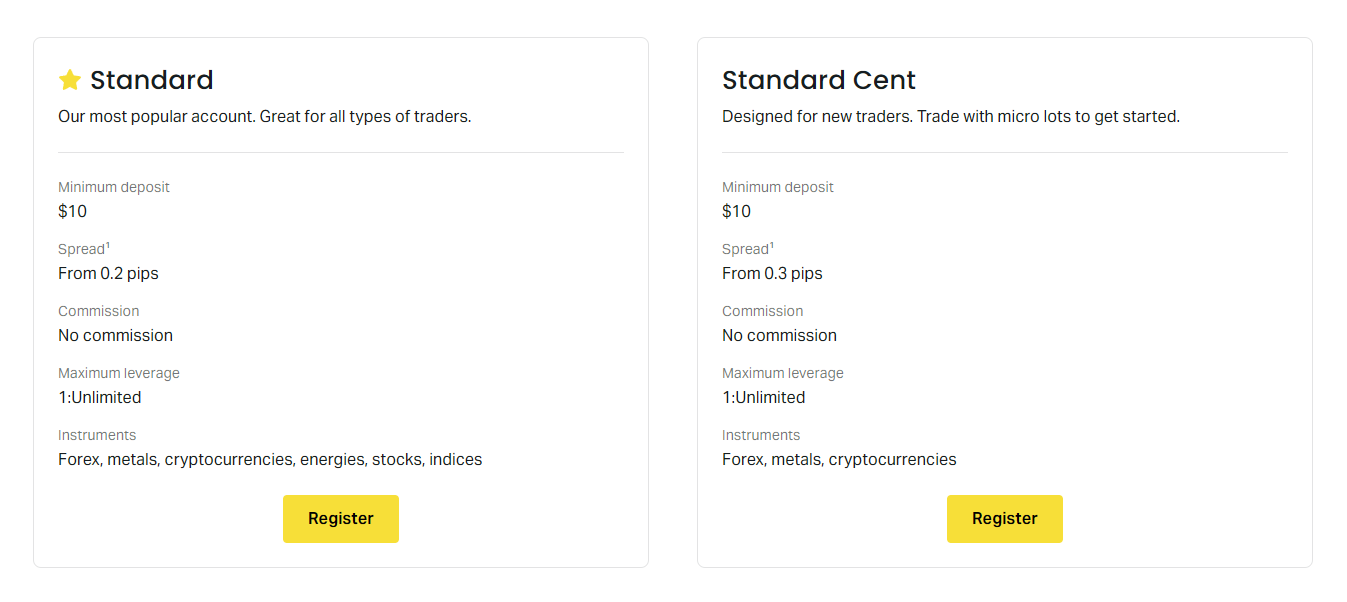
The Standard Cent account is unique because the account balance is displayed in cents. A deposit of $10 appears as 1,000 cents. When you trade 0.01 lot on a cent account, you are trading 1,000 units of the base currency, but each pip movement is worth approximately $0.01 (one cent) rather than $0.10 on a standard dollar-denominated account. This makes cent accounts ideal for learning live market dynamics with real money while keeping absolute risk very low.
On a Standard account, 0.01 lot on EURUSD means each pip is worth roughly $0.10. A 20-pip stop loss risks $2. On a Standard Cent account, the same 0.01 lot risks only $0.20 for a 20-pip stop. The position size in lots is identical, but the financial consequence scales with the account denomination. This distinction is critical when migrating strategies from a cent account to a standard account; you must adjust lot sizes to maintain equivalent risk percentages.
- Standard Cent: 0.01 lot = ~$0.01 per pip on EURUSD
- Standard: 0.01 lot = ~$0.10 per pip on EURUSD
- Pro, Raw Spread, Zero: same pip value as Standard
- Cent account maximum lot 100 vs 200 on others
The image above illustrates the account comparison available in the Exness personal area. Notice that all accounts show 0.01 as the minimum lot. The cent account's lower maximum lot (100 vs 200) reflects its design for smaller balance trading. Traders graduating from cent to standard accounts should recalculate their position sizing formulas to account for the 100x increase in pip value.
How Minimum Lot Affects Risk Management
Minimum lot size sets the floor for position granularity. If your account balance is $50 and you risk 1% per trade ($0.50), a 0.01 lot on a Standard account with a 5-pip stop loss risks $0.50 — exactly your risk budget. But if your stop loss needs to be 20 pips for the strategy to work, the minimum 0.01 lot risks $2, exceeding your 1% rule. In this scenario, you either need a larger account, a cent account, or a strategy with tighter stops. The minimum lot therefore constrains the minimum viable account size for a given strategy.
Professional traders often use the formula: Lot Size = (Account Balance × Risk Percentage) / (Stop Loss in Pips × Pip Value per Lot). With a 0.01 minimum lot, the smallest position you can take is fixed. If the formula outputs 0.005 lots, you cannot execute the trade at your desired risk level. You must either increase the stop loss (reducing probability of success), increase account balance, or switch to a cent account where the same lot size represents 1/100th the monetary risk.
Scroll horizontally to see all columns
| Stop Loss (Pips) | Standard Account | Standard Cent Account |
|---|---|---|
| 5 | $50 | $0.50 |
| 10 | $100 | $1 |
| 20 | $200 | $2 |
| 50 | $500 | $5 |
| 100 | $1,000 | $10 |
The table assumes EURUSD with $10 pip value per standard lot (0.01 lot = $0.10 per pip). Cent account pip value is $0.001 per pip at 0.01 lot. These figures illustrate why cent accounts enable meaningful risk management with deposits under $100. A $10 deposit on a cent account allows a 20-pip stop at 0.01 lot while risking only 2% of capital. The same trade on a standard account would require $200 for equivalent 1% risk.
The minimum lot is not just a technical specification; it is the practical boundary that determines whether a trader can follow their risk rules on a given account size.
Calculating Position Size with Exness Trading Calculator
Exness provides a built-in trading calculator accessible from the personal area and web terminal. This tool computes required margin, pip value, swap costs, and profit/loss projections for any lot size and instrument. Using the calculator before every trade ensures you understand the exact financial implications of your position size, especially when switching between account types or trading unfamiliar instruments like indices or cryptocurrencies where contract sizes differ from forex.
The calculator requires inputs: account type, instrument, lot size, leverage, and account currency. It outputs margin required, pip value, swap long/short, and commission if applicable. For minimum lot analysis, set lot size to 0.01 and observe the margin requirement and pip value. This tells you the minimum capital needed to open the smallest position and the monetary impact of each pip movement.
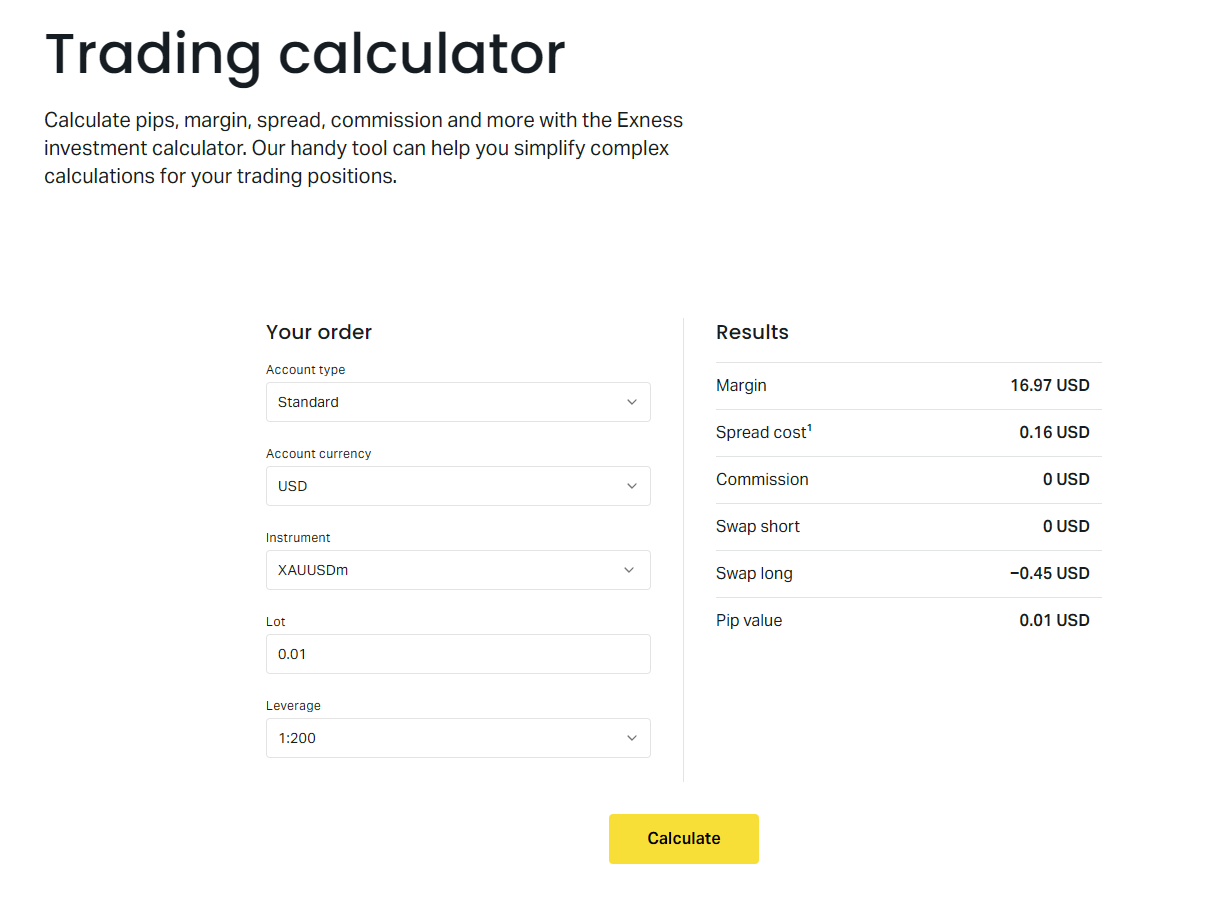
The calculator screenshot shows the interface where traders input parameters. Note that leverage affects margin but not pip value. A 0.01 lot on EURUSD always has a $0.10 pip value on a standard account regardless of whether leverage is 1:100 or 1:2000. Leverage only determines how much of your balance is locked as margin. This distinction is vital: high leverage does not increase risk per pip; it only frees up margin for additional positions.
Lot Size Limits for Non-Forex Instruments
While forex pairs uniformly offer 0.01 minimum lot across Exness accounts, CFDs on other asset classes have varying minimum lot requirements. These differences stem from the underlying contract specifications of each market. For example, gold (XAUUSD) typically has a 0.01 minimum lot where one lot equals 100 troy ounces. Index CFDs like US30 (Dow Jones) may have a minimum of 0.10 lots. Cryptocurrency CFDs often allow 0.01 lots but with vastly different notional values per lot depending on the coin.
Stock CFDs on Exness generally have a minimum lot of 1 share (equivalent to 0.01 lot in platform notation for some symbols). The platform normalizes display, but the contract specification window in MetaTrader 4/5 or Exness Terminal reveals the exact minimum volume. Always check the 'Contract Size' field in the symbol specification: this tells you how many units of the underlying asset one lot represents.
Scroll horizontally to see all columns
| Instrument | Symbol | Minimum Lot | Contract Size (per 1 lot) |
|---|---|---|---|
| Gold | XAUUSD | 0.01 | 100 oz |
| Silver | XAGUSD | 0.01 | 5,000 oz |
| US Crude Oil | USOIL | 0.01 | 1,000 barrels |
| US30 Index | US30 | 0.10 | 1 contract |
| Bitcoin | BTCUSD | 0.01 | 1 BTC |
| Apple Stock | AAPL | 0.01 | 1 share |
The table shows representative minimums; actual values may vary by account type and market conditions. Notably, US30 requires 0.10 minimum lots, meaning the smallest position is ten times larger than forex in lot terms. However, the tick value and margin requirements scale accordingly. Traders must adjust their position sizing models when diversifying across asset classes. The Exness trading calculator handles these differences automatically when you select the correct symbol.
Diversifying across asset classes requires re-learning position sizing for each instrument. The 0.01 lot habit from forex does not transfer directly to indices or commodities.
Scaling In and Out with Minimum Lots
The 0.01 lot minimum enables precise scaling strategies. A trader with a $1,000 standard account risking 2% ($20) per trade can enter a 0.02 lot position with a 100-pip stop ($20 risk). If the trade moves favorably, they can add another 0.01 lot (scaling in) while moving the stop to breakeven on the initial position. This granularity is impossible with brokers that enforce 0.10 minimum lots. Exness's 0.01 floor supports sophisticated position management even on modest accounts.
Scaling out works similarly. A 0.05 lot position can be reduced by 0.01 lots at predefined profit targets, locking in partial gains while letting the remainder run. The 0.01 step size allows five distinct exit points for a 0.05 lot trade. On accounts with 0.10 minimum steps, you would have only one exit decision. This flexibility improves risk-adjusted returns by allowing traders to implement multi-target exit plans without over-leveraging.
- Enter 0.02 lot, add 0.01 at pullback (scale in)
- Exit 0.01 at target 1, 0.01 at target 2, trail remainder
- 0.01 step allows up to 5 exits on 0.05 lot position
- Reduces all-or-nothing pressure on single exit decision
Transitioning from Cent to Standard Accounts
Many Exness traders start on Standard Cent accounts and migrate to Standard accounts as their capital grows. This transition requires careful lot size adjustment. A trader accustomed to trading 1.00 lots on a cent account (equivalent to 0.01 standard lots in monetary exposure) might mistakenly trade 1.00 lots on a standard account, increasing risk 100-fold. The platform does not prevent this; it only enforces the 0.01 minimum. Discipline and updated position sizing rules are essential.
A practical migration approach: keep the same monetary risk per trade. If you risked $2 per trade on a cent account with 0.10 lots (20-pip stop), on a standard account you would use 0.01 lots with the same 20-pip stop to risk $2. The lot size decreases by a factor of 10, but the risk in dollars stays constant. Your strategy's statistical expectancy remains unchanged; only the account denomination and absolute lot numbers shift.
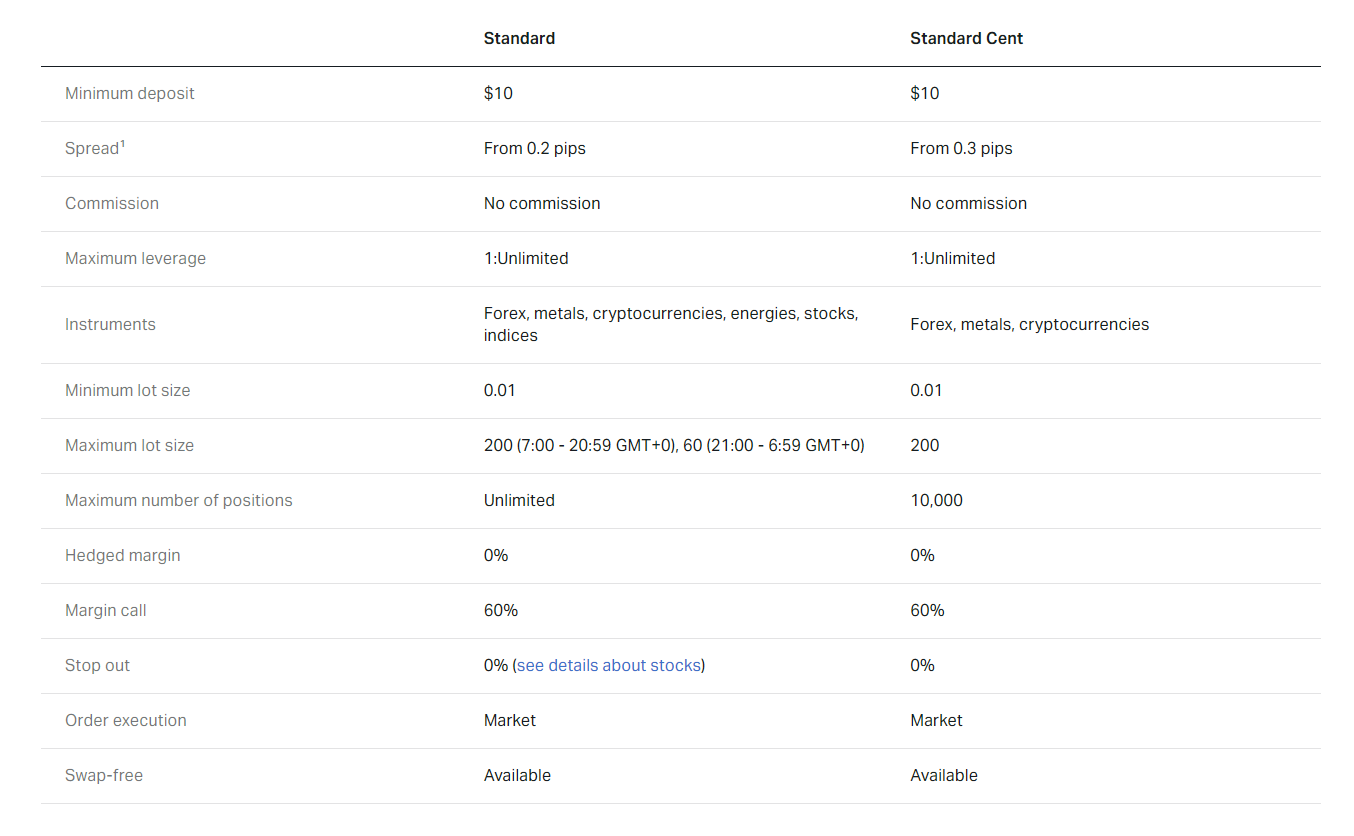
The comparison image highlights the spread and commission differences alongside lot parameters. Cent accounts typically have slightly wider spreads but no commissions. Standard accounts offer tighter spreads on Pro/Raw Spread/Zero variants with commissions. When migrating, factor in the commission cost per lot: Raw Spread charges $3.5 per side per lot ($7 round turn). At 0.01 lot, that's $0.07 per trade — negligible for swing trades but material for high-frequency scalping.
Leverage Interaction with Minimum Lot
Leverage does not change the minimum lot size, but it determines the margin required to open that minimum position. Exness offers dynamic leverage up to 1:2000 on forex for balances under $2,000, decreasing at higher equity tiers. At 1:2000 leverage, a 0.01 lot EURUSD position requires only $0.50 margin (at 1.0000 price). At 1:100 leverage, the same position requires $10 margin. The minimum lot stays 0.01; the capital efficiency changes dramatically.
High leverage allows traders with very small balances to meet margin requirements for the minimum lot. A $10 account at 1:2000 can open a 0.01 lot EURUSD position with $0.50 margin, leaving $9.50 free margin. At 1:100, the same account could not open even the minimum lot because $10 margin exceeds the balance. Thus, leverage expands the practical accessibility of the minimum lot for undercapitalized accounts, but it does not reduce the monetary risk per pip.
Scroll horizontally to see all columns
| Leverage | Margin Required | Free Margin on $100 Account |
|---|---|---|
| 1:2000 | $0.50 | $99.50 |
| 1:500 | $2.00 | $98.00 |
| 1:200 | $5.00 | $95.00 |
| 1:100 | $10.00 | $90.00 |
| 1:50 | $20.00 | $80.00 |
The table assumes EURUSD at 1.0000. Margin = (Lot Size × Contract Size × Price) / Leverage. For 0.01 lot: (0.01 × 100,000 × 1.0000) / Leverage. Higher leverage frees margin for additional positions or wider stops, but the pip risk remains $0.10 per pip. Traders must not confuse margin availability with risk capacity. A $100 account at 1:2000 can open twenty 0.01 lot positions simultaneously, but a 5-pip adverse move on all twenty would wipe out the account.
Leverage determines how many minimum lots you can open; it does not change the risk of each minimum lot. Confusing margin with risk is a primary cause of account blow-ups.
Minimum Lot on Exness Trading Platforms
Exness supports MetaTrader 4, MetaTrader 5, Exness Terminal (web), and the Exness Trade mobile app. All platforms enforce the same 0.01 minimum lot for forex on standard account types. The order entry dialogs display volume in lots with two decimal precision by default. On MT4/MT5, you can type 0.01 directly or use the volume step arrows. On Exness Terminal and the mobile app, the volume selector increments in 0.01 steps. The consistency across platforms means muscle memory transfers seamlessly.
One platform-specific nuance: MT4 shows volume as '0.01' while MT5 and Exness Terminal may display '0.01' or '1,000' depending on the 'Show volumes in lots' setting. The underlying value is identical. Mobile app users should verify the volume field before confirming market orders, as touch interfaces can accidentally increment the lot selector. The Exness Trade app includes a confirmation screen showing the notional value and margin impact, which acts as a final safeguard.
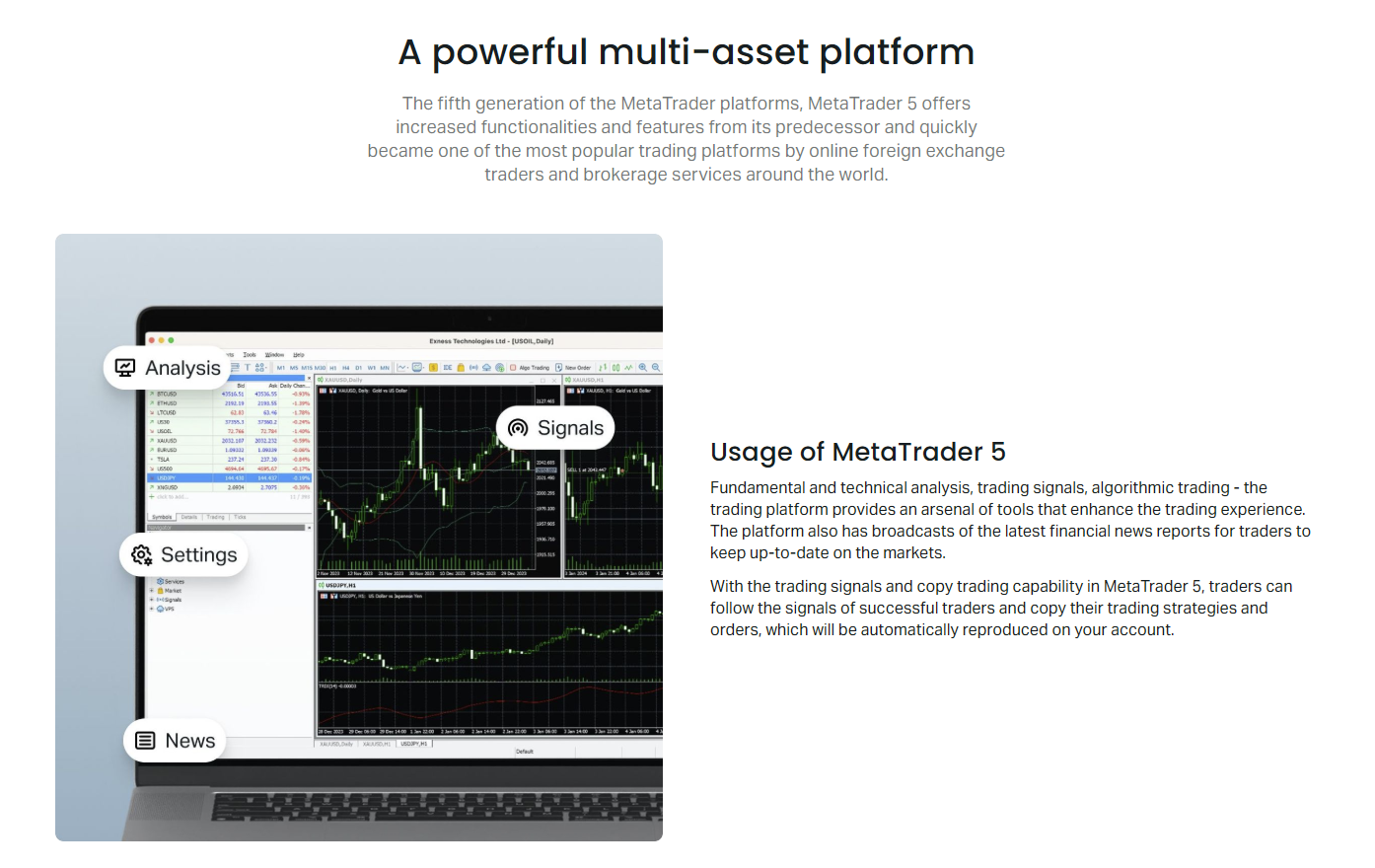
The MT5 screenshot demonstrates the order entry interface where traders select volume. The minimum 0.01 is enforced by the platform; attempting to enter 0.005 will revert to 0.01 or show an error. The 'Type' dropdown allows market, pending, and stop orders — all respect the same minimum lot. For pending orders (buy limit, sell stop, etc.), the volume field behaves identically. This consistency ensures that automated strategies (EAs) using 0.01 lots function identically across order types.
Common Mistakes with Minimum Lot Sizing
Traders frequently make avoidable errors when working with minimum lots. The most common is assuming 0.01 lot represents the same risk across all instruments. As shown earlier, 0.01 lot on XAUUSD (gold) has a vastly different pip value than 0.01 lot on EURUSD. Another mistake is ignoring swap costs on overnight positions. At minimum lot size, swaps may seem trivial, but they accumulate over weeks and can erode profits on carry-negative pairs.
A third error is failing to account for commission on Raw Spread and Zero accounts. The commission is charged per lot per side. At 0.01 lot, the commission is small ($0.035 per side on Raw Spread), but high-frequency strategies executing hundreds of trades per month see meaningful cumulative costs. Always include commission in your expectancy calculation. A strategy with 0.5 pip average profit before commission becomes negative after commission on a 0.01 lot Raw Spread account.
- Assuming uniform pip value across all symbols
- Ignoring swap accumulation on long-term minimum lot positions
- Forgetting commission on Raw Spread/Zero accounts
- Not adjusting lot size when moving from cent to standard account
- Using minimum lot with stop loss too wide for account size
- Over-leveraging because margin allows many 0.01 lots
Optimizing Minimum Lot Usage for Strategy Types
Different trading styles benefit from the 0.01 minimum lot in distinct ways. Scalpers targeting 3-5 pip moves need the smallest possible position to keep risk per trade low while maintaining reasonable reward-to-risk ratios. A 0.01 lot with a 3-pip stop risks $0.30 on a standard account, allowing a $100 account to risk 0.3% per trade — well within conservative guidelines. Without 0.01 lots, the same scalper would need $1,000 for equivalent risk control.
Swing traders holding positions for days or weeks use 0.01 lots to fine-tune position size relative to wider stops. A 150-pip stop at 0.01 lot risks $15. On a $2,000 account, that's 0.75% risk — precise and controlled. If the minimum lot were 0.10, the same stop would risk $150 (7.5%), forcing the trader to either reduce stop distance (increasing stop-out probability) or increase account size. The 0.01 minimum preserves strategic flexibility.
Algorithmic traders and EA developers rely on 0.01 lot granularity for backtesting accuracy. Strategy optimizers test lot sizing algorithms that output fractional lots. If the broker minimum were 0.10, the optimizer's precision would be severely limited, potentially missing optimal parameter combinations. Exness's 0.01 floor supports robust quantitative strategy development.
The 0.01 minimum lot is a feature that enables professional risk management on retail account sizes. It is the difference between following your plan and breaking your rules.
Regulatory and Regional Considerations
Exness operates under multiple regulatory licenses including CySEC (Cyprus), FCA (UK), FSCA (South Africa), and FSA (Seychelles). Minimum lot specifications are consistent across all regulated entities. However, leverage limits imposed by regulators affect margin requirements for the minimum lot. Under ESMA rules (CySEC/FCA), retail clients are capped at 1:30 leverage on major forex pairs. This increases the margin for a 0.01 lot EURUSD position to approximately $33 (at 1.0000), compared to $0.50 at 1:2000 available under FSA (Seychelles) for international clients.
The minimum lot itself does not change by jurisdiction. A UK retail trader still opens 0.01 lots minimum. The difference is capital efficiency: the UK trader needs $33 margin versus $0.50 for an international client. This effectively raises the minimum viable account size for the same number of concurrent positions. Traders should verify their regulatory entity in the Exness personal area and understand the applicable leverage caps.
Practical Examples of Minimum Lot Application
Consider a trader with a $500 Standard account using a breakout strategy on GBPUSD with a 30-pip stop loss. Risk per trade: 1% = $5. Pip value at 0.01 lot = $0.10. Maximum lots = $5 / (30 × $0.10) = 1.66 lots. The trader can use 1.66 lots (rounded to 1.66 or 1.67 depending on lot step). The 0.01 step allows precise 1.66 lot sizing. If the minimum were 0.10, the choices would be 1.0 lot ($3 risk, 0.6%) or 2.0 lots ($6 risk, 1.2%) — neither hits the 1% target exactly.
Another example: a $50 Standard Cent account trader using a mean reversion strategy on EURUSD with a 10-pip stop. Risk per trade: 2% = $1. Pip value at 0.01 lot = $0.001. Maximum lots = $1 / (10 × $0.001) = 100 lots. But the cent account maximum lot is 100. The trader can use the full 100 lots (10 standard lots equivalent) while risking only $1. This demonstrates the cent account's unique ability to simulate standard account position sizing with 1/100th the capital.
Scroll horizontally to see all columns
| Account | Balance | Risk % | Stop (Pips) | Calculated Lots | Rounded Lots |
|---|---|---|---|---|---|
| Standard | $500 | 1% | 30 | 1.66 | 1.66 |
| Standard Cent | $50 | 2% | 10 | 100 | 100 |
| Standard | $1,000 | 1.5% | 50 | 3.00 | 3.00 |
| Raw Spread | $2,000 | 0.5% | 20 | 5.00 | 5.00 |
These examples assume forex pairs with $10 pip value per standard lot. The calculated lots column shows the exact mathematical result; the rounded lots column shows the nearest achievable size given the 0.01 step. In all cases, the 0.01 granularity allows near-perfect risk targeting. The cent account example hits the maximum lot limit, illustrating that even with 0.01 minimums, account constraints eventually bind.
Monitoring and Adjusting Lot Sizes Over Time
As your account grows or shrinks, your optimal lot size changes. A disciplined trader recalculates position size for every trade based on current equity, not initial deposit. Exness updates account equity in real-time across all platforms. The trading calculator can be used dynamically: input current balance, desired risk percentage, and planned stop loss to get the exact lot size. This practice prevents the common error of keeping lot sizes fixed while equity compounds, which inadvertently increases risk percentage over time.
Conversely, after a drawdown, continuing to trade the same lot size increases risk percentage dramatically. A trader who risks 1% at $10,000 with 0.50 lots (20-pip stop) would risk 2% at $5,000 with the same 0.50 lots. The 0.01 minimum lot allows smooth downscaling: reduce to 0.25 lots to restore 1% risk. Brokers with 0.10 minimum steps force coarse adjustments that either over-risk or under-utilize capital during recovery phases.
- Recalculate lot size every trade using current equity
- Use Exness calculator for precise sizing
- Downscale immediately after drawdowns
- Upscale gradually as equity compounds
- Never keep lot size fixed while equity changes
Frequently Asked Questions
What is the minimum lot size on Exness for forex pairs?
The minimum lot size on Exness for all forex pairs is 0.01 lots (1 micro lot = 1,000 units of base currency) across all account types including Standard Cent, Standard, Pro, Raw Spread, and Zero.
Does the minimum lot differ between Standard Cent and Standard accounts?
No, both accounts have a 0.01 minimum lot. However, the monetary value differs: 0.01 lot on a cent account risks approximately 1/100th the dollar amount of the same lot on a standard account due to cent denomination.
Can I trade less than 0.01 lots on Exness?
No, 0.01 lots is the minimum increment enforced by the trading platforms (MT4, MT5, Exness Terminal, mobile app). Orders with volume below 0.01 will be rejected or rounded up.
What is the minimum lot for gold (XAUUSD) on Exness?
The minimum lot for XAUUSD (gold) is 0.01 lots, where 1 lot equals 100 troy ounces. This applies to all Exness account types.
How does leverage affect the minimum lot I can trade?
Leverage does not change the minimum lot size (0.01). It only affects the margin required to open that position. Higher leverage reduces margin requirement, making the minimum lot accessible with smaller account balances.
Do Raw Spread and Zero accounts have different minimum lots?
No, Raw Spread and Zero accounts also have a 0.01 minimum lot for forex. The difference is in spreads and commissions, not lot size granularity.
What happens if I try to open a position smaller than 0.01 lots?
The platform will prevent the order. In MT4/MT5, the volume field only accepts values ≥ 0.01 with 0.01 increments. In Exness Terminal and mobile app, the volume selector starts at 0.01.
How do I calculate the correct lot size for my risk tolerance?
Use the formula: Lots = (Account Balance × Risk %) / (Stop Loss Pips × Pip Value per 0.01 Lot). Or use the Exness Trading Calculator in your Personal Area for automated calculation.
Final Assessment of Exness Minimum Lot
Exness maintains a consistent 0.01 minimum lot across all account types and trading platforms, providing traders with the granularity needed for precise risk management regardless of account size. This uniformity simplifies strategy development and cross-account migration. The real differentiation lies in account denomination (cents vs dollars), spread structures, and commission models — not in lot size floors. Traders should leverage the 0.01 step to scale positions, fine-tune risk per trade, and adapt position sizing as equity fluctuates. The Exness trading calculator remains the most reliable tool for translating risk parameters into exact lot sizes across all supported instruments.