

Forex & Crypto Trading
Exness Crypto Trading: Platform Features and Market Access
Trade Bitcoin, Ethereum, and major cryptocurrencies with low costs and reliable execution on Exness platforms.

Forex Analyst
Forex Analyst specializing in currency markets, market trends, technical and fundamental analysis, and providing clear insights to help traders make informed decisions.
Exness crypto trading provides access to a broad range of digital assets through contracts for difference, allowing traders to speculate on price movements without owning the underlying coins. The broker offers cryptocurrency CFDs on major assets such as Bitcoin, Ethereum, Litecoin, Ripple, and several altcoins, with trading available around the clock on most instruments. This structure appeals to both short-term speculators and longer-term position traders who want exposure to crypto volatility without managing wallets, private keys, or exchange custody risk.
Contents
- Available Cryptocurrency Instruments
- Trading Platforms for Crypto
- Account Types and Crypto Conditions
- Spreads, Commissions, and Swaps
- Leverage and Margin Requirements
- Execution Quality and Speed
- Risk Management Tools
- Mobile Trading Experience
- Deposits and Withdrawals for Crypto Traders
- Security and Regulation
- Analytical Resources and Market Insights
- Comparative Advantages and Limitations
- Getting Started with Exness Crypto Trading
- Final Assessment of Exness Crypto Trading
The platform suite includes MetaTrader 4, MetaTrader 5, the proprietary Exness Terminal, and a mobile application, each supporting crypto CFDs with real-time pricing, charting tools, and order management. Spreads on major pairs like BTCUSD and ETHUSD are variable and tend to tighten during peak liquidity hours, while commissions apply on certain account types. Leverage up to 1:400 is available for professional clients on select crypto instruments, though retail limits follow regulatory caps. Understanding these parameters is essential for sizing positions and managing margin effectively.
Exness operates under multiple regulatory licenses, including authorizations from the FCA in the United Kingdom, CySEC in Cyprus, FSCA in South Africa, and FSA in Seychelles. Client funds are segregated from operational capital, and negative balance protection applies across all jurisdictions. The broker also publishes quarterly audited financial statements, adding a layer of transparency uncommon in the crypto CFD space. These safeguards matter because cryptocurrency markets can experience extreme price gaps, and robust risk infrastructure reduces the chance of disputes during turbulent periods.
This guide examines every practical aspect of trading cryptocurrencies with Exness, from instrument specifications and platform workflows to funding methods, risk controls, and comparative advantages. Whether you are evaluating the broker for the first time or optimizing an existing setup, the following sections provide the detail needed to make informed decisions.
Available Cryptocurrency Instruments
Exness offers CFDs on more than a dozen cryptocurrencies, covering the largest by market capitalization and a selection of liquid altcoins. The core lineup includes Bitcoin (BTCUSD), Ethereum (ETHUSD), Litecoin (LTCUSD), Ripple (XRPUSD), Bitcoin Cash (BCHUSD), Cardano (ADAUSD), Dogecoin (DOGEUSD), Polkadot (DOTUSD), Chainlink (LINKUSD), Stellar (XLMUSD), Uniswap (UNIUSD), and Solana (SOLUSD). Each pair is quoted against the US dollar, and pricing aggregates liquidity from multiple venues to reduce the impact of any single exchange outage or manipulation event.
Trading hours for most crypto CFDs run 24/7, with only brief maintenance windows on weekends. This continuous access differs from traditional forex sessions and allows traders to react to news, on-chain data, or macroeconomic shifts at any hour. However, liquidity thins during late-night UTC hours, which can widen spreads and increase slippage on market orders. The broker publishes a detailed schedule of trading breaks in the contract specifications, and it is advisable to check those times before holding positions over weekends or holidays.
- BTCUSD — Bitcoin vs US Dollar, highest liquidity and tightest spreads
- ETHUSD — Ethereum vs US Dollar, deep order book and active derivatives market
- LTCUSD — Litecoin vs US Dollar, often used as a Bitcoin proxy
- XRPUSD — Ripple vs US Dollar, sensitive to regulatory news
- BCHUSD — Bitcoin Cash vs US Dollar, fork-related volatility
- ADAUSD — Cardano vs US Dollar, proof-of-stake narrative driver
- DOGEUSD — Dogecoin vs US Dollar, social-media-driven momentum
- DOTUSD — Polkadot vs US Dollar, parachain auction cycles
- LINKUSD — Chainlink vs US Dollar, oracle demand correlation
- XLMUSD — Stellar vs US Dollar, cross-border payment focus
- UNIUSD — Uniswap vs US Dollar, DEX volume proxy
- SOLUSD — Solana vs US Dollar, high-throughput blockchain narrative
Contract specifications for each symbol include the minimum lot size, tick value, margin currency, and swap rates for long and short positions. These details are accessible in the trading platform by right-clicking a symbol and selecting Specification, or through the Exness website under Trading Conditions. Minimum lot sizes are typically 0.01 lots, though some altcoins may require 0.1 lots due to lower liquidity. Tick values vary by instrument and are denominated in USD, simplifying profit and loss calculations for dollar-based accounts.
Trading Platforms for Crypto
Exness supports crypto CFD trading across four primary interfaces: MetaTrader 4, MetaTrader 5, the browser-based Exness Terminal, and the Exness mobile app. Each platform delivers the same pricing feed and execution engine, so the choice comes down to workflow preferences, analytical tooling, and device compatibility. MetaTrader 4 remains popular for its lightweight footprint and extensive library of custom indicators and expert advisors, though it lacks native hedging mode and depth-of-market features. MetaTrader 5 adds more timeframes, an economic calendar, and a built-in marketplace for signals and robots, making it better suited for multi-asset strategies that include crypto alongside forex and indices.
The Exness Terminal is a proprietary web platform that requires no installation and works on any modern browser. It offers a clean, responsive layout with TradingView-powered charts, one-click trading, and a customizable workspace. For crypto traders, the Terminal includes a dedicated watchlist for digital assets, quick-switch buttons for timeframes, and integrated risk calculators. The mobile app mirrors the Terminal's functionality and adds push notifications for price alerts, margin calls, and executed orders. Both web and mobile versions support biometric login and two-factor authentication for added security.
All platforms provide market, limit, stop, and stop-limit order types, along with trailing stops and one-cancels-other (OCO) brackets on MT5 and the Terminal. Execution is market-based with no requotes, and the broker advertises average order fill times under 25 milliseconds for major crypto pairs. Slippage can still occur during high-volatility events such as Bitcoin halving news, ETF approval announcements, or major exchange outages. Using limit orders instead of market orders during these windows helps control entry prices, though it carries the risk of non-execution if the market moves away.
Account Types and Crypto Conditions
Exness offers several account categories, each with distinct pricing structures that affect crypto trading costs. The Standard and Standard Cent accounts use spread-only pricing with no commission, making them straightforward for beginners. Spreads on BTCUSD in these accounts typically start around 30–50 points (USD 30–50 per lot) during liquid hours but can widen significantly overnight. The Pro, Raw Spread, and Zero accounts introduce commission-based pricing: Raw Spread charges a low commission per lot per side with spreads near zero, while Zero fixes spreads at zero for the top instruments and applies a higher commission. Professional clients can access the Premier program with further reduced commissions and dedicated support.
Swap rates for crypto CFDs differ from forex because they reflect the cost of funding a leveraged position in a 24/7 market. Long positions generally incur a daily financing charge, while short positions may receive a credit or pay a smaller debit depending on the asset and prevailing interest-rate differentials. Exness publishes swap values in the contract specifications and updates them regularly. Traders holding positions beyond the daily rollover at 22:00 UTC should factor these costs into their expectancy calculations, especially for multi-week trades.
Scroll horizontally to see all columns
| Account | Pricing Model | Typical BTCUSD Spread | Commission (per lot/side) | Min Deposit |
|---|---|---|---|---|
| Standard | Spread only | 30–50 pts | None | USD 1 |
| Standard Cent | Spread only | 30–50 pts | None | USD 1 |
| Pro | Spread + commission | 10–20 pts | USD 3.50 | USD 200 |
| Raw Spread | Commission + raw spread | 0–5 pts | USD 3.50 | USD 200 |
| Zero | Fixed zero spread + commission | 0 pts | USD 5.00–10.00 | USD 200 |
Islamic (swap-free) accounts are available for clients who cannot earn or pay interest for religious reasons. On these accounts, crypto positions held overnight incur an administration fee instead of a swap, which is disclosed upfront. The fee structure varies by instrument and is typically higher than the standard swap for long positions but eliminates the uncertainty of variable financing costs. Eligibility requires a request through the personal area and may be subject to regional restrictions.
Spreads, Commissions, and Swaps
The total cost of a crypto trade on Exness combines the spread, any commission, and the overnight swap if the position is held past the rollover. Spreads are variable and driven by the underlying liquidity providers; during Asian-session hours, BTCUSD spreads may widen to 80–120 points, while European and US overlap hours often see 20–40 points. The Raw Spread and Zero accounts are designed for high-frequency or scalping strategies where the spread component dominates, whereas the Standard accounts suit swing traders who hold positions for days and prefer a single all-in cost.
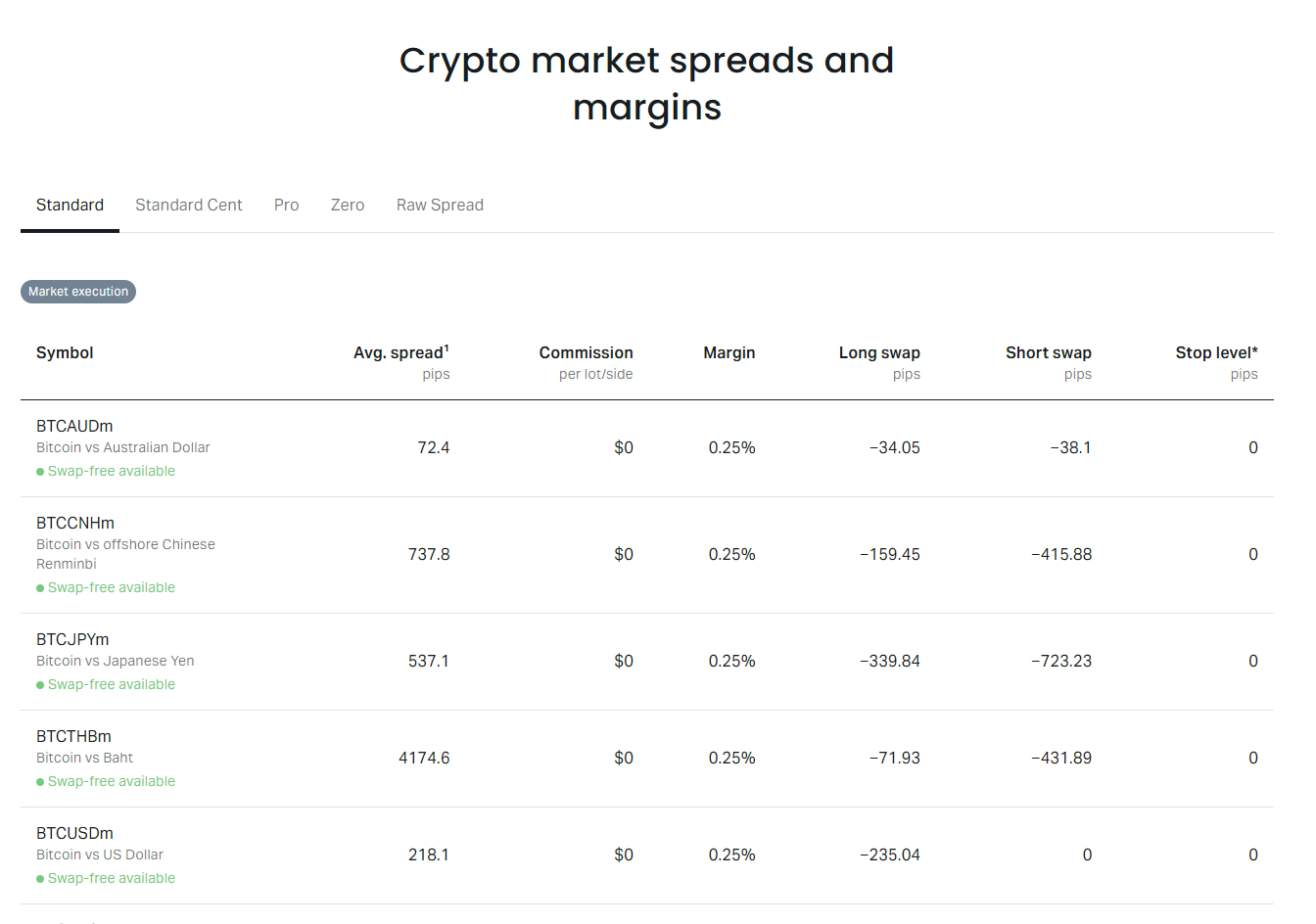
Commissions on Raw Spread and Zero accounts are charged per lot per side, meaning a round-turn trade incurs twice the listed rate. For example, a Raw Spread commission of USD 3.50 per lot per side equals USD 7.00 per lot round-turn. On a 1-lot BTCUSD position (1 lot = 1 BTC), this is a fixed cost regardless of price level. Traders should compare the effective all-in cost: a Standard account with a 40-point spread (USD 40) versus a Raw Spread account with a 5-point spread (USD 5) plus USD 7 commission (USD 12 total). The commission model becomes cheaper as spread widens, which often happens during volatile crypto moves.
- Monitor spread widening during major news: FOMC minutes, ETF decisions, exchange hacks
- Use limit orders to avoid crossing wide spreads at market open
- Calculate swap costs for positions held longer than three days
- Consider Zero account if you trade large volume and want predictable spread cost
- Check commission tier for Premier clients if monthly volume exceeds 500 lots
Swap rates for crypto are expressed in points per lot per night. A long BTCUSD swap of -150 points means a USD 150 charge per lot per night. Short swaps can be positive (credit) or negative depending on the asset. For example, shorting BTCUSD might yield +20 points (USD 20 credit) while shorting a less liquid altcoin could cost -30 points. These values fluctuate with funding rates on perpetual futures markets, which Exness references for pricing. The trading platform displays current swap values in the Market Watch window, and the Exness website provides a historical swap calculator for backtesting.
Leverage and Margin Requirements
Leverage for crypto CFDs on Exness varies by account type, client classification, and instrument. Retail clients under FCA and CySEC regulation are capped at 1:2 for cryptocurrencies per ESMA guidelines, while professional clients and those under FSCA or FSA jurisdictions can access up to 1:400 on major pairs like BTCUSD and ETHUSD. Leverage tiers step down as position size increases: the first 10 lots may enjoy 1:400, the next 20 lots at 1:200, and so on. This tiered margin model protects both the trader and the broker from excessive concentration risk in a single instrument.
Margin is calculated in the account currency (usually USD) and displayed in real time in the platform. The margin requirement for a 1-lot BTCUSD position at 1:100 leverage with Bitcoin at USD 60,000 is USD 600. If the account equity falls below 50% of used margin, a margin call triggers; at 20%, the stop-out level begins closing positions automatically. Exness provides a margin calculator in the personal area and within the trading platforms, allowing traders to simulate position sizing before entry. Using the calculator is especially important for crypto, where a 10% price move can wipe out a highly leveraged account in minutes.
Execution Quality and Speed
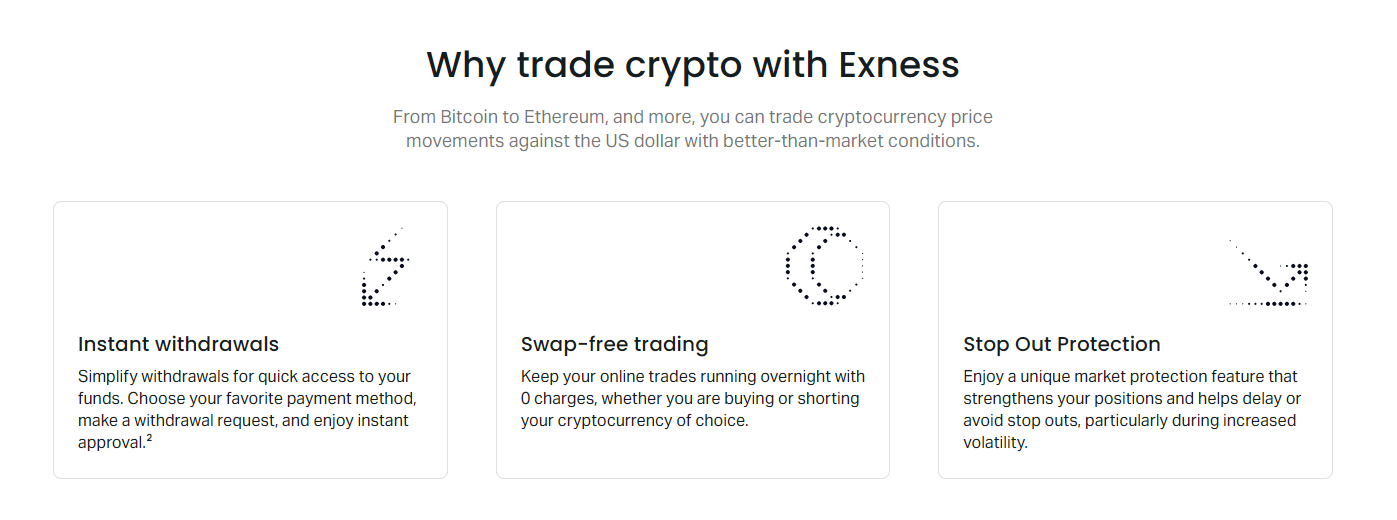
Exness emphasizes execution speed as a core differentiator, citing average fill times under 25 milliseconds for major instruments including BTCUSD and ETHUSD. The broker connects to multiple liquidity venues — tier-1 banks, prime brokers, and crypto exchanges — and uses smart order routing to fill at the best available price. Execution is market-based with no dealing desk intervention, meaning orders are filled at the next available price in the liquidity pool. This model eliminates requotes but introduces slippage risk during fast moves, which is standard for NDD (no dealing desk) brokers.
The broker publishes quarterly execution quality reports showing metrics such as slippage distribution, fill rates, and price improvement frequency. For crypto CFDs, the reports indicate that over 90% of market orders on BTCUSD receive zero or positive slippage during normal conditions. During extreme volatility — such as the March 2020 crash or the November 2022 FTX collapse — slippage distributions widen, and some orders fill several points away from the requested price. Traders can mitigate this by using limit orders, which guarantee the price but not the fill, or by reducing position size ahead of known catalysts.
Execution quality matters most when markets move fastest. A broker with deep liquidity connections and transparent reporting gives traders confidence that their orders reflect genuine market prices, not internalized flow.
Risk Management Tools
Effective risk management is critical when trading crypto CFDs due to the asset class's inherent volatility. Exness provides several built-in tools: stop-loss and take-profit orders attached to every position, trailing stops that lock in profits as the market moves favorably, and margin call notifications via email, SMS, and push alerts. The platforms also display real-time margin level, free margin, and equity, allowing traders to monitor exposure at a glance. For algorithmic traders, MT4 and MT5 support expert advisors that can enforce position-sizing rules, daily loss limits, and correlation filters across multiple crypto symbols.
The Exness Terminal includes a position risk calculator that shows the potential profit or loss for a given price move, the margin impact, and the distance to stop-out. This feature helps visualize the effect of a 5%, 10%, or 20% adverse move before entering a trade. Additionally, the broker offers negative balance protection across all entities, ensuring that a client cannot lose more than their deposited funds even in a flash crash scenario. This protection is a regulatory requirement in most jurisdictions but is applied globally by Exness as a policy.
- Always attach a stop-loss when opening a crypto position
- Use the position calculator to estimate margin impact of a 10% move
- Set daily and weekly loss limits in your trading plan
- Diversify across uncorrelated assets (forex, indices, gold) to reduce portfolio drawdown
- Enable two-factor authentication and withdrawal whitelists in the personal area
Mobile Trading Experience
The Exness mobile app, available for iOS and Android, delivers full crypto CFD functionality in a compact interface. The app includes TradingView charts with over 30 technical indicators, drawing tools, and multiple chart types. Traders can switch between symbols, timeframes, and accounts with a few taps, and the watchlist supports custom groups for crypto-only monitoring. Order entry is streamlined: a long-press on a symbol opens a ticket with pre-filled lot size, stop-loss, and take-profit fields based on user defaults. Push notifications cover price alerts, margin calls, executed orders, and deposit/withdrawal confirmations.
The app also integrates the personal area, allowing deposits, withdrawals, account verification, and leverage changes without leaving the application. Biometric login (Face ID, fingerprint) and PIN protection secure access. For traders who rely on the MetaTrader ecosystem, the MT4 and MT5 mobile apps are fully compatible with Exness servers and offer similar feature sets, though the native Exness app tends to have faster load times and a more modern UI. Synchronization across devices is seamless — chart layouts, indicators, and watchlists persist between web, desktop, and mobile.
Deposits and Withdrawals for Crypto Traders
Exness supports a wide range of funding methods, including bank wire, credit/debit cards, electronic wallets (Skrill, Neteller, WebMoney, Perfect Money), and regional payment systems (Pix, UPI, local bank transfers). Minimum deposit is USD 1 for Standard and Standard Cent accounts, and USD 200 for Pro, Raw Spread, and Zero accounts. Most electronic methods are instant, while bank wires take 1–3 business days. The broker does not charge deposit fees, though third-party processors may apply their own charges.
Withdrawals are processed back to the original deposit method per anti-money-laundering rules. Exness advertises instant withdrawals for electronic wallets and cards, meaning funds reach the payment provider within minutes of approval. Bank withdrawals take 1–5 business days. There are no withdrawal fees from Exness, and no minimum withdrawal amount for most methods. The personal area tracks transaction history with timestamps and status updates. For crypto traders who prefer to fund via stablecoins, Exness does not currently accept direct cryptocurrency deposits; all funding goes through fiat channels.
Security and Regulation
Exness holds licenses from the UK Financial Conduct Authority (FCA), Cyprus Securities and Exchange Commission (CySEC), South Africa Financial Sector Conduct Authority (FSCA), and Seychelles Financial Services Authority (FSA). Each regulator imposes capital adequacy, client fund segregation, audit, and reporting requirements. Client funds are held in segregated accounts at top-tier banks and cannot be used for operational expenses. The broker is a member of the Financial Commission's compensation fund, which provides up to EUR 20,000 coverage per client in the event of broker insolvency.
On the technology side, Exness employs TLS 1.3 encryption for all data in transit, two-factor authentication (TOTP and SMS), device authorization, and withdrawal address whitelisting. The personal area logs all login attempts and allows revoking active sessions. Regular penetration testing and third-party security audits are conducted, and the broker runs a bug bounty program. For algorithmic traders, the VPS hosting service (available free for qualifying accounts) provides low-latency connectivity to Exness servers with 99.9% uptime SLA, reducing the risk of missed orders due to local internet or power outages.
Regulatory oversight and fund segregation are non-negotiable when choosing a crypto CFD broker. Exness's multi-jurisdictional licensing and transparent financial reporting set a high bar for the industry.
Analytical Resources and Market Insights
Exness provides a suite of analytical tools that support crypto trading decisions. The economic calendar covers macro events (CPI, NFP, FOMC) that influence risk appetite and, by extension, crypto prices. Trading Central signals integrate directly into MT4, MT5, and the Terminal, offering technical patterns, key levels, and directional bias for BTCUSD, ETHUSD, and other major pairs. The broker's market news feed aggregates headlines from FXStreet and other providers, with a filter for cryptocurrency-specific stories. Additionally, the Exness blog publishes weekly crypto outlooks, on-chain metric analyses, and strategy articles written by the research team.
For traders who build their own models, the platforms support custom indicators and scripts. MT5's MQL5 language allows machine-learning integration via ONNX, enabling neural-network-based signals for crypto volatility forecasting. The Exness Terminal's TradingView charts include Pine Script compatibility, so community indicators can be applied without leaving the browser. Historical data for backtesting is available via the MetaTrader History Center (tick data for MT5, minute data for MT4) and through the Exness API for institutional clients.
Comparative Advantages and Limitations
Exness crypto trading stands out for its combination of tight spreads on major pairs, multiple platform choices, instant withdrawals, and strong regulatory coverage. The Raw Spread and Zero accounts are particularly competitive for active traders, and the Premier program rewards high volume with further cost reductions. The proprietary Terminal and mobile app offer a modern, responsive experience that many traders prefer over the dated MetaTrader interface. Negative balance protection, segregated funds, and quarterly audited financials add institutional-grade safety.
Limitations include the lack of direct cryptocurrency deposits/withdrawals, which forces fiat on-ramping. Retail leverage caps in major jurisdictions (1:2 under ESMA/FCA) restrict position sizing for European and UK clients. The altcoin selection, while covering the top 12 assets, is narrower than specialized crypto exchanges that list hundreds of tokens. Swap costs on long crypto positions can accumulate quickly, making multi-week holds expensive unless the trend is strongly favorable. Finally, during extreme market stress, spreads and slippage can widen beyond typical levels, a risk common to all CFD brokers.
Scroll horizontally to see all columns
| Advantages | Limitations |
|---|---|
| Tight spreads on BTCUSD, ETHUSD | No direct crypto deposits/withdrawals |
| Multiple platforms (MT4, MT5, Terminal, App) | Retail leverage capped at 1:2 in EU/UK |
| Instant withdrawals on e-wallets | Limited altcoin selection vs crypto exchanges |
| Multi-jurisdictional regulation | Overnight swaps add cost to long holds |
| Negative balance protection | Spread widening during extreme volatility |
| Quarterly audited financials | No spot crypto ownership option |
Getting Started with Exness Crypto Trading
Opening an account takes minutes: register on the Exness website or app with email and password, complete the profile questionnaire (trading experience, financial knowledge), and verify identity with a government-issued ID and proof of address. The verification tier determines maximum deposit limits and withdrawal speeds. Once approved, fund the account via your preferred method, select a platform, and add crypto symbols to your watchlist. The demo account mirrors live conditions with virtual funds and is recommended for testing strategies, platform familiarity, and risk-management rules before committing real capital.
For the first live trades, start with the Standard account on a small deposit (USD 50–100) to experience real execution, spreads, and psychology without significant risk. Use 0.01-lot positions on BTCUSD or ETHUSD, set stop-losses at 1–2% of account equity, and track results in a trading journal. Gradually increase size as consistency improves, and consider upgrading to Raw Spread or Zero once monthly volume exceeds 50 lots. The personal area allows adding additional accounts under the same profile, so you can run parallel strategies (e.g., swing on Standard, scalp on Raw Spread) with separate risk parameters.
- Register and verify identity (KYC) — typically under 15 minutes
- Open a Standard demo account and trade crypto for 2–4 weeks
- Fund live Standard account with minimum USD 50
- Trade 0.01 lots with fixed 1% risk per trade
- Review weekly: win rate, risk-reward, max drawdown, swap costs
- Upgrade account type when volume and consistency justify it
Final Assessment of Exness Crypto Trading
Exness delivers a professional-grade crypto CFD offering that balances cost, speed, and safety. The broker's multi-platform approach caters to discretionary traders, algorithmic developers, and mobile-first users alike, while its regulatory footprint and transparent financials inspire confidence. Competitive spreads on Bitcoin and Ethereum, instant withdrawals, and negative balance protection address the core concerns of crypto speculators. The main trade-offs — no direct crypto funding, retail leverage limits in regulated regions, and swap costs on long holds — are structural to the CFD model and not unique to Exness. Traders who understand these constraints and build risk management around them will find a reliable venue for cryptocurrency exposure without the operational burden of spot exchanges.
Frequently Asked Questions
Which cryptocurrencies can I trade as CFDs on Exness?
Exness offers CFDs on Bitcoin (BTCUSD), Ethereum (ETHUSD), Litecoin (LTCUSD), Ripple (XRPUSD), Bitcoin Cash (BCHUSD), Cardano (ADAUSD), Dogecoin (DOGEUSD), Polkadot (DOTUSD), Chainlink (LINKUSD), Stellar (XLMUSD), Uniswap (UNIUSD), and Solana (SOLUSD), all quoted against the US dollar.
What are the trading hours for crypto CFDs on Exness?
Most cryptocurrency CFDs trade 24/7 with only brief maintenance windows on weekends. Exact break times are published in the contract specifications for each symbol.
What leverage is available for crypto trading on Exness?
Retail clients under FCA and CySEC regulation are limited to 1:2 leverage on cryptocurrencies. Professional clients and those under FSCA or FSA jurisdictions can access up to 1:400 on major pairs like BTCUSD and ETHUSD, with tiered reductions for larger positions.
Does Exness charge commissions on crypto trades?
Standard and Standard Cent accounts use spread-only pricing with no commission. Pro, Raw Spread, and Zero accounts charge a commission per lot per side (e.g., USD 3.50 on Raw Spread) in exchange for tighter or zero spreads.
Can I deposit or withdraw using cryptocurrencies directly?
No, Exness does not currently accept direct cryptocurrency deposits or withdrawals. All funding goes through fiat channels such as bank wire, cards, and electronic wallets (Skrill, Neteller, etc.).
Are swap fees charged on crypto CFD positions held overnight?
Yes, swap rates apply to positions held past the daily rollover at 22:00 UTC. Long positions typically incur a financing charge; short positions may receive a credit or pay a debit depending on the asset. Swap values are published in the contract specifications and the trading platform.
Is negative balance protection available for crypto trading?
Yes, Exness provides negative balance protection across all its regulatory entities, ensuring clients cannot lose more than their deposited funds even during extreme market moves.
Which platforms support crypto CFD trading on Exness?
MetaTrader 4, MetaTrader 5, the browser-based Exness Terminal, and the Exness mobile app (iOS/Android) all support the full range of cryptocurrency CFDs with identical pricing and execution.