

Forex Trading
Exness GBPUSD Trading: Spreads, Execution, and Strategy
A comprehensive guide to trading the GBPUSD pair on Exness, covering costs, tools, and tips.

Forex Analyst
Forex Analyst specializing in currency markets, market trends, technical and fundamental analysis, and providing clear insights to help traders make informed decisions.
The GBPUSD currency pair, often called Cable, remains one of the most liquid and heavily traded instruments in the foreign exchange market. Its popularity stems from the economic weight of both the United Kingdom and the United States, producing frequent volatility and clear technical patterns that attract day traders, swing traders, and algorithmic systems alike. Exness provides access to this pair through multiple account types and platforms, offering competitive pricing and execution technology designed for high-frequency and discretionary strategies.
Contents
- Account Types and GBPUSD Pricing Structure
- Execution Model and Order Fill Quality
- Platform Options for GBPUSD Analysis and Trading
- Risk Management Tools and Position Sizing
- Trading Sessions and GBPUSD Volatility Patterns
- Technical Analysis Tools and Trading Central Integration
- Funding, Withdrawals, and Account Security
- Strategy Considerations for GBPUSD on Exness
- Comparing GBPUSD Conditions Across Brokers
- Mobile Trading Experience for GBPUSD
- Educational Resources and Market Analysis
- Final Assessment of Exness GBPUSD Trading
Traders evaluating a broker for GBPUSD typically focus on three core factors: the all-in cost per trade (spread plus commission), the speed and reliability of order execution, and the availability of analytical tools that support informed decision-making. Exness addresses each of these areas with raw-spread accounts, market-execution models, and integrated research from Trading Central. The following sections examine how these elements combine to shape the trading experience on this major pair.
Account Types and GBPUSD Pricing Structure
Exness offers Standard, Standard Cent, Raw Spread, Zero, and Pro account categories. For GBPUSD, the Raw Spread and Zero accounts are most relevant to cost-sensitive traders because they separate the broker markup from the raw interbank spread and apply a fixed commission per lot. Standard accounts embed the cost inside a wider spread with no commission, which can simplify calculations for beginners but often results in higher effective costs during active sessions.
- Raw Spread: near-zero spreads with a fixed commission per side
- Zero: zero spreads on top instruments for most of the trading day, commission-based
- Pro: low spreads with no commission, suited for larger volumes
- Standard: commission-free, wider spreads, instant or market execution
- Standard Cent: same conditions as Standard but denominated in cents for micro risk
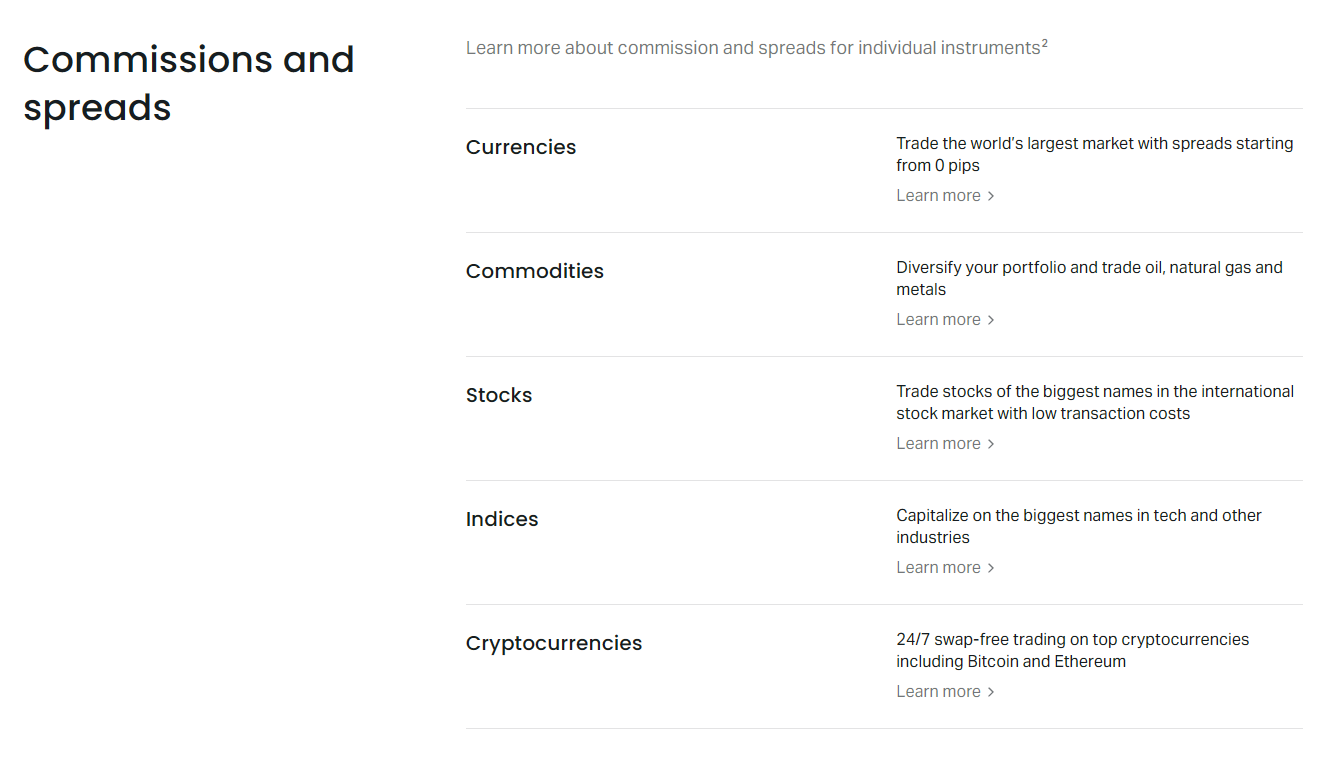
During the London–New York overlap, GBPUSD spreads on Raw Spread accounts frequently approach 0.0–0.2 pips before commission. The commission per lot (round turn) is typically $3.5–$5 depending on the account currency and registration entity. Traders should calculate the effective cost per trade by adding the commission to the prevailing spread and compare it against the wider spread on Standard accounts to determine the break-even volume threshold.
The image above illustrates the typical spread ranges and commission rates for major pairs. Note that GBPUSD often benefits from the tightest pricing due to its deep liquidity pool. Swap rates for holding positions overnight are also displayed in the platform and vary by account type; Raw Spread and Zero accounts generally offer more favorable swap terms than Standard accounts.
Execution Model and Order Fill Quality
Exness operates a market-execution model with no dealing desk intervention for most account types. Orders are filled at the best available price from liquidity providers, which can result in positive or negative slippage during volatile news events. The broker publishes execution statistics, including fill rates and slippage distribution, allowing traders to audit historical performance. For GBPUSD, the high liquidity typically yields fill times under 50 milliseconds on the MetaTrader 5 server infrastructure.
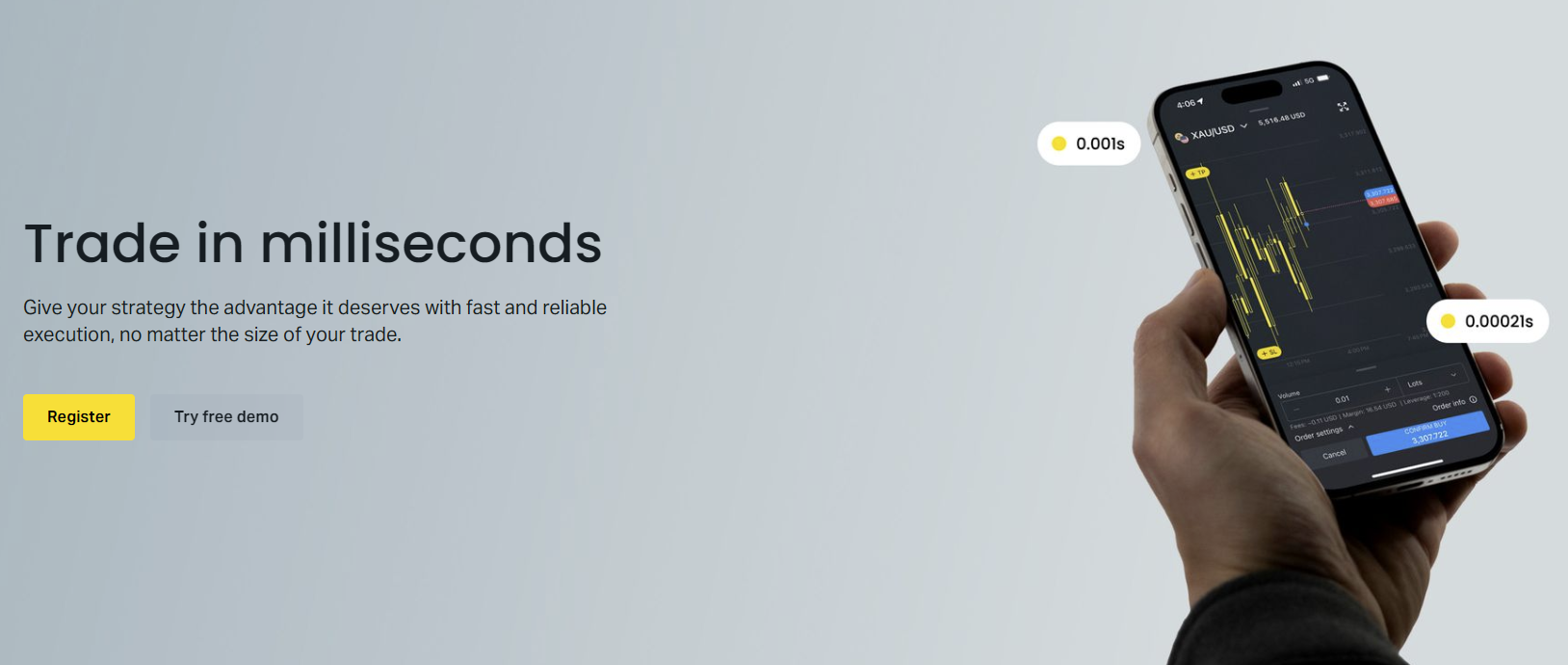
The execution engine routes orders through Equinix data centers co-located with major liquidity venues. This proximity reduces network latency and helps maintain consistent fill quality even during high-impact releases such as Bank of England rate decisions or U.S. non-farm payrolls. Traders using Expert Advisors or high-frequency strategies benefit from the low-latency VPS hosting offered free to qualifying accounts.
Platform Options for GBPUSD Analysis and Trading
Exness supports MetaTrader 4, MetaTrader 5, the proprietary Exness Terminal (web and desktop), and mobile applications for iOS and Android. Each platform provides full charting capabilities, custom indicators, and one-click trading. MetaTrader 5 adds more timeframes, an economic calendar, and a built-in depth-of-market (DOM) view that can be useful for assessing GBPUSD liquidity at different price levels.
- MetaTrader 4: familiar interface, extensive EA ecosystem, 9 timeframes
- MetaTrader 5: 21 timeframes, DOM, netting and hedging modes, improved strategy tester
- Exness Terminal: browser-based, no installation, integrated Trading Central signals
- Mobile apps: full trading functionality, push notifications, biometric login
The Exness Terminal includes Trading Central technical analysis directly on the chart, offering pattern recognition, pivot points, and short-term directional forecasts for GBPUSD. This integration can accelerate decision-making for traders who prefer not to switch between separate analysis windows. The web terminal also synchronizes chart layouts and watchlists across devices.

The banner above highlights the competitive spread environment for major pairs. GBPUSD consistently ranks among the tightest spreads offered, reflecting its status as a benchmark forex instrument. Traders should still monitor spread widening around the daily rollover (23:59 server time) and during major news releases, when liquidity providers temporarily widen quotes.
Risk Management Tools and Position Sizing
Effective risk management on GBPUSD requires precise position sizing, stop-loss placement, and awareness of leverage limits. Exness provides a trading calculator that computes margin requirements, pip value, and swap costs for any position size. The calculator supports all account currencies and automatically applies the current leverage tier based on account equity.
Scroll horizontally to see all columns
| Account Currency | Lot Size | Pip Value (USD) | Margin at 1:2000 | Margin at 1:500 |
|---|---|---|---|---|
| USD | 1.00 | 10.00 | 5.00 | 20.00 |
| USD | 0.10 | 1.00 | 0.50 | 2.00 |
| EUR | 1.00 | 9.20 | 4.60 | 18.40 |
| GBP | 1.00 | 7.80 | 3.90 | 15.60 |
The table shows approximate pip values and margin requirements for different account currencies and leverage settings. Exness offers dynamic leverage up to 1:2000 for equities below certain thresholds, but GBPUSD margin is capped at 1:2000 for Standard and Pro accounts and 1:500 for Raw Spread and Zero accounts. Traders must adjust position size to keep margin usage within comfortable limits, especially during volatile sessions.
Trading Sessions and GBPUSD Volatility Patterns
GBPUSD exhibits distinct volatility cycles aligned with the London and New York sessions. The Asian session typically produces narrow ranges, while the London open (07:00–08:00 UTC) often triggers directional moves. The overlap between London and New York (12:00–16:00 UTC) generates the highest volume and tightest spreads, making it the preferred window for scalpers and day traders.
- Asian session (00:00–07:00 UTC): low volatility, range-bound, wider spreads
- London open (07:00–08:00 UTC): breakout potential, increased volume
- London–New York overlap (12:00–16:00 UTC): peak liquidity, tightest spreads
- New York afternoon (16:00–21:00 UTC): fading volume, potential reversals
- Rollercoaster days: BoE announcements, UK CPI, US NFP, FOMC minutes
Traders should align their strategy with the session characteristics. Range-based strategies suit the Asian session, while breakout and trend-following approaches perform better during the overlap. Economic calendar integration in MetaTrader 5 and the Exness Terminal helps avoid unexpected exposure during high-impact releases.
Technical Analysis Tools and Trading Central Integration
Exness integrates Trading Central analytics across its platforms, providing automated pattern recognition, key levels, and short-term forecasts for GBPUSD. The tool identifies classic formations such as triangles, wedges, and head-and-shoulders patterns, and assigns a confidence score. Traders can overlay these signals on their charts and receive alerts when new patterns complete.
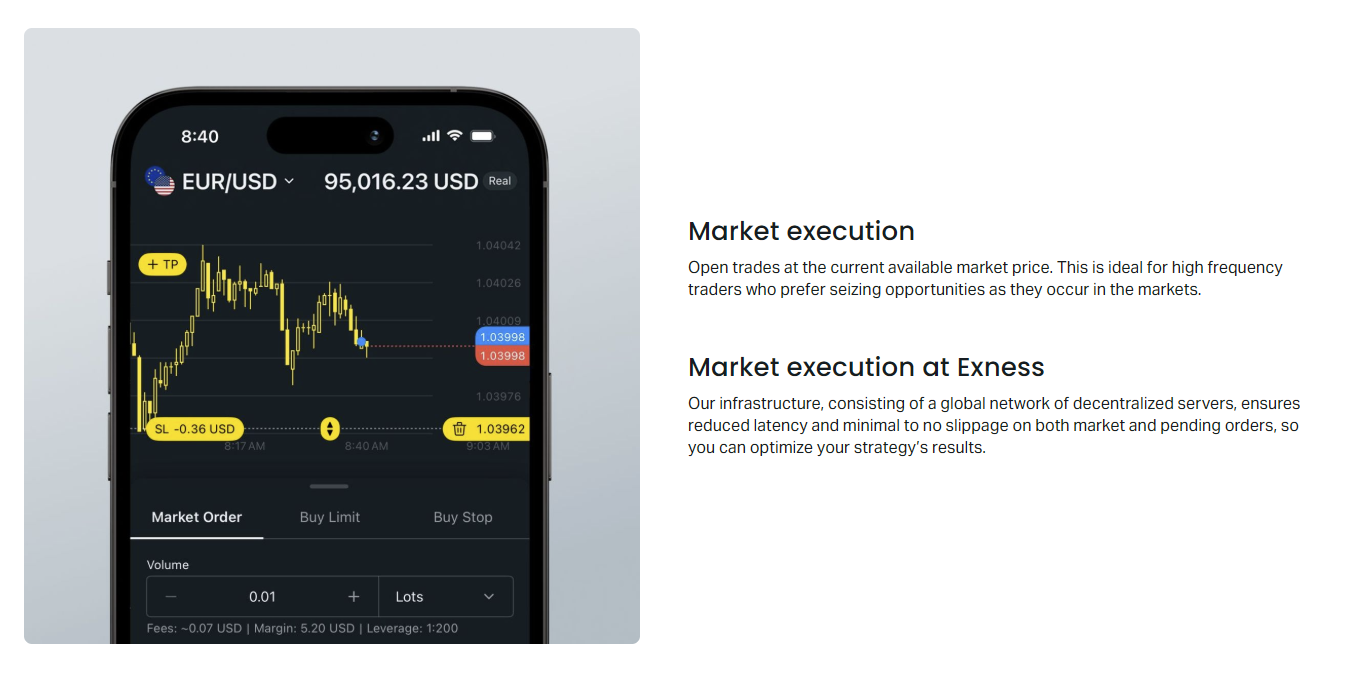
The execution-types overview shows the available order modes: market, instant, request, and exchange execution. For GBPUSD, market execution is the default on Raw Spread, Zero, and Pro accounts, ensuring the fastest possible fill. Instant execution is available on Standard accounts but may result in requotes during fast markets. Understanding the execution type helps set realistic expectations for slippage and fill certainty.
Consistent execution quality matters more than a single pip of spread savings over hundreds of trades.
Funding, Withdrawals, and Account Security
Exness supports a wide range of deposit and withdrawal methods, including bank cards, electronic wallets (Skrill, Neteller, WebMoney), and local payment systems in many jurisdictions. Most methods process instantly for deposits and within a few hours for withdrawals, with no internal fees. The broker segregates client funds from operational capital and participates in compensation schemes where applicable.
Strategy Considerations for GBPUSD on Exness
Developing a GBPUSD strategy on Exness involves matching the account type to the trading style. Scalpers and high-frequency traders benefit from Raw Spread or Zero accounts with market execution and VPS hosting. Swing traders may prefer Pro or Standard accounts for simplicity and lower per-trade friction at wider stops. Algorithmic traders should test EAs on the MetaTrader 5 strategy tester using real tick data from Exness servers to validate performance under actual spread and slippage conditions.
- Scalping: Raw Spread/Zero, VPS, M1–M5 timeframes, tight stops
- Day trading: Pro/Raw Spread, M15–H1, session-based filters
- Swing trading: Pro/Standard, H4–D1, wider stops, swap awareness
- Algorithmic: MT5, tick-data backtest, commission-inclusive optimization
Risk-per-trade discipline remains paramount. A common guideline is to risk no more than 1–2% of account equity on a single GBPUSD position. The trading calculator simplifies converting this risk percentage into a lot size based on the planned stop-loss distance in pips. Traders should also factor in correlation with other open positions (e.g., EURUSD, GBPJPY) to avoid unintended portfolio concentration.
Comparing GBPUSD Conditions Across Brokers
When benchmarking Exness against other brokers for GBPUSD, compare the all-in cost (spread + commission), execution speed, slippage statistics, and platform stability. Exness publishes quarterly execution reports that detail average fill time, slippage distribution, and requote rates. Independent audit firms verify these metrics, providing transparency that many competitors do not offer.
Scroll horizontally to see all columns
| Broker | Account Type | Avg Spread (pips) | Commission (per lot round turn) | Effective Cost (pips) |
|---|---|---|---|---|
| Exness | Raw Spread | 0.1 | $3.5 | 0.45 |
| Exness | Zero | 0.0 | $5.0 | 0.50 |
| Competitor A | ECN | 0.2 | $6.0 | 0.80 |
| Competitor B | Standard | 1.2 | $0.0 | 1.20 |
The table illustrates how a low spread combined with a reasonable commission often beats a zero-spread account with high commission, depending on trade frequency and volume. Exness Raw Spread accounts frequently deliver the lowest effective cost for active GBPUSD traders. Always verify current rates on the broker's website, as pricing structures change.
Transparency in execution reporting separates brokers who compete on quality from those who compete on marketing.
Mobile Trading Experience for GBPUSD
The Exness mobile app and MetaTrader mobile versions provide full charting, order management, and account monitoring on iOS and Android. Push notifications alert traders to price levels, margin calls, and news events. The app includes a simplified version of the trading calculator and quick access to deposit/withdrawal functions. For GBPUSD traders who monitor the market during commutes or away from their desk, the mobile experience is responsive and feature-complete.
Educational Resources and Market Analysis
Exness maintains an education hub with articles, video tutorials, and webinars covering forex basics, technical analysis, and risk management. The economic calendar highlights upcoming UK and US data releases that move GBPUSD. Trading Central webinars often focus on live analysis of major pairs, including Cable. These resources help traders of all experience levels refine their approach without leaving the broker ecosystem.
- Beginner guides: pips, lots, leverage, margin
- Advanced: order flow, market structure, algorithmic trading
- Daily market outlook: technical and fundamental drivers for GBPUSD
- Webinar archive: recorded sessions on strategy and psychology
Traders should treat educational content as a supplement to, not a substitute for, independent research and backtesting. The most reliable edge comes from a personally validated process that accounts for individual risk tolerance, time availability, and capital constraints.
Frequently Asked Questions
What is the typical spread for GBPUSD on Exness Raw Spread accounts?
During the London–New York overlap, the spread often ranges from 0.0 to 0.2 pips before commission.
Which Exness account type is best for scalping GBPUSD?
Raw Spread or Zero accounts with market execution and VPS hosting provide the lowest all-in cost and fastest fills for scalping.
Does Exness charge swap fees for holding GBPUSD overnight?
Yes, swap rates apply and vary by account type. Raw Spread and Zero accounts generally offer more favorable swap terms than Standard accounts.
Can I trade GBPUSD on the Exness mobile app?
Yes, the Exness mobile app and MetaTrader mobile apps support full GBPUSD trading with charting, orders, and alerts.
What is the maximum leverage for GBPUSD on Exness?
Up to 1:2000 for Standard and Pro accounts (subject to equity thresholds) and up to 1:500 for Raw Spread and Zero accounts.
How fast are withdrawals processed for GBPUSD profits?
Most e-wallet withdrawals are instant after internal processing; bank cards and wire transfers take 1–5 business days depending on the provider.
Is there a minimum deposit to trade GBPUSD on Exness?
The minimum deposit varies by payment method and region but can be as low as $1 for Standard Cent accounts.
Final Assessment of Exness GBPUSD Trading
Exness delivers a compelling package for GBPUSD traders: raw spreads with transparent commissions, market execution backed by published statistics, multiple platform choices, and integrated research tools. The broker's focus on execution quality and cost efficiency aligns well with the demands of trading a highly liquid major pair. Whether you are a scalper seeking the lowest all-in cost, a swing trader valuing swap transparency, or an algorithmic developer needing reliable tick data, Exness provides the infrastructure to support a professional approach. As with any leveraged product, disciplined risk management and continuous strategy validation remain the trader's responsibility.