

Forex Trading Accounts
Exness ECN Account: Features, Costs, and Trading Conditions
A detailed breakdown of the Exness ECN account offering for serious traders seeking raw spreads and direct market access.

Forex Analyst
Forex Analyst specializing in currency markets, market trends, technical and fundamental analysis, and providing clear insights to help traders make informed decisions.
The Exness ECN account is designed for traders who prioritize direct market access, transparent pricing, and execution speed. Unlike standard accounts that operate on a dealing desk model, this account type routes orders straight to liquidity providers, eliminating potential conflicts of interest. The result is a trading environment where spreads reflect genuine interbank conditions and commissions replace markup-based pricing. For algorithmic traders, scalpers, and high-volume participants, these characteristics can meaningfully affect profitability over time.
Contents
- What Is the Exness ECN Account
- ECN Account vs Other Exness Account Types
- Spreads and Commission Structure
- Execution Model and Trading Technology
- Platform Compatibility: MT4, MT5, and Web Terminal
- Minimum Deposit and Account Requirements
- Leverage, Margin, and Risk Management
- Available Trading Instruments
- Deposit and Withdrawal Options
- Advantages and Limitations
- Who Should Consider This Account
- Regulatory Framework and Client Protection
- Risk Considerations for ECN Trading
- Final Assessment of Exness ECN Account
Exness positions its ECN offering under the Raw Spread and Zero account categories, both of which share core ECN attributes while differing in commission structure and minimum deposit requirements. Understanding these nuances helps traders select the variant that aligns with their strategy, capital, and risk tolerance. This article examines every practical aspect of the Exness ECN account, from cost calculations and platform compatibility to execution quality and regulatory safeguards.
Traders evaluating ECN accounts often compare multiple brokers on spreads, commissions, slippage, and technological infrastructure. Exness has invested heavily in low-latency connectivity, co-located servers, and partnerships with top-tier liquidity venues. These investments aim to deliver the tight spreads and fast fills that ECN traders expect. The following sections break down each component so you can assess whether this account type fits your trading approach.
Before diving into specifics, it is worth noting that ECN trading carries inherent risks. Market depth can vary during news events, spreads may widen significantly, and commissions add a fixed cost per trade that must be overcome before profit begins. The sections ahead address these realities without promotional language, focusing on verifiable features and structural characteristics.
What Is the Exness ECN Account
The Exness ECN account operates on an Electronic Communication Network model, meaning client orders are matched directly with liquidity providers such as banks, hedge funds, and other institutional participants. There is no dealing desk intervention, no requotes, and no artificial spread widening by the broker. Pricing comes from aggregated liquidity pools, and the broker earns revenue through a transparent commission per lot traded rather than embedding costs into the spread.
Exness offers two primary ECN-style accounts: Raw Spread and Zero. The Raw Spread account features commissions starting from $3.5 per lot per side with spreads from 0.0 pips on major pairs. The Zero account offers fixed commission of $3.5 per lot per side (or $7 round turn) with spreads also starting from 0.0 pips, but includes a commission-free period for the first 30 days on certain instruments. Both accounts support market execution, hedging, and all order types including limit, stop, and trailing stops.
A defining characteristic of true ECN accounts is the visibility of market depth. While Exness does not provide a full Level 2 order book within MetaTrader, the pricing engine reflects real-time liquidity conditions. During high volatility, spreads widen naturally as liquidity providers adjust quotes. This behavior distinguishes ECN from fixed-spread or market-maker models where the broker controls the spread displayed to clients.
The ECN account supports all major asset classes available at Exness: forex pairs, metals, energies, indices, stocks, and cryptocurrencies. Each instrument has its own liquidity profile, so spread and commission behavior varies. Forex majors typically show the tightest spreads, while exotic pairs and cryptocurrencies carry wider spreads reflecting lower liquidity depth.
ECN Account vs Other Exness Account Types
Exness provides several account categories: Standard, Standard Cent, Pro, Raw Spread, and Zero. The Standard and Standard Cent accounts use instant or market execution with spreads that include a broker markup and no commission. The Pro account offers lower spreads than Standard but still operates on a spread-only model. Raw Spread and Zero are the only accounts built on ECN architecture with commission-based pricing.
The key differentiator is cost structure. On a Standard account, the EURUSD spread might average 1.0 pip with no commission. On a Raw Spread account, the same pair could show 0.1 pip spread plus $3.5 commission per lot per side. For a trader executing 10 lots round turn, the Standard account costs approximately $100 in spread (1 pip × $10 per pip × 10 lots), while the Raw Spread account costs $70 in commission plus $10 in spread, totaling $80. The savings scale with volume.
Execution model also differs. Standard accounts may use instant execution for certain order types, allowing requotes during fast markets. ECN accounts use market execution exclusively, meaning orders fill at the best available price without requotes, but slippage can occur. This is a trade-off: certainty of fill price versus certainty of fill itself.
Minimum deposits vary significantly. Standard Cent accounts open with $1, Standard with $10, Pro with $200, while Raw Spread and Zero require $200 minimum. The higher threshold reflects the professional orientation of ECN accounts and the expectation that users understand commission math and margin requirements.
Scroll horizontally to see all columns
| Account Type | Execution Model | Pricing Model | Min Deposit | Typical EURUSD Spread |
|---|---|---|---|---|
| Standard Cent | Instant/Market | Spread only | $1 | 1.0 pip |
| Standard | Instant/Market | Spread only | $10 | 1.0 pip |
| Pro | Market | Spread only | $200 | 0.5 pip |
| Raw Spread | Market (ECN) | Commission + spread | $200 | 0.0-0.1 pip |
| Zero | Market (ECN) | Commission + spread | $200 | 0.0 pip |
The table above summarizes structural differences. Note that spreads are indicative averages and fluctuate with market conditions. Commission rates shown apply to forex majors; other instruments may have different commission schedules.
Spreads and Commission Structure
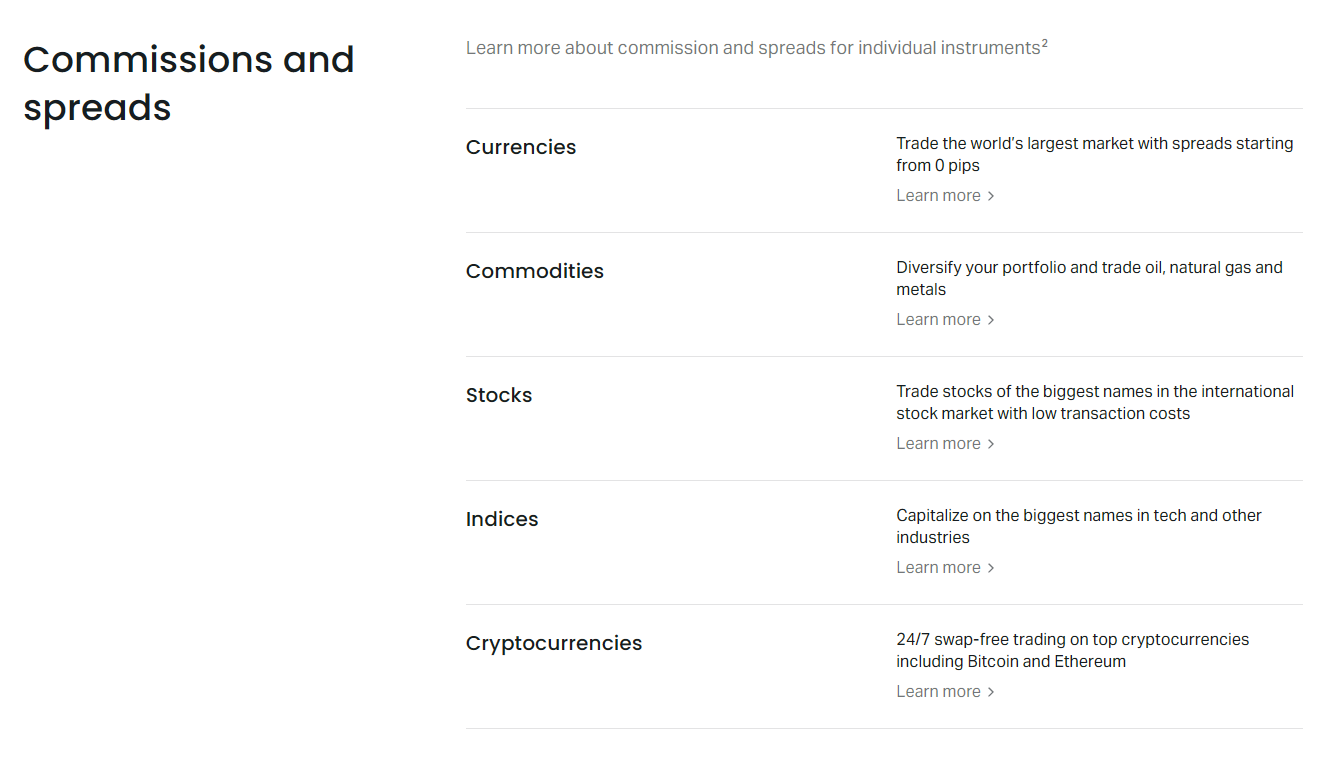
Spreads on the Exness ECN account are variable and determined by liquidity provider quotes. During the London-New York overlap, major pairs like EURUSD, GBPUSD, and USDJPY frequently trade at 0.0 to 0.2 pips. Outside peak hours, spreads widen to 0.5-1.5 pips. The Zero account maintains 0.0 pip spreads on top forex pairs during most trading hours, while Raw Spread shows slightly wider raw spreads but identical commission.
Commission is charged per lot per side. For forex majors, the rate is $3.5 per lot per side ($7 round turn). Metals, energies, and indices carry higher commissions reflecting wider spreads and different liquidity profiles. For example, gold (XAUUSD) commission is typically $5 per lot per side. Cryptocurrency commissions vary by coin and can reach $10-15 per lot per side due to lower liquidity and higher operational costs.
Calculating total trading cost requires adding spread cost and commission. Spread cost equals spread in pips × pip value × lots traded. For EURUSD, one pip on a standard lot equals $10. If the spread is 0.2 pips and you trade 5 lots, spread cost is 0.2 × $10 × 5 = $10. Commission on 5 lots round turn is $3.5 × 2 × 5 = $35. Total cost: $45. On a Standard account with 1.0 pip spread, the same trade costs 1.0 × $10 × 5 = $50 with no commission. The ECN advantage grows with tighter spreads and higher volume.
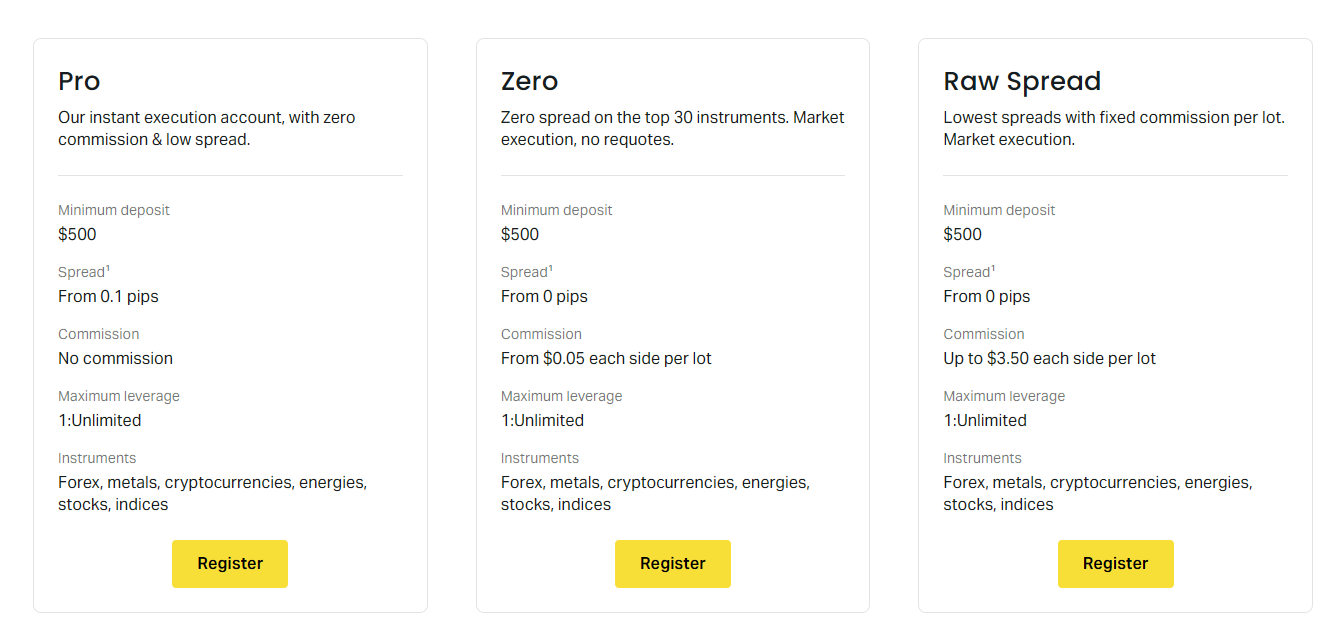
The image above illustrates the commission and spread tiers across account types. Note that the Zero account offers a promotional commission-free period for new clients on select instruments, which can reduce initial trading costs during evaluation.
Swap rates (overnight financing) apply to positions held past 23:59 server time. ECN accounts use the same swap calculation as other account types, derived from interbank interest rate differentials plus a broker markup. Swap-free status is available for Islamic accounts upon request and approval, which removes overnight charges but may widen spreads slightly on certain instruments.
Execution Model and Trading Technology
Execution quality is the cornerstone of any ECN offering. Exness routes orders through its aggregation engine to a pool of liquidity providers including major banks and non-bank market makers. The system selects the best available price at the moment of order arrival. Market execution means no requotes, but positive and negative slippage both occur depending on market movement between order placement and fill.
Exness publishes execution statistics quarterly, showing average execution speed, slippage distribution, and fill rates. As of recent reports, over 99% of orders execute in under 100 milliseconds, with median speeds below 50ms. The broker uses Equinix data centers in London (LD4) and New York (NY4) for co-location, minimizing latency to liquidity venues. This infrastructure supports high-frequency strategies and expert advisors that depend on consistent low latency.
Order types supported include market, limit, stop, stop-limit, and trailing stops. One-cancels-other (OCO) orders are not natively supported in MetaTrader but can be implemented via custom scripts. Partial fills are possible on large orders when liquidity at the top of book is insufficient, with the remainder filled at subsequent price levels or cancelled based on order settings.
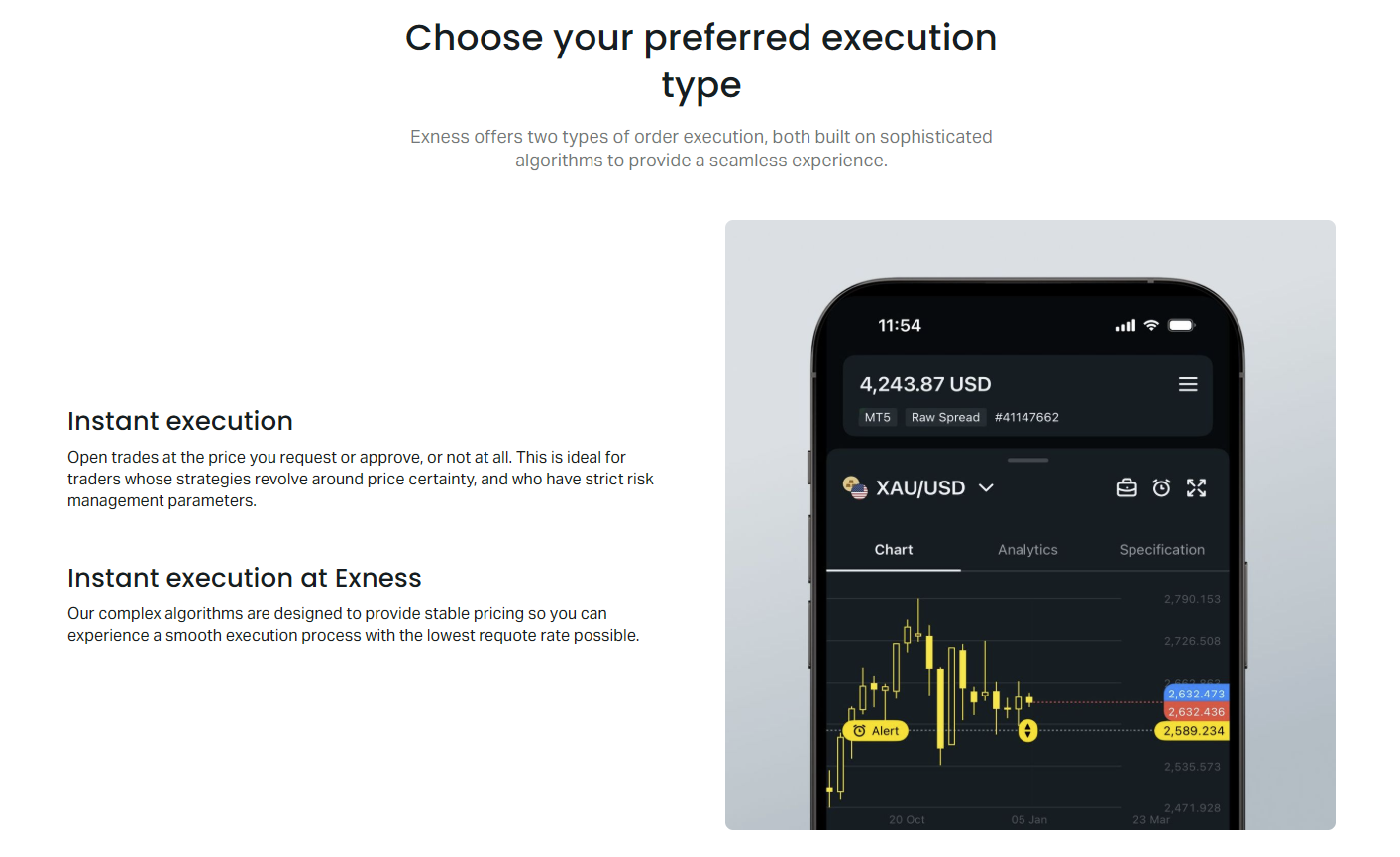
The diagram above shows how market execution routes orders directly to liquidity providers. This bypasses any dealing desk, ensuring that the broker has no incentive to delay or reject orders based on profitability.
During major news releases (NFP, CPI, central bank decisions), spreads can widen dramatically and liquidity may thin. Exness does not guarantee stop-loss execution at the exact price during such events; stops become market orders once triggered and fill at the next available price. This is standard ECN behavior and traders should adjust position sizes or use guaranteed stop-loss alternatives where available.
Execution speed alone does not guarantee profitability. Consistent low latency matters more than occasional microsecond advantages, especially for strategies holding positions beyond a few seconds.
Platform Compatibility: MT4, MT5, and Web Terminal
The Exness ECN account is accessible on MetaTrader 4, MetaTrader 5, and the proprietary Exness Web Terminal. All platforms connect to the same pricing engine and liquidity pool, so spreads, commissions, and execution are identical regardless of platform choice. The decision comes down to feature preferences, charting tools, and automation needs.
MetaTrader 4 remains popular for its vast library of custom indicators and expert advisors. It supports hedging natively and uses MQL4 for programming. However, MT4 lacks native depth of market (DOM) display, multi-currency backtesting, and modern order management features. For ECN traders who value raw spread visibility, MT4 shows only the best bid/ask without volume depth.
MetaTrader 5 adds DOM with volume, netting and hedging modes, more timeframes, built-in economic calendar, and MQL5 with object-oriented programming. The strategy tester supports multi-currency backtesting and cloud optimization. For algorithmic ECN traders, MT5 is generally superior. Exness offers both platforms with identical trading conditions.
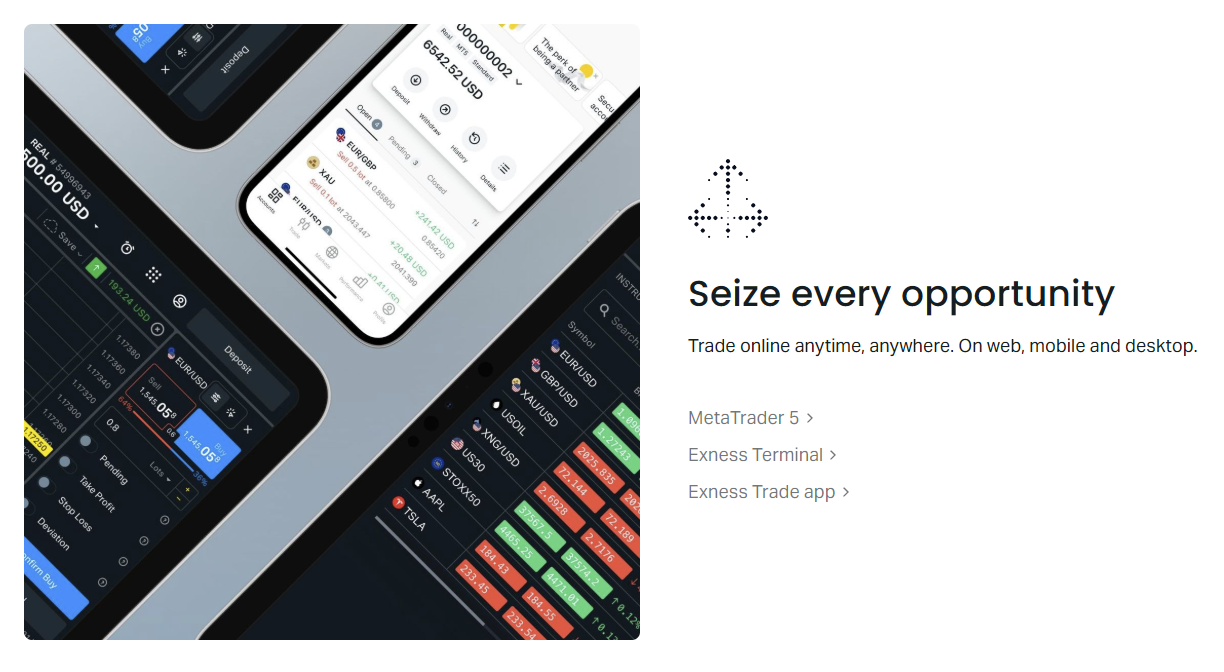
The Exness Web Terminal runs in any modern browser without installation. It provides essential charting, one-click trading, and account management. While it lacks the customization depth of desktop MetaTrader, it is useful for monitoring positions, quick entries, and traders who cannot install software. Mobile apps for iOS and Android mirror the Web Terminal functionality with push notifications and biometric login.
All platforms support the full range of order types, real-time news from FXStreet, and integrated trading signals from Trading Central. The Economic Calendar is accessible within MT5 and Web Terminal, helping ECN traders avoid unexpected volatility around scheduled events.
Minimum Deposit and Account Requirements
The Exness Raw Spread and Zero accounts both require a minimum deposit of $200 to open. This is higher than Standard ($10) and Standard Cent ($1) accounts, reflecting the professional focus. There is no maximum deposit limit. Accounts can be denominated in USD, EUR, GBP, CHF, JPY, AUD, CAD, NZD, SGD, HKD, ZAR, and several other currencies. The base currency affects swap calculations and conversion fees if deposits are made in a different currency.
Verification (KYC) is mandatory before withdrawals can be processed. This requires a government-issued ID (passport, national ID, or driver's license) and proof of address (utility bill or bank statement dated within three months). The process typically completes within a few hours during business days. Unverified accounts can deposit and trade but cannot withdraw funds.
Exness allows multiple accounts per client. You can hold Standard, Pro, Raw Spread, and Zero accounts simultaneously under the same Personal Area. This enables strategy segregation — for example, using a Standard account for swing trades with wider stops and a Raw Spread account for scalping. Funds can be transferred instantly between accounts in the same currency within the Personal Area.
Corporate accounts are available for legal entities. Requirements include certificate of incorporation, memorandum and articles of association, register of directors and shareholders, and beneficial owner identification. Corporate ECN accounts access the same trading conditions but may qualify for volume-based commission rebates through the Exness Partner or Institutional programs.
Scroll horizontally to see all columns
| Requirement | Raw Spread | Zero |
|---|---|---|
| Minimum Deposit | $200 | $200 |
| Base Currencies | 15+ options | 15+ options |
| KYC for Withdrawal | Required | Required |
| Max Leverage | 1:2000 | 1:2000 |
| Islamic Option | Available | Available |
The table shows that both ECN variants share identical structural requirements. The choice between them comes down to commission preference and whether the Zero account promotional period aligns with your onboarding timeline.
Leverage, Margin, and Risk Management
Exness offers dynamic leverage up to 1:2000 on ECN accounts for forex majors, reducing automatically as account equity grows. The leverage tiers are: up to $999 equity — 1:2000; $1,000-$4,999 — 1:1000; $5,000-$29,999 — 1:500; $30,000-$99,999 — 1:200; above $100,000 — 1:100. Metals, energies, indices, stocks, and crypto have fixed maximum leverage regardless of equity: typically 1:200 for gold, 1:100 for other metals and energies, 1:50 for indices, 1:20 for stocks, and 1:10 for cryptocurrencies.
Margin requirements follow the leverage schedule. For a 1 lot EURUSD position at 1:2000 leverage, required margin is $5 (100,000 / 2000). At 1:100 leverage, the same position requires $1,000 margin. The dynamic leverage system means a growing account automatically faces higher margin requirements, which can trigger stop-outs if positions are not adjusted. Traders must monitor the margin level (equity / used margin × 100%) in the platform.
Stop-out level on Exness ECN accounts is 0%. This means positions are closed automatically when margin level reaches 0%, not at a higher threshold like 20% or 50% seen at some brokers. While this provides maximum capital efficiency, it also means accounts can go negative during extreme gaps if liquidity vanishes. Exness offers negative balance protection for retail clients under applicable regulations, resetting negative equity to zero at no cost to the trader.
Margin call notifications are sent when margin level falls below 100% (configurable in Personal Area). There is no forced closure at margin call; only stop-out at 0% triggers liquidation. This gives traders time to add funds or reduce exposure, but requires discipline to avoid the sudden liquidation at zero margin level.
Dynamic leverage is a double-edged sword. It allows small accounts to access meaningful position sizes, but the automatic reduction at equity milestones can catch overleveraged traders off guard. Plan position sizing for the leverage tier you will reach, not the one you start with.
Available Trading Instruments
The Exness ECN account provides access to over 100 currency pairs, including majors, minors, and exotics. Major pairs (EURUSD, GBPUSD, USDJPY, USDCHF, AUDUSD, USDCAD, NZDUSD) offer the tightest spreads and deepest liquidity. Minor pairs like EURGBP, EURJPY, GBPJPY have slightly wider spreads. Exotic pairs (USDTRY, USDZAR, USDMXN) carry significantly wider spreads and higher swap costs due to lower liquidity and higher volatility.
Metals include gold (XAUUSD), silver (XAGUSD), platinum (XPTUSD), and palladium (XPDUSD). Gold is the most actively traded with spreads often below 10 cents (0.10) during peak hours. Energies cover US Oil (WTI), UK Oil (Brent), and Natural Gas. Indices include US30, US500, USTEC, UK100, GER40, JPN225, and others. Stocks CFDs cover major US, EU, and UK equities. Cryptocurrencies include BTCUSD, ETHUSD, LTCUSD, XRPUSD, and several altcoins.
Each instrument class has distinct trading hours. Forex trades 24/5 from Monday 00:00 server time to Friday 23:59. Metals follow similar hours with a daily break. Energies and indices have exchange-based sessions with daily closes. Cryptocurrencies trade 24/7 including weekends. Spreads widen during session transitions and daily rollovers. ECN traders should be aware of these schedules to avoid unintended exposure during low-liquidity windows.
Scroll horizontally to see all columns
| Category | Examples | Typical Spread Range | Max Leverage |
|---|---|---|---|
| Forex Majors | EURUSD, GBPUSD, USDJPY | 0.0-0.5 pips | 1:2000 |
| Forex Minors | EURGBP, EURJPY, GBPJPY | 0.2-1.5 pips | 1:2000 |
| Forex Exotics | USDTRY, USDZAR, USDMXN | 5-50 pips | 1:200 |
| Metals | XAUUSD, XAGUSD | 0.10-0.50 | 1:200 |
| Energies | USOIL, UKOIL, NGAS | 0.02-0.10 | 1:100 |
| Indices | US30, US500, GER40 | 0.4-2.0 points | 1:50 |
| Stocks | AAPL, TSLA, AMZN | 0.1-0.5% of price | 1:20 |
| Cryptocurrencies | BTCUSD, ETHUSD | 0.2-1.0% | 1:10 |
Spread ranges are indicative for peak trading hours. Actual spreads vary by time of day, volatility, and liquidity conditions. Commission per lot per side applies to all instruments and is added to the spread cost.
Deposit and Withdrawal Options
Exness supports a wide range of deposit and withdrawal methods, varying by client region. Common options include bank wire transfer, credit/debit cards (Visa, Mastercard), electronic wallets (Skrill, Neteller, WebMoney, Perfect Money), and local payment systems (e.g., Pix in Brazil, UPI in India, local bank transfers in Nigeria, Kenya, Vietnam, Indonesia). Most electronic methods process deposits instantly with no fee from Exness. Bank wires take 1-3 business days and may incur intermediary bank charges.
Withdrawals are processed back to the original deposit method where possible, following anti-money laundering regulations. E-wallet withdrawals are typically instant after approval. Card refunds take 1-10 business days depending on the issuer. Bank wire withdrawals take 1-5 business days. Exness does not charge withdrawal fees, but payment processors may apply their own fees. Minimum withdrawal amounts vary by method but are generally low ($1-10 equivalent).
A notable feature is instant withdrawal processing for verified accounts using electronic methods. Once the withdrawal request passes automated checks (usually within minutes), funds are sent immediately. This applies 24/7 including weekends for supported e-wallets. Bank withdrawals follow banking hours. The Exness Personal Area shows real-time status and estimated arrival times.
Currency conversion occurs automatically if the deposit currency differs from the account base currency. Exness uses competitive rates but the conversion spread is not published transparently. To avoid conversion costs, deposit in your account base currency when possible. Corporate accounts may have additional documentation requirements for large transactions.
Advantages and Limitations
The primary advantages of the Exness ECN account include raw spreads from 0.0 pips, transparent commission-based pricing, no dealing desk intervention, market execution with no requotes, high leverage up to 1:2000 (dynamic), instant withdrawals on e-wallets, and access to MT4, MT5, and Web Terminal. The broker's regulatory licenses from FCA (UK), CySEC (Cyprus), FSCA (South Africa), and CBCS (Curaçao) provide oversight across multiple jurisdictions.
Limitations include the $200 minimum deposit (higher than Standard accounts), commission costs that add up on high-frequency strategies, variable spreads that can widen dramatically during news, no guaranteed stop-loss orders, dynamic leverage that reduces automatically, and no native Level 2 order book in MetaTrader. The Zero account promotional commission-free period has eligibility conditions and expires after 30 days.
For scalpers, the commission per trade must be overcome by spread savings. A round-turn commission of $7 on EURUSD requires the ECN spread to be at least 0.7 pips tighter than a Standard account spread to break even. During low-volatility periods when Standard spreads compress, this threshold may not be met. Traders should analyze their typical trading hours and compare real spread data.
Algorithmic traders benefit from the low-latency infrastructure and lack of requotes. However, the absence of native DOM in MT4 and limited DOM in MT5 (showing only Exness liquidity, not full market depth) means order flow analysis is constrained. Traders requiring full market depth may need external data feeds or platforms.
The ECN model aligns broker and trader incentives: the broker profits from volume, not from client losses. This structural alignment is the strongest argument for ECN accounts, provided the trader has sufficient volume to offset commissions.
Who Should Consider This Account
The Exness ECN account suits traders who execute sufficient volume for commission savings to exceed spread markup savings, use strategies requiring market execution without requotes (scalping, high-frequency, news trading), value transparent pricing over simplicity, maintain account equity above $200 comfortably, and understand margin dynamics including dynamic leverage tiers and 0% stop-out.
Day traders and scalpers benefit most from tight spreads and fast execution. A trader doing 50 lots per month on EURUSD saves approximately $350-500 monthly versus a Standard account, assuming 0.5-0.7 pip spread advantage. Swing traders holding positions for days or weeks care less about spread width and more about swap rates, which are identical across account types. For them, the Standard or Pro account may be more cost-effective due to zero commission.
Algorithmic traders using expert advisors on MT5 gain from the netting/hedging flexibility, better backtesting, and DOM visibility. MT4 EA users can still operate but miss DOM data. Copy trading and social trading followers should check whether the signal provider uses an ECN account; copying from a Standard account onto an ECN account (or vice versa) can produce different results due to spread and execution differences.
Beginners with small capital may find the $200 minimum and commission math challenging. The Standard Cent account allows micro-lot trading (0.01 lots = 1,000 units) with $1 deposit, providing a lower-risk learning environment. Once consistent and volume grows, migrating to Raw Spread or Zero is a natural progression.
Regulatory Framework and Client Protection
Exness operates through multiple regulated entities. Exness (UK) Ltd is authorized by the Financial Conduct Authority (FCA) under register number 730729. Exness (Cy) Ltd is regulated by CySEC under license 178/12. Exness (ZA) Ltd is authorized by the FSCA in South Africa (FSP 51024). Exness (SC) Ltd is registered in Seychelles and regulated by the FSA. The entity serving you depends on your residence and the regulatory perimeter applicable.
Retail clients under FCA and CySEC regulation receive negative balance protection, segregation of client funds from company operational funds, and access to the Financial Ombudsman Service (UK) or Investor Compensation Fund (Cyprus) up to £85,000 / €20,000 respectively. Professional clients opting out of retail protections lose these safeguards but gain higher leverage. The ECN account is available to both retail and professional classifications.
Client funds are held in segregated accounts at top-tier banks. Exness participates in regular audits and publishes financial statements. The broker is a member of the Financial Commission, an external dispute resolution body providing compensation up to €20,000 per claim for eligible clients. These protections apply regardless of account type.
It is important to verify which Exness entity will onboard you based on your country of residence. Regulatory protections differ significantly between jurisdictions. Traders in regions served by the Seychelles or Curaçao entities do not have access to FCA/CySEC compensation schemes. The Exness website displays the applicable regulator during signup.
The image above outlines the regulatory entities and their respective client protections. Always confirm your assigned entity in the Personal Area after registration.
Risk Considerations for ECN Trading
ECN trading introduces specific risks beyond standard market risk. Variable spreads can widen to 10-20 times normal during major news, turning profitable positions into margin calls instantly. Commission costs are fixed per trade, meaning high-frequency strategies pay proportionally more in costs. A strategy profitable on a spread-only account may become unprofitable after commissions if the spread advantage is insufficient.
Slippage works both ways. Positive slippage improves fills; negative slippage worsens them. During low liquidity, market orders may fill several pips away from the expected price. Stop-loss orders become market orders when triggered and are subject to the same slippage. There is no guaranteed stop-loss on Exness ECN accounts.
The 0% stop-out level means accounts can theoretically lose more than the deposited margin during extreme gaps (e.g., CHF unpegging 2015). Negative balance protection resets the account to zero for retail clients, but the process is not instantaneous and may involve temporary negative equity. Professional clients waive this protection.
Leverage up to 1:2000 allows large positions with small margin. A 0.05% adverse move on a 1:2000 leveraged position wipes out 100% of margin. Dynamic leverage reduction at equity milestones can increase margin requirements suddenly if you cross a threshold while holding positions. Monitor the margin level indicator constantly.
Final Assessment of Exness ECN Account
The Exness ECN account delivers on the core promises of the ECN model: raw spreads, commission transparency, no dealing desk, and market execution. The infrastructure — co-located servers, multi-bank liquidity, sub-100ms execution — supports the technical demands of professional trading. The choice between Raw Spread and Zero comes down to whether you value the promotional commission-free period (Zero) or prefer the slightly different commission schedule (Raw Spread). Both provide essentially the same market access.
Cost-effectiveness depends entirely on your trading volume and style. Scalpers and high-frequency traders executing 50+ lots monthly will likely save money versus spread-only accounts. Swing traders and low-frequency participants may find commissions erode the spread advantage. The $200 minimum deposit is accessible but not trivial; the Standard Cent account remains the better starting point for new traders building experience.
Platform flexibility is a strength. MT4, MT5, Web Terminal, and mobile apps all connect to the same ECN pricing. MT5 is the superior choice for ECN traders needing depth of market and advanced testing. The Web Terminal covers essential needs for monitoring and emergency management. Exness's instant withdrawal capability on e-wallets is a practical advantage for capital management.
Regulatory coverage is broad but jurisdiction-dependent. Verify your assigned entity and the corresponding protections before funding. Negative balance protection, fund segregation, and external dispute resolution provide meaningful safeguards for retail clients. Professional clients should understand the protections they forfeit.
The Exness ECN account is a competent, well-executed offering for traders who understand commission-based pricing and need direct market access. It is not a magic solution — commissions, variable spreads, slippage, and leverage dynamics all require disciplined management. Traders who match the profile described in this analysis will find the conditions competitive and the infrastructure reliable.
Frequently Asked Questions
What is the difference between Exness Raw Spread and Zero accounts?
Both are ECN accounts with market execution and raw spreads from 0.0 pips. Raw Spread charges commission from $3.5 per lot per side. Zero charges a fixed $3.5 per lot per side ($7 round turn) and offers a 30-day commission-free promotion on select instruments for new clients.
Does Exness ECN account support hedging?
Yes, both Raw Spread and Zero accounts support hedging mode on MT4 and MT5. MT5 also offers netting mode. You can hold opposite positions on the same instrument simultaneously.
What is the minimum deposit for Exness ECN account?
The minimum deposit for both Raw Spread and Zero accounts is $200 (or equivalent in other base currencies).
Are there swap-free ECN accounts?
Yes, Islamic (swap-free) versions of Raw Spread and Zero accounts are available upon request and approval. Overnight financing charges are removed, though spreads may be slightly wider on some instruments.
What leverage is available on Exness ECN accounts?
Dynamic leverage up to 1:2000 for forex majors, reducing automatically as equity increases. Metals max 1:200, energies 1:100, indices 1:50, stocks 1:20, crypto 1:10.
How fast are withdrawals on Exness ECN accounts?
E-wallet withdrawals (Skrill, Neteller, etc.) are processed instantly 24/7 after automated verification. Card refunds take 1-10 business days. Bank wires take 1-5 business days.
Can I use expert advisors on Exness ECN account?
Yes, both MT4 and MT5 support expert advisors on ECN accounts. No restrictions on scalping, hedging, or algorithmic trading. VPS hosting is available for low-latency EA operation.
Is there a Level 2 order book on Exness MT4 or MT5?
MT4 does not have native DOM. MT5 includes Depth of Market showing Exness liquidity provider prices and volumes, but not a full aggregated market order book.