
Forex & CFD Trading
Exness Indices Trading: Complete Guide to Global Index CFDs
Discover available indices, trading conditions, platforms, and account types for index CFD trading on Exness.

Forex Analyst
Forex Analyst specializing in currency markets, market trends, technical and fundamental analysis, and providing clear insights to help traders make informed decisions.
Exness indices trading provides access to major global stock market benchmarks through contracts for difference (CFDs). Traders can speculate on price movements of indices like the US Tech 100, US 500, US 30, Germany 40, UK 100, and Japan 225 without owning the underlying assets. This approach allows participation in broad market trends with flexible position sizing and the ability to trade both rising and falling markets.
Contents
- Available Index Instruments on Exness
- Trading Nasdaq and Major US Indices on Exness
- Exness Indices Trading Conditions and Specifications
- Platforms for Index CFD Trading
- Account Types Suited for Index Trading Strategies
- Trading Hours and Session Overlaps for Indices
- Risk Management Tools for Index CFD Positions
- Analytical Resources for Index Market Analysis
- Opening Your First Index Trade on Exness
- Comparing Exness Index CFDs with Alternative Brokers
- Tax Implications and Regulatory Considerations
- Final Assessment of Exness Indices Trading
The broker offers index CFDs on its Standard, Standard Cent, Pro, Raw Spread, and Zero account types. Each account tier presents different spread and commission structures, letting traders choose conditions that match their strategy. Index instruments are available on MetaTrader 4, MetaTrader 5, the Exness Web Terminal, and the Exness Trade mobile app, ensuring accessibility across devices.
Understanding the specific symbols, trading hours, margin requirements, and cost structure is essential before placing trades. This guide covers the complete range of indices available on Exness, the trading conditions for each major instrument, platform capabilities, and practical steps to begin trading index CFDs with proper risk management.
Available Index Instruments on Exness
Exness provides CFDs on over ten major global indices covering North American, European, and Asian markets. The most actively traded instruments include the US Tech 100 (Nasdaq 100), US 500 (S&P 500), and US 30 (Dow Jones Industrial Average). European coverage features the Germany 40 (DAX), France 40 (CAC 40), UK 100 (FTSE 100), and Euro 50 (Euro Stoxx 50). Asian sessions offer the Japan 225 (Nikkei 225), Hong Kong 50 (Hang Seng), and Australia 200 (ASX 200).
- US Tech 100 — tracks the Nasdaq 100 index of large non-financial companies
- US 500 — mirrors the S&P 500 broad market benchmark
- US 30 — follows the Dow Jones Industrial Average of 30 blue-chip stocks
- Germany 40 — represents the DAX 40 leading German equities
- UK 100 — tracks the FTSE 100 largest UK-listed companies
- France 40 — covers the CAC 40 major French stocks
- Euro 50 — reflects the Euro Stoxx 50 eurozone leaders
- Japan 225 — follows the Nikkei 225 price-weighted index
- Hong Kong 50 — tracks the Hang Seng Index of Hong Kong listings
- Australia 200 — mirrors the S&P/ASX 200 Australian benchmark
Each index CFD uses a specific symbol format in the trading platforms. For example, the US Tech 100 appears as USTEC or NAS100 depending on the platform, while US 500 shows as US500 or SPX500. Traders should verify the exact symbol in their Market Watch window before opening positions. The broker does not currently offer synthetic indices or volatility indices such as the Volatility 75 Index; the available instruments track real-world exchange-traded benchmarks only.
The instrument list may vary slightly by regulatory entity and client residence. Some jurisdictions restrict access to certain CFD products. Clients should check their Personal Area or contact support to confirm which indices are available for their specific account registration. New instruments are occasionally added based on market demand and liquidity conditions.
Trading Nasdaq and Major US Indices on Exness
The US Tech 100 (Nasdaq 100) is among the most popular index CFDs on Exness due to its technology-sector concentration and high volatility. The instrument tracks the Nasdaq 100 Index, which includes 100 of the largest non-financial companies listed on the Nasdaq stock exchange. Traders often refer to this symbol as NAS100, USTEC, or US Tech 100 in platform searches. The US 500 (S&P 500) and US 30 (Dow Jones) provide broader market exposure with different sector weightings and volatility profiles.
US index CFDs on Exness follow the underlying exchange trading hours with extended sessions. The primary session runs from 9:30 AM to 4:00 PM Eastern Time, while pre-market and after-hours sessions allow trading from 4:00 AM to 8:00 PM ET. Liquidity and spreads are tightest during the main New York session. Overnight financing (swap) rates apply to positions held past the daily rollover time, which varies by instrument and account type.
- US Tech 100: High volatility, technology-weighted, popular for day trading
- US 500: Broad market representation, 500 large-cap companies across sectors
- US 30: Price-weighted index of 30 industrial and financial leaders
- Extended hours: Pre-market 4:00 AM ET, after-hours until 8:00 PM ET
- Rollover: Daily at 5:00 PM ET (New York close) for swap calculation
Margin requirements for US indices differ by account type. On Standard and Standard Cent accounts, leverage up to 1:200 is typically available for major indices, translating to a 0.5% margin requirement. Pro, Raw Spread, and Zero accounts may offer leverage up to 1:400 (0.25% margin) for the same instruments. During periods of elevated volatility or major news events, the broker may temporarily increase margin requirements to protect clients from excessive risk.
Exness Indices Trading Conditions and Specifications
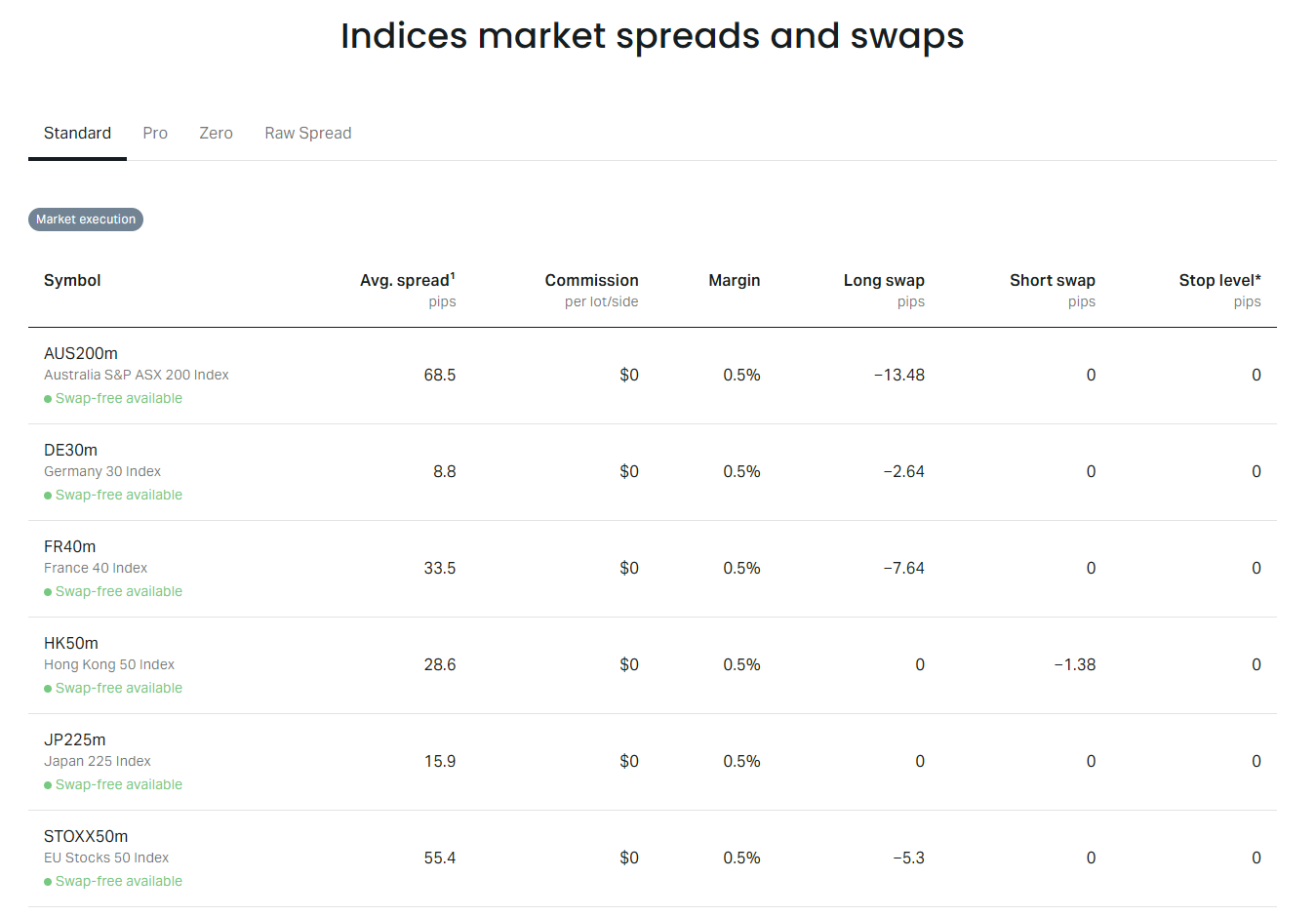
Trading conditions for index CFDs vary across account types. Standard and Standard Cent accounts use spread-only pricing with no commission, while Raw Spread and Zero accounts charge a round-turn commission per lot in exchange for tighter spreads. The Pro account offers a hybrid model with low spreads and no commission. Minimum trade size is 0.01 lots for all index instruments, allowing precise position sizing even on smaller accounts.
Scroll horizontally to see all columns
| Account Type | Pricing Model | Typical Spread (US Tech 100) | Commission | Max Leverage |
|---|---|---|---|---|
| Standard | Spread only | From 0.4 points | None | 1:200 |
| Standard Cent | Spread only | From 0.4 points | None | 1:200 |
| Pro | Low spread, no commission | From 0.2 points | None | 1:400 |
| Raw Spread | Raw spread + commission | From 0.0 points | $3.50 per side per lot | 1:400 |
| Zero | Zero spread + commission | From 0.0 points | $3.50 per side per lot | 1:400 |
Spreads are variable and widen during low-liquidity periods such as market open, major economic releases, and overnight hours. The values in the table represent typical spreads during peak liquidity. Swap rates for long and short positions differ by instrument and are published in the contract specifications within the trading platform. Islamic (swap-free) accounts are available for eligible clients, replacing overnight financing with a fixed administration fee after a grace period.
Execution quality is a key consideration for index traders. Exness uses market execution with no requotes, meaning orders fill at the best available price. The broker publishes execution statistics including slippage data and fill rates. For index CFDs, the majority of orders execute with zero or positive slippage during normal market conditions. During high-impact news, slippage can occur in either direction.
Platforms for Index CFD Trading
Exness supports index CFD trading across four platforms. MetaTrader 5 offers the most comprehensive toolset with 21 timeframes, 38 built-in indicators, depth of market, and native hedging and netting modes. MetaTrader 4 remains popular for its extensive expert advisor ecosystem and familiar interface, though it lacks depth of market and has fewer timeframes. The Exness Web Terminal runs in any modern browser with no installation required, providing full charting, one-click trading, and account management. The Exness Trade mobile app delivers a streamlined experience optimized for smartphones with push notifications and biometric login.
- MetaTrader 5: Full feature set, depth of market, 21 timeframes, hedging/netting
- MetaTrader 4: Large EA library, 9 timeframes, hedging only, widely supported
- Exness Web Terminal: Browser-based, no install, full charting, one-click trading
- Exness Trade App: Mobile-first, push alerts, biometric login, simplified UI
All platforms display real-time index prices, support technical analysis tools, and allow automated trading via expert advisors (MT4/MT5) or the Exness API. The Web Terminal and mobile app sync seamlessly with desktop platforms — charts, drawings, and indicators persist across devices. Traders can manage multiple index positions simultaneously, set pending orders, and apply trailing stops on any supported platform.
For algorithmic traders, the MetaTrader platforms support custom indicators and expert advisors written in MQL4 or MQL5. Exness also offers a free VPS service for qualifying accounts, reducing latency for automated index strategies. The VPS runs MetaTrader continuously, ensuring expert advisors operate without interruption from local internet or power issues.
Account Types Suited for Index Trading Strategies
Choosing the right account type depends on trading frequency, position size, and cost sensitivity. High-frequency scalpers and algorithmic traders often prefer Raw Spread or Zero accounts where tight spreads offset commission costs. Swing traders and position traders holding trades for days or weeks may find Standard or Pro accounts more economical due to the absence of commissions. Standard Cent accounts allow micro-lot trading (0.01 lots = 1,000 units of base currency) ideal for learning or testing strategies with minimal capital.
Scroll horizontally to see all columns
| Trader Profile | Recommended Account | Key Advantage | Consideration |
|---|---|---|---|
| Scalper / High frequency | Raw Spread / Zero | Tightest spreads, predictable costs | Commission per lot adds up |
| Swing / Position trader | Standard / Pro | No commission, simpler cost calc | Wider spreads than raw accounts |
| Beginner / Small capital | Standard Cent | Micro lots, cent-denominated balance | Limited to 1:200 leverage |
| Algorithmic / EA user | Pro / Raw Spread | VPS eligible, fast execution | Requires min. deposit for VPS |
Professional clients who meet eligibility criteria (portfolio size, trading experience, or professional background) can access higher leverage up to 1:2000 on indices, though this increases risk substantially. Retail clients remain capped at the regulatory maximums. All account types support hedging (multiple opposing positions on the same instrument) and offer negative balance protection, ensuring losses cannot exceed deposited funds.
Trading Hours and Session Overlaps for Indices
Index CFD trading hours on Exness align with the underlying exchange schedules, extended by the broker's liquidity providers. US indices trade from Sunday 22:05 to Friday 21:00 UTC with a daily break from 21:00 to 22:05 UTC. European indices follow their respective exchange hours: Germany 40 trades 07:00–21:00 UTC, UK 100 trades 08:00–16:30 UTC, and Euro 50 trades 07:00–21:00 UTC. Asian indices have shorter windows: Japan 225 trades 00:00–06:00 and 07:00–14:00 UTC, Hong Kong 50 trades 01:30–04:00 and 05:00–08:00 UTC.
- US indices: Sunday 22:05 – Friday 21:00 UTC (daily break 21:00–22:05)
- Germany 40: 07:00 – 21:00 UTC, Monday–Friday
- UK 100: 08:00 – 16:30 UTC, Monday–Friday
- Euro 50: 07:00 – 21:00 UTC, Monday–Friday
- Japan 225: 00:00–06:00 and 07:00–14:00 UTC, Monday–Friday
- Hong Kong 50: 01:30–04:00 and 05:00–08:00 UTC, Monday–Friday
- Australia 200: 22:50–06:30 UTC, Monday–Friday
The most active periods occur during session overlaps. The London–New York overlap (13:00–17:00 UTC) sees peak liquidity for US and European indices simultaneously. The Tokyo–London overlap (07:00–08:00 UTC) provides a brief window for Asian and European index correlation trades. Spreads are tightest and execution fastest during these high-volume periods. Traders should avoid the daily maintenance window (21:00–22:05 UTC) when pricing may be unavailable or spreads significantly wider.
Risk Management Tools for Index CFD Positions
Effective risk management is critical when trading leveraged index CFDs. Exness provides several built-in tools. Stop loss and take profit orders can be set at position entry or modified afterward. Trailing stops automatically adjust the stop level as price moves favorably, locking in gains while allowing room for normal fluctuations. The margin calculator in the Personal Area and trading platforms helps determine required margin before opening a trade. Negative balance protection ensures accounts cannot go below zero, a regulatory requirement for retail clients.
- Stop loss: Mandatory for risk control, set in points or price level
- Take profit: Locks in target gains automatically
- Trailing stop: Dynamic stop that follows price at fixed distance
- Margin calculator: Pre-trade margin and pip value estimation
- Negative balance protection: Account floor at zero, no debt risk
- Margin call: Notification at 100% margin level, stop out at 0%
Position sizing should account for index volatility. The US Tech 100 can move 100–300 points in a single session during earnings season or Fed announcements. A 0.1 lot position on US Tech 100 represents approximately $1 per point (varies by contract specification). Traders should calculate maximum risk per trade as a percentage of account equity — commonly 1–2% — and set stop losses accordingly. The Exness trading calculator simplifies this by computing pip value, margin, and potential profit/loss for any position size.
Index CFDs amplify both gains and losses through leverage. A 1% index move with 1:200 leverage produces a 200% account impact on full margin usage. Size positions to survive normal volatility, not just ideal scenarios.
Analytical Resources for Index Market Analysis
Exness provides integrated analytical tools to support index trading decisions. The economic calendar highlights high-impact events affecting major indices: US non-farm payrolls, FOMC meetings, CPI releases, and earnings seasons for US Tech 100 components. Trading Central signals, available in the Personal Area and platforms, offer technical analysis-based trade ideas for major indices with entry, stop, and target levels. Market news from FXStreet delivers real-time headlines and analysis covering global equity markets.
- Economic calendar: Filter by country, impact, and index-relevant events
- Trading Central: Technical signals for US Tech 100, US 500, Germany 40, others
- FXStreet news: Real-time equity market coverage and central bank commentary
- Platform indicators: 38 built-in (MT5) or 30 (MT4) plus custom indicators
- Chart templates: Save preferred index analysis layouts across devices
Traders can also access the Exness blog and education section for index-specific articles covering seasonal patterns, correlation analysis, and strategy guides. The broker's social trading platform allows copying index trades from verified strategy providers, though past performance does not guarantee future results. All analytical content is for informational purposes and does not constitute investment advice.
Opening Your First Index Trade on Exness
Starting index CFD trading on Exness involves a straightforward process. First, register an account through the website or app, completing email verification and identity verification (KYC) as required by regulation. Next, choose an account type — Standard for simplicity, Raw Spread for tight spreads with commission, or Standard Cent for micro-lot practice. Fund the account via bank card, electronic wallet, or bank transfer; most methods credit instantly. Download your preferred platform or use the Web Terminal, then locate index symbols in Market Watch.
- Register and verify identity (KYC) — typically completes within minutes
- Select account type matching your strategy and capital
- Deposit funds — minimum $1 for Standard Cent, $10 for others
- Open MetaTrader 5, MT4, Web Terminal, or Exness Trade app
- Find index symbols: USTEC/NAS100, US500/SPX500, US30/DJ30, etc.
- Analyze charts, set position size, apply stop loss and take profit
- Execute buy (long) or sell (short) order at market or pending price
Demo accounts are available for all platform types and replicate live conditions with virtual funds. This allows risk-free practice of index strategies, platform familiarization, and testing of expert advisors. Demo accounts do not expire but may be archived after prolonged inactivity. Transitioning to live trading requires a verified account and minimum deposit. The Exness Personal Area manages all accounts, deposits, withdrawals, and settings in one dashboard.
Comparing Exness Index CFDs with Alternative Brokers
When evaluating Exness for index trading, several factors stand out. The broker offers among the lowest typical spreads on major indices, especially on Raw Spread and Zero accounts where spreads can approach zero during peak hours. Commission rates of $3.50 per side per lot are competitive with industry averages. Execution speed averages under 25 milliseconds on major indices, with published slippage statistics showing predominantly zero or positive slippage. The range of platforms (MT4, MT5, Web, Mobile) exceeds many competitors who offer only one or two options.
Scroll horizontally to see all columns
| Feature | Exness | Typical Industry Range |
|---|---|---|
| Number of index CFDs | 10+ major global indices | 8–15 indices |
| US Tech 100 min spread (Raw/Zero) | 0.0 points | 0.0–0.5 points |
| Commission per lot (round turn) | $7.00 | $6.00–$10.00 |
| Max leverage (retail) | 1:200–1:400 | 1:20–1:500 |
| Platforms supported | 4 (MT4, MT5, Web, App) | 2–3 platforms |
| Negative balance protection | Yes (all retail) | Varies by regulator |
| VPS for algorithmic trading | Free for qualifying accounts | Often paid or unavailable |
Areas where traders may find limitations include the absence of synthetic indices, volatility indices, and micro-index futures. Some competitors offer a wider selection of sector-specific or regional indices. Exness also does not provide direct market access (DMA) or exchange-traded futures — all index products are OTC CFDs. For traders requiring these specific instruments, a multi-broker approach may be necessary.
Exness distinguishes itself through execution transparency and cost efficiency on major indices. The combination of raw spreads, low commissions, and multi-platform access creates a compelling package for index-focused traders.
Tax Implications and Regulatory Considerations
Tax treatment of index CFD profits varies by country of residence. In many jurisdictions, CFD gains are subject to capital gains tax or income tax depending on trading frequency and classification. Some countries treat CFDs as gambling winnings (tax-free), while others apply standard investment tax rates. Exness does not provide tax advice and does not withhold taxes on trading profits. Clients are responsible for maintaining records and complying with local tax obligations. The Personal Area provides account statements and trade history exports suitable for tax reporting.
- CFD tax treatment differs by country — consult a local tax professional
- Exness provides trade history exports (CSV, PDF) for record-keeping
- No tax withholding by broker — client responsibility entirely
- Regulatory protection depends on registering entity (CySEC, FCA, FSCA, etc.)
- Retail leverage caps apply per regulator (ESMA: 1:20 for major indices)
Regulatory oversight depends on which Exness entity holds the account. European clients typically fall under Exness (Cy) Ltd regulated by CySEC with ESMA leverage limits (1:20 for major indices). Other regions may be served by entities regulated by the FCA (UK), FSCA (South Africa), FSA (Seychelles), or CBCS (Curaçao), each with different leverage caps and investor protection schemes. Clients should verify their registering entity in the Personal Area and understand the applicable protections.
Final Assessment of Exness Indices Trading
Exness indices trading delivers a competitive offering for CFD traders seeking exposure to global equity benchmarks. The broker combines tight spreads, flexible account types, multi-platform access, and strong execution quality across ten-plus major indices. US Tech 100, US 500, and US 30 provide deep liquidity and tight pricing during New York hours, while European and Asian indices cover global sessions. The absence of synthetic or volatility indices narrows the product range compared to some specialists, but the core major-index lineup meets the needs of most directional and hedging strategies. Traders should match account type to their cost structure preferences, verify regulatory leverage limits for their jurisdiction, and apply disciplined risk management given the leveraged nature of CFDs.
Frequently Asked Questions
Does Exness have Nasdaq 100 for trading?
Yes, Exness offers the US Tech 100 CFD which tracks the Nasdaq 100 Index. The symbol appears as USTEC or NAS100 in MetaTrader platforms.
What is the Exness Nasdaq symbol in MT5?
In MetaTrader 5, the Nasdaq 100 index CFD is typically listed as USTEC or NAS100. Check Market Watch → Symbols → Indices for the exact name.
Does Exness offer synthetic indices or Volatility 75 Index?
No, Exness does not currently offer synthetic indices or the Volatility 75 Index. Available index CFDs track real-world exchange-traded benchmarks only.
What leverage is available for index CFDs on Exness?
Retail clients can access up to 1:200 on Standard accounts and 1:400 on Pro, Raw Spread, and Zero accounts for major indices, subject to regulatory caps in their jurisdiction.
Are there commissions on index trades at Exness?
Standard and Standard Cent accounts use spread-only pricing with no commission. Raw Spread and Zero accounts charge $3.50 per side per lot ($7 round turn) for tighter spreads.
Can I trade indices on the Exness mobile app?
Yes, the Exness Trade mobile app supports full index CFD trading with charting, order management, and push notifications for price alerts.
What are the trading hours for US indices on Exness?
US index CFDs trade Sunday 22:05 to Friday 21:00 UTC with a daily break from 21:00–22:05 UTC. Extended hours cover pre-market and after-hours sessions.
Does Exness offer swap-free accounts for index trading?
Yes, Islamic (swap-free) accounts are available for eligible clients. These replace overnight financing with a fixed administration fee after a grace period.