

Forex Trading Education
Exness Lot Size Guide for Forex and CFD Traders
Complete breakdown of lot sizes, contract specifications, and calculation methods on Exness.

Forex Analyst
Forex Analyst specializing in currency markets, market trends, technical and fundamental analysis, and providing clear insights to help traders make informed decisions.
Understanding lot size is fundamental to trading on Exness. Every position you open is measured in lots, which determine your market exposure, pip value, and risk per trade. Whether you trade forex pairs, metals, indices, or cryptocurrencies, the lot size you choose directly affects your potential profit and loss. This guide explains how lot sizes work on Exness, the minimum requirements for each account type, how to calculate position sizes, and practical ways to manage risk through proper sizing.
Contents
- Understanding Lot Sizes on Exness
- Standard Lot vs Mini Lot vs Micro Lot
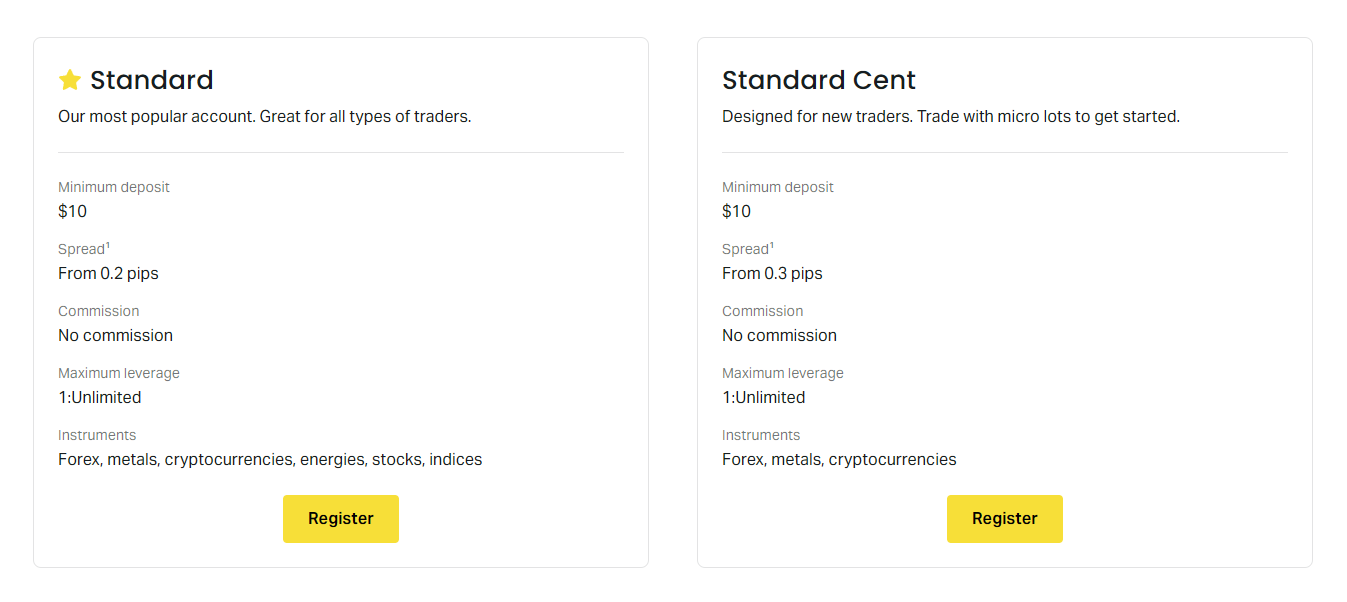
- Exness Minimum Lot Requirements by Account Type
- Calculating Pip Value for Different Lot Sizes
- Exness 1 Lot Price Across Major Instruments
- Exness 0.01 Lot Price for Micro Trading
- Using the Exness Lot Size Calculator
- Position Sizing and Risk Management
- Lot Size Limits for Different Asset Classes
- Leverage Impact on Lot Size Selection
- Common Lot Size Mistakes to Avoid
- Adjusting Lot Size for Volatility and News Events
- Scaling In and Out with Multiple Lot Sizes
- Final Assessment of Exness Lot Size Options
Exness offers flexible lot sizing across its account types, allowing both beginners and experienced traders to scale positions according to their strategy and capital. Standard accounts typically start at 0.01 lots, while cent accounts allow even smaller increments. Professional accounts such as Raw Spread and Zero provide raw pricing with commission-based structures, where lot size determines the commission charged per round turn. Knowing these details helps you select the right account and position size for your trading goals.
The concept of lot size originated in the interbank forex market, where a standard lot represents 100,000 units of the base currency. Retail brokers like Exness fractionalized this unit into mini lots (0.1), micro lots (0.01), and even nano lots (0.001) on cent accounts. This fractionalization lets traders with modest capital participate in the same markets as institutional players. On Exness, the maximum lot size per position can reach 200 lots on major forex pairs, though margin requirements and leverage settings will constrain the actual size you can open.
Understanding Lot Sizes on Exness
A lot is a standardized unit of measurement for trade volume. On Exness, one standard lot equals 100,000 units of the base currency for forex pairs. For example, buying 1 lot of EURUSD means purchasing 100,000 euros. Mini lots represent 10,000 units (0.1 lot), micro lots represent 1,000 units (0.01 lot), and nano lots represent 100 units (0.001 lot). The platform displays volume in lots, and you can enter fractional values such as 0.25 or 0.37 depending on your precision needs.
- Standard lot: 100,000 units of base currency (1.00 lot)
- Mini lot: 10,000 units of base currency (0.10 lot)
- Micro lot: 1,000 units of base currency (0.01 lot)
- Nano lot: 100 units of base currency (0.001 lot, cent accounts only)
For non-forex instruments, the contract specification defines what one lot represents. One lot of gold (XAUUSD) equals 100 troy ounces. One lot of US crude oil (USOIL) equals 1,000 barrels. One lot of a stock CFD typically equals 1 share, though this varies by symbol. Indices and cryptocurrencies have their own contract sizes listed in the Exness contract specifications. Always check the specific instrument details before trading to confirm the exact lot definition.
Lot size is the lever that connects your account equity to market movement. Choose it with the same care you apply to entry and exit decisions.
Standard Lot vs Mini Lot vs Micro Lot
The choice between standard, mini, and micro lots depends on your account balance, risk tolerance, and trading style. A standard lot on EURUSD moves approximately $10 per pip. A mini lot moves $1 per pip. A micro lot moves $0.10 per pip. This linear relationship makes it easy to scale position size to match your desired risk per trade. For instance, if you want to risk $50 on a 50-pip stop loss, you would trade 0.10 lots (mini lot) on EURUSD.
Scroll horizontally to see all columns
| Lot Size | Units | EURUSD Pip Value | GBPUSD Pip Value | USDJPY Pip Value |
|---|---|---|---|---|
| 1.00 (Standard) | 100,000 | $10.00 | $10.00 | ~$9.00 |
| 0.10 (Mini) | 10,000 | $1.00 | $1.00 | ~$0.90 |
| 0.01 (Micro) | 1,000 | $0.10 | $0.10 | ~$0.09 |
| 0.001 (Nano) | 100 | $0.01 | $0.01 | ~$0.009 |
Pip values for JPY pairs differ because the pip is the second decimal place (0.01) rather than the fourth (0.0001). The approximate values above assume USD as the account currency. If your account is denominated in another currency, the pip value will be converted at the current exchange rate. Exness displays the pip value for each symbol in the Market Watch window and in the order ticket, so you can verify the exact figure before placing a trade.
Exness Minimum Lot Requirements by Account Type
Exness sets minimum lot sizes that vary by account type and instrument. Standard and Standard Cent accounts allow a minimum of 0.01 lots for forex. On Standard Cent, the minimum can go down to 0.001 lots (nano lots) because the account currency is cents, effectively reducing the monetary value of each lot by a factor of 100. Professional accounts — Raw Spread, Zero, and Pro — also start at 0.01 lots for forex. Some exotic pairs or CFDs may have higher minimums due to liquidity constraints.
The table below summarizes typical minimum lot sizes across Exness account types for major forex pairs. Always verify the current specification in your trading terminal, as brokers occasionally adjust minimums based on market conditions.
Scroll horizontally to see all columns
| Account Type | Forex Min Lot | Metals Min Lot | Indices Min Lot | Crypto Min Lot |
|---|---|---|---|---|
| Standard Cent | 0.001 | 0.01 | 0.10 | 0.10 |
| Standard | 0.01 | 0.01 | 0.10 | 0.10 |
| Pro | 0.01 | 0.01 | 0.10 | 0.10 |
| Raw Spread | 0.01 | 0.01 | 0.10 | 0.10 |
| Zero | 0.01 | 0.01 | 0.10 | 0.10 |
Cent accounts are unique because the account balance is denominated in cents. A $100 deposit shows as 10,000 cents. This means a 0.01 lot on a cent account has the same monetary exposure as a 0.0001 lot on a standard dollar account. For absolute beginners, cent accounts provide the lowest barrier to entry while still experiencing real market conditions, including spreads, swaps, and execution speed.
Calculating Pip Value for Different Lot Sizes
Pip value calculation is essential for risk management. The formula for forex pairs where USD is the quote currency (EURUSD, GBPUSD, AUDUSD, NZDUSD) is straightforward: Pip Value = Lot Size × 100,000 × 0.0001. For a 0.01 lot, this equals $0.10 per pip. For pairs where USD is the base currency (USDJPY, USDCHF, USDCAD), the formula divides by the current exchange rate: Pip Value = (Lot Size × 100,000 × 0.01) / Current Price for JPY pairs, or 0.0001 for others.
- Identify the quote currency of the pair
- Determine the pip increment (0.0001 for most, 0.01 for JPY)
- Multiply lot size by contract size (100,000) by pip increment
- Convert to account currency if different from quote currency
Cross pairs (EURGBP, EURJPY, GBPJPY) require an extra conversion step because the quote currency is not USD. The pip value in the quote currency is calculated first, then converted to your account currency using the current cross rate. Exness trading calculators automate this process, but understanding the mechanics helps you estimate risk quickly without tools. For metals, one pip on a standard lot of gold (100 oz) equals $10 per $1 price move. For oil, one pip on a standard lot (1,000 barrels) equals $10 per $0.01 price move.
If you cannot calculate the pip value of your position in under ten seconds, you are trading with unknown risk.
Exness 1 Lot Price Across Major Instruments
The price of 1 lot varies significantly across asset classes because each instrument has a different contract size and tick value. On forex majors, 1 lot represents 100,000 units of the base currency. The margin required depends on your leverage setting. At 1:2000 leverage (available on Exness for eligible accounts), 1 lot of EURUSD requires approximately $50 margin. At 1:100 leverage, the same position requires $1,000 margin. The notional value of 1 lot EURUSD at 1.0800 is $108,000.
Scroll horizontally to see all columns
| Instrument | Contract Size (1 Lot) | Example Price | Notional Value |
|---|---|---|---|
| EURUSD | 100,000 EUR | 1.0800 | $108,000 |
| XAUUSD (Gold) | 100 oz | 2,000.00 | $200,000 |
| USOIL (WTI) | 1,000 barrels | 75.00 | $75,000 |
| US30 (Dow Jones) | 1 contract | 39,000 | $39,000 |
| BTCUSD | 1 BTC | 65,000 | $65,000 |
These notional values illustrate why leverage is necessary for retail traders to access standard lots. Without leverage, a single gold lot would require $200,000 in capital. Exness offers dynamic leverage that adjusts based on your account equity and the instrument traded. Higher leverage reduces margin requirements but amplifies both gains and losses. The 1 lot price you see in the order window reflects the current market price multiplied by the contract size, not the margin required.
Exness 0.01 Lot Price for Micro Trading
Trading 0.01 lots (micro lots) is the most accessible way to participate in live markets with minimal capital. On EURUSD, 0.01 lots represents 1,000 euros, with a notional value of approximately $1,080 at current rates. The pip value is $0.10, meaning a 100-pip move equals $10 profit or loss. At 1:2000 leverage, the margin for 0.01 lots EURUSD is roughly $0.54. At 1:100 leverage, margin is about $10.80. This low barrier makes micro lots ideal for strategy testing, signal following, and learning real-market psychology without risking significant capital.
Cent accounts take this further by offering 0.001 lots (nano lots). On a cent account, 0.01 lots has the same monetary exposure as 0.0001 lots on a standard account. A 100-pip move on 0.01 lots cent account equals $0.10. This allows traders to experience live execution, spreads, and slippage with virtually negligible risk. Many traders use cent accounts to validate expert advisors or manual strategies before scaling to standard accounts.
- 0.01 lot EURUSD: ~$1,080 notional, $0.10/pip
- 0.01 lot XAUUSD: 1 oz gold, $0.10 per $0.01 move
- 0.01 lot USOIL: 10 barrels, $0.10 per $0.01 move
- 0.01 lot BTCUSD: 0.01 BTC, $0.10 per $1 move
Using the Exness Lot Size Calculator
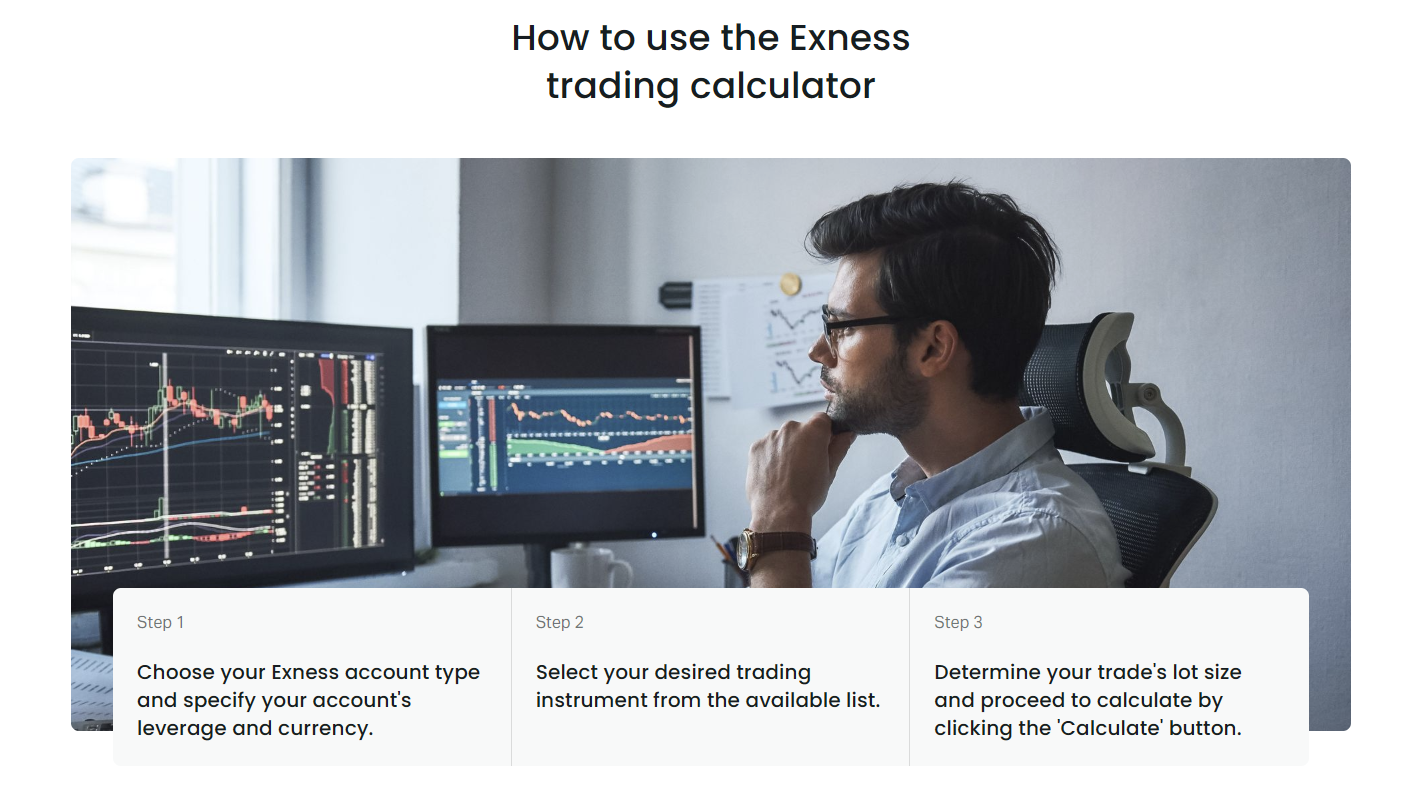
Exness provides a built-in trading calculator accessible from the website and personal area. This tool computes margin, pip value, swap, and profit for any position size across all instruments. You enter the account type, leverage, instrument, lot size, and direction (buy/sell). The calculator returns the required margin, point value, swap long/short, and estimated profit for a given price change. It also shows the stop-out level based on your equity. This eliminates manual calculation errors and helps you plan trades with precision.
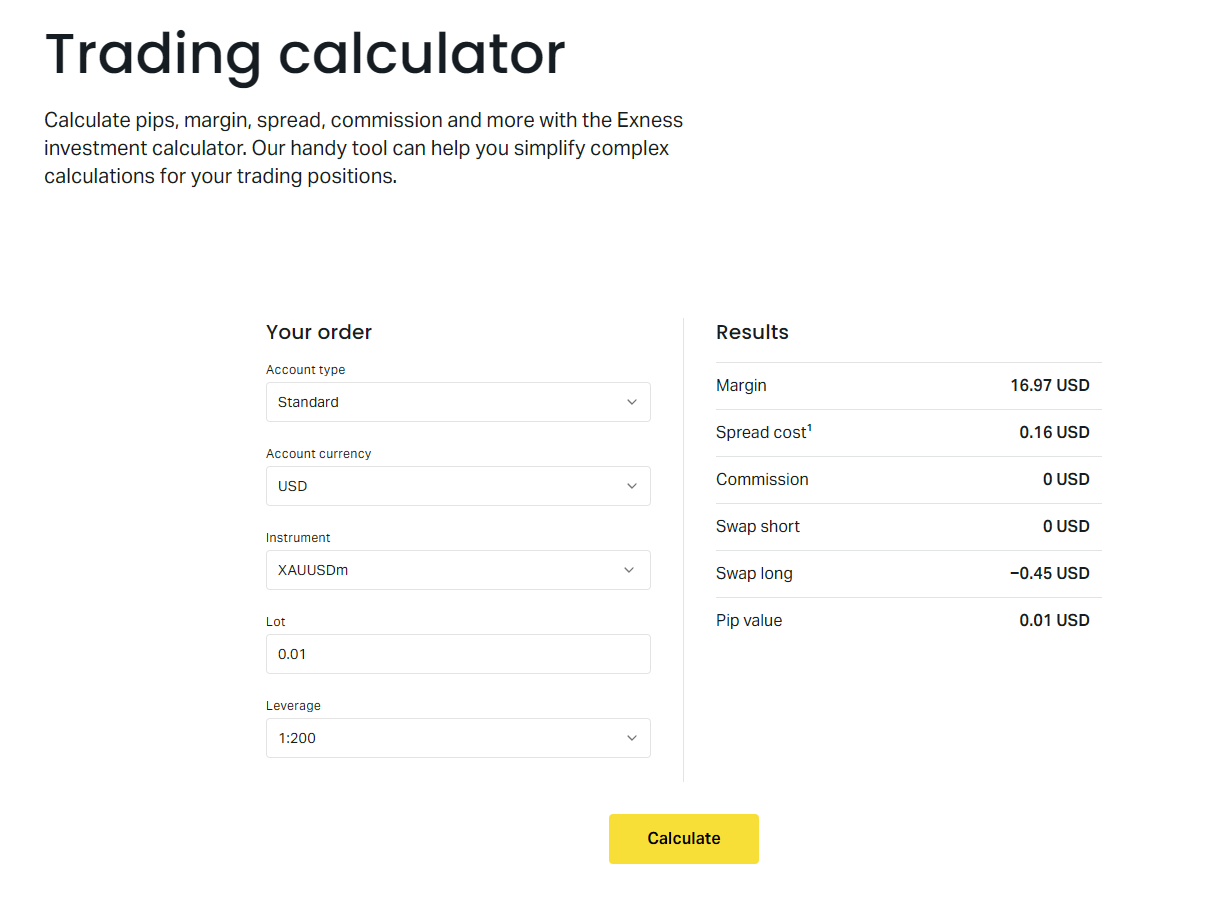
The calculator is especially useful when trading multiple instruments simultaneously. You can check the combined margin impact of several positions before opening them. For example, if you plan to hold 0.5 lots EURUSD, 0.2 lots XAUUSD, and 1 lot US30, the calculator shows the total margin required and the free margin remaining. This prevents accidental over-leveraging. The tool also displays swap charges for overnight positions, which vary by instrument and direction. Swap can be positive or negative depending on interest rate differentials.
Position Sizing and Risk Management
Position sizing is the process of determining how many lots to trade based on your account size, risk per trade, and stop-loss distance. The standard formula is: Lot Size = (Account Equity × Risk Percentage) / (Stop Loss in Pips × Pip Value per Lot). For a $1,000 account risking 2% ($20) with a 50-pip stop on EURUSD ($10/pip per standard lot), the calculation is: ($1,000 × 0.02) / (50 × $10) = 0.04 lots. This ensures that if the stop loss is hit, you lose exactly 2% of equity.
- Define maximum risk per trade (typically 1-2% of equity)
- Determine stop-loss distance in pips before entry
- Calculate pip value for your chosen instrument and lot size
- Apply the position sizing formula
- Round down to the nearest allowed lot increment
Exness allows lot increments of 0.01 on standard accounts and 0.001 on cent accounts. Always round down to stay within your risk limit. Rounding up increases risk beyond your plan. Many traders use a fixed fractional approach, risking the same percentage on every trade regardless of recent wins or losses. This prevents the common error of increasing size after wins (overconfidence) or decreasing after losses (fear). Consistent position sizing is a hallmark of professional risk management.
Position sizing is the only tool that lets you survive a string of losses while staying in the game for the winners.
Lot Size Limits for Different Asset Classes
Maximum lot sizes per position and per account vary by instrument. For major forex pairs, Exness allows up to 200 lots per position on standard accounts. For gold, the limit is typically 100 lots per position. For cryptocurrencies, limits are lower due to volatility and liquidity — often 10 to 20 lots per position. Indices and energies also have specific caps. These limits exist to protect both the trader and the broker from excessive exposure that could lead to unmanageable margin calls or execution issues during volatile periods.
Scroll horizontally to see all columns
| Asset Class | Max Lots per Position | Typical Max Leverage |
|---|---|---|
| Major Forex | 200 | 1:2000 |
| Minor Forex | 100 | 1:2000 |
| Exotic Forex | 50 | 1:200 |
| Metals (Gold/Silver) | 100 | 1:2000 |
| Energies (Oil/Gas) | 50 | 1:200 |
| Indices | 100 | 1:200 |
| Cryptocurrencies | 20 | 1:100 |
| Stocks | 100 | 1:20 |
Account-level exposure limits also apply. Even if the per-position limit is 200 lots, your total open positions across all symbols may be capped based on your equity and the dynamic leverage schedule. Exness publishes leverage tiers: as equity grows, maximum leverage decreases. For example, equity above $1,000 may reduce max leverage from 1:2000 to 1:1000. This automatically limits the total lot size you can sustain. Monitor your margin level in the terminal to avoid unexpected stop-outs.
Leverage Impact on Lot Size Selection
Leverage determines how much margin is required to open a given lot size. Higher leverage means lower margin per lot, allowing you to open larger positions with the same capital. However, leverage does not change the pip value or the notional value of the position. A 1 lot EURUSD position moves $10 per pip regardless of whether you use 1:100 or 1:2000 leverage. The difference is that at 1:2000, you only need $50 margin instead of $1,000. This frees up capital for other trades but also means a smaller adverse move can trigger a margin call or stop-out.
- Leverage affects margin, not pip value or profit/loss per pip
- Higher leverage = more free margin = ability to open more lots
- Higher leverage = closer stop-out level = less room for drawdown
- Exness dynamic leverage reduces max leverage as equity increases
Choosing leverage is a strategic decision. Conservative traders often select 1:100 or 1:200 to maintain a wide margin buffer. Aggressive traders may use 1:500 or higher to maximize position size. Exness allows you to change leverage in the personal area, but changes only affect new positions. Existing positions retain their original leverage. Some regulators restrict maximum leverage for retail clients (e.g., 1:30 in the EU, 1:50 in the US). Exness complies with local regulations, so your available leverage depends on your registration jurisdiction.
Common Lot Size Mistakes to Avoid
Traders frequently make sizing errors that lead to unnecessary losses or margin calls. One common mistake is confusing lot size with contract size. Entering 1.00 thinking it means 1 mini lot when it actually means 1 standard lot creates a position 10 times larger than intended. Another error is ignoring the account currency conversion. If your account is in EUR and you trade GBPJPY, the pip value fluctuates with EURGBP and EURJPY rates. Failing to account for this can cause risk calculations to drift over time.
- Confusing 1.00 (standard) with 0.10 (mini) or 0.01 (micro)
- Forgetting to convert pip value to account currency
- Using fixed lot sizes instead of percentage-based sizing
- Increasing lot size to recover losses (martingale behavior)
- Not checking margin requirements before adding to positions
- Ignoring swap costs on multi-day positions
Martingale strategies — doubling the lot size after each loss — are particularly dangerous on leveraged accounts. A string of five losses starting at 0.01 lots reaches 0.32 lots on the sixth trade. If the trend continues, the account faces a margin call quickly. Exness does not restrict position sizing strategies, but the stop-out system will close positions automatically when margin level falls below the threshold (typically 0% on Exness, meaning stop-out occurs at zero margin level). Proper sizing from the start eliminates the temptation to gamble on recovery.
The most expensive lot size is the one you did not calculate before pressing buy or sell.
Adjusting Lot Size for Volatility and News Events
Market volatility changes the risk profile of a given lot size. During major news releases (NFP, CPI, central bank decisions), spreads widen and price gaps can occur. A position sized for normal conditions may incur slippage far beyond the planned stop loss. Experienced traders reduce lot size by 50% or more ahead of high-impact events, or avoid new entries entirely until volatility subsides. Exness provides an economic calendar in the terminal and on the website to track upcoming events. Checking this calendar should be part of your pre-trade routine.
Average True Range (ATR) is a useful indicator for volatility-adjusted sizing. If the 14-day ATR on EURUSD is 80 pips and your normal stop is 50 pips, you might reduce lot size because the market is moving more than usual. Conversely, in low-volatility periods (ATR 40 pips), you might increase lot size slightly to maintain similar profit potential, though this also increases risk if volatility expands. The key is consistency: define your volatility adjustment rules in your trading plan and follow them without discretion.
Scaling In and Out with Multiple Lot Sizes
Advanced traders often scale into positions using multiple smaller lots rather than entering a single large lot. For example, instead of opening 0.50 lots at once, you might open 0.10 lots at the initial entry, 0.10 lots on a pullback, and 0.30 lots on a breakout confirmation. This approach improves average entry price and reduces the impact of a single bad entry. Exness allows multiple positions on the same symbol, including hedging (simultaneous long and short). Each position shows separately in the terminal with its own lot size, entry price, and profit/loss.
- Scale in: add to winning positions in smaller increments
- Scale out: close partial lots at predefined targets
- Hedge: open opposite positions to lock in profit or limit risk
- Track each position's lot size and entry independently
Scaling out is equally important. You might close 0.20 lots at the first target, 0.20 lots at the second target, and let the remaining 0.10 lots run with a trailing stop. This locks in partial profits while maintaining exposure to a potential extended move. The Exness terminal supports one-click partial close, letting you specify the lot size to close. This functionality works on MT4, MT5, the web terminal, and the mobile app. Consistent scaling discipline separates professional position management from all-or-nothing gambling.
When scaling, ensure the total combined lot size never exceeds your maximum risk per trade. If your plan allows 2% risk ($20 on $1,000), the sum of all lots on a single trade idea must respect that limit. Many traders mistakenly treat each scaled entry as a separate trade with full risk, effectively multiplying their exposure. Track aggregate risk in a spreadsheet or trading journal. The Exness personal area shows total margin used and free margin, which helps monitor overall exposure across all open positions.
Final Assessment of Exness Lot Size Options
Exness provides one of the most flexible lot size structures in the retail forex industry. From nano lots on cent accounts to 200-lot maximums on major pairs, the range accommodates every trading style and capital level. The key to using this flexibility effectively is disciplined position sizing based on account equity, stop-loss distance, and instrument volatility. The built-in trading calculator removes computational friction, while dynamic leverage and transparent margin requirements keep risk visible at all times. Whether you are a beginner testing strategies with 0.001 lots or a professional managing 50-lot positions, the principles remain the same: know your pip value, respect your risk limit, and never trade a size you cannot calculate.
Frequently Asked Questions
What is the minimum lot size on Exness Standard account?
The minimum lot size on Exness Standard account is 0.01 lots for forex pairs. This equals 1,000 units of the base currency, also known as a micro lot.
How much is 0.01 lot on Exness for EURUSD?
0.01 lot on EURUSD represents 1,000 euros. The pip value is approximately $0.10 per pip when the account currency is USD. Margin required depends on your leverage setting.
Does Exness offer nano lots (0.001)?
Yes, Exness offers nano lots (0.001) on Standard Cent accounts. On standard dollar-denominated accounts, the minimum is 0.01 lots.
What is the maximum lot size per trade on Exness?
Maximum lot size varies by instrument. Major forex pairs allow up to 200 lots per position. Gold allows up to 100 lots. Cryptocurrencies typically allow up to 20 lots per position.
How do I calculate the correct lot size for my risk?
Use the formula: Lot Size = (Account Equity × Risk %) / (Stop Loss Pips × Pip Value per Lot). The Exness trading calculator automates this calculation for any instrument.
Does leverage change the pip value of a lot?
No, leverage does not change pip value. A 1 lot EURUSD position always moves $10 per pip regardless of leverage. Leverage only affects the margin required to open the position.
Can I change lot size after opening a position?
You cannot change the lot size of an open position. You can only close it partially or fully, or open additional positions with different lot sizes to adjust your total exposure.
Where do I find the contract size for each instrument on Exness?
Contract specifications are available in the trading terminal (right-click a symbol → Specification), on the Exness website under Trading Conditions, and in the personal area under Instruments.