

Forex Trading Education
Exness Trading Hours: Complete Market Schedule Guide
Comprehensive guide to Exness market hours across all asset classes and trading sessions worldwide.

Forex Analyst
Forex Analyst specializing in currency markets, market trends, technical and fundamental analysis, and providing clear insights to help traders make informed decisions.
Exness trading hours determine when you can open, modify, or close positions across the broker's extensive range of instruments. Understanding these schedules is essential for planning entries, managing risk around rollovers, and aligning your strategy with the most liquid market sessions. Exness operates on a server time based on UTC+0 during winter and UTC+3 during summer, which corresponds to the MetaTrader platform standard used by most global brokers. This time zone choice ensures that daily candles close at 5:00 PM New York time, the widely accepted cutoff for the forex trading day.
Contents
- Understanding Exness Server Time and Time Zones
- Forex Market Sessions on Exness
- Exness Gold Trading Hours and XAUUSD Schedule
- Commodities Trading Hours: Metals and Energies
- Indices Trading Schedule on Exness
- Cryptocurrency Trading: 24/7 Market Access
- Stock CFD Trading Hours by Exchange
- Seasonal Time Changes and Daylight Saving Impact
- How to Check Current Trading Hours in Your Terminal
- Trading During High Volatility Session Overlaps
- Weekend and Holiday Trading Availability
- Managing Positions Around Market Close and Rollovers
- Exness Trading Hours for Different Account Types
- Using the Economic Calendar for Session Planning
- Key Takeaways for Exness Trading Hours
The broker offers access to forex pairs, precious metals, energies, indices, stocks, and cryptocurrencies, each with its own trading schedule. While the forex market runs 24 hours a day from Monday morning in Wellington to Friday evening in New York, other asset classes follow the hours of their underlying exchanges. Gold and silver trade nearly around the clock with a brief daily break, major indices track their home exchange sessions, and cryptocurrencies remain open 24/7. Knowing exactly when each market opens and closes helps you avoid unexpected spreads, slippage, or the inability to exit a position when you need to.
This guide breaks down Exness trading hours by asset class, explains how daylight saving transitions affect the schedule, and shows you how to verify current hours directly in your trading terminal. Whether you are a scalper targeting the London-New York overlap, a swing trader holding gold through the Asian session, or an algorithmic trader relying on precise server timestamps, the information here will help you structure your trading week with confidence.
Understanding Exness Server Time and Time Zones
Exness uses MetaTrader 4 and MetaTrader 5 platforms, both of which display server time in the Market Watch window and on chart time axes. The server time is set to UTC+0 during standard time (winter months) and UTC+3 during daylight saving time (summer months). This specific offset aligns the daily candle close with 5:00 PM Eastern Time in the United States, which is the conventional end of the forex trading day. Traders in other time zones must convert this server time to their local clock to know exactly when sessions begin and end for them.
The switch between UTC+0 and UTC+3 occurs on the last Sunday of March and the last Sunday of October, matching the European Union daylight saving schedule. During the transition weekends, the market open and close times shift by one hour relative to UTC. Exness typically announces the exact transition dates in advance through the platform news feed and the client portal. It is good practice to mark these dates on your calendar, because any expert advisors, scripts, or scheduled orders that rely on fixed hour values will execute at a different wall-clock time after the change.
Forex Market Sessions on Exness
The forex market on Exness opens at 00:05 server time on Monday (which is Sunday 17:05 in New York during standard time) and closes at 23:55 server time on Friday (Friday 17:55 in New York). Between these endpoints, the market runs continuously 24 hours a day. The trading day is conventionally divided into four major sessions: Sydney, Tokyo, London, and New York. Each session brings its own liquidity profile, typical volatility, and currency pair focus. Overlaps between sessions, especially London-New York, produce the highest volume and tightest spreads.
- Sydney session: 22:00–07:00 server time (winter) / 21:00–06:00 (summer) — AUD, NZD pairs most active
- Tokyo session: 00:00–09:00 server time (winter) / 23:00–08:00 (summer) — JPY pairs dominate
- London session: 08:00–17:00 server time (winter) / 07:00–16:00 (summer) — EUR, GBP, CHF pairs peak
- New York session: 13:00–22:00 server time (winter) / 12:00–21:00 (summer) — USD pairs and cross volatility highest
- London-New York overlap: 13:00–17:00 server time (winter) / 12:00–16:00 (summer) — deepest liquidity, tightest spreads
Exness offers raw spread and zero account types that pass through institutional pricing with a commission. During the major session overlaps, spreads on major pairs like EURUSD can approach zero pips before commission. Outside these windows, spreads widen naturally as liquidity providers reduce quoting depth. The Asian session often sees wider spreads on European crosses, while the late New York afternoon can see thinning liquidity ahead of the daily rollover at 23:55 server time.
Exness Gold Trading Hours and XAUUSD Schedule
Gold (XAUUSD) and silver (XAGUSD) are among the most popular instruments on Exness, and their trading hours differ from standard forex pairs. Precious metals trade from 01:00 server time Monday to 23:55 server time Friday, with a daily trading break from 23:55 to 01:00 server time (a 65-minute pause). This break coincides with the end of the New York session and the start of the next trading day. During the break, you cannot open new positions, modify existing orders, or close trades; any pending orders will queue and execute when the market reopens.
Scroll horizontally to see all columns
| Instrument | Monday Open | Daily Break | Friday Close |
|---|---|---|---|
| XAUUSD (Gold) | 01:00 server time | 23:55–01:00 | 23:55 server time |
| XAGUSD (Silver) | 01:00 server time | 23:55–01:00 | 23:55 server time |
| XAUEUR (Gold/EUR) | 01:00 server time | 23:55–01:00 | 23:55 server time |
| XAUGBP (Gold/GBP) | 01:00 server time | 23:55–01:00 | 23:55 server time |
The daily break is a critical period for gold traders. Any open positions remain exposed to price movement during the break, but you cannot manage them. Stop-loss and take-profit orders will not trigger until the market reopens, which means a gap against your position could result in execution at a significantly worse price. Many experienced traders either close gold positions before the 23:55 break or widen stops to accommodate potential gaps. The first hour after the 01:00 reopen often sees elevated volatility as Asian session participants react to overnight developments.
The gold daily break is not a pause in risk — it is a pause in control. Plan your exposure accordingly.
Commodities Trading Hours: Metals and Energies
Beyond gold and silver, Exness offers platinum (XPTUSD), palladium (XPDUSD), and copper (XCUUSD) with similar schedules to precious metals. Energy CFDs such as US Oil (XTIUSD), UK Oil (XBRUSD), and Natural Gas (XNGUSD) follow the underlying futures exchange hours. US Oil and UK Oil trade from 01:00 to 23:55 server time with the same 65-minute daily break. Natural Gas has a slightly different schedule, typically opening at 01:00 and closing at 23:45 server time, also with a daily break. These hours mirror the CME and ICE electronic trading sessions.
Scroll horizontally to see all columns
| Instrument | Session Open | Daily Break | Session Close |
|---|---|---|---|
| XTIUSD (US Oil) | 01:00 server time | 23:55–01:00 | 23:55 server time |
| XBRUSD (UK Oil) | 01:00 server time | 23:55–01:00 | 23:55 server time |
| XNGUSD (Natural Gas) | 01:00 server time | 23:45–01:00 | 23:45 server time |
Energy markets are heavily influenced by inventory reports (EIA crude oil stocks on Wednesdays, API data on Tuesdays) and geopolitical headlines. These events often occur during the New York session, creating sharp moves. The daily break for energies aligns with the precious metals break, so the same risk management considerations apply. If you hold energy positions into the break, be aware that weekend gaps can be substantial, especially when OPEC meetings or supply disruptions occur over Saturday-Sunday.
Indices Trading Schedule on Exness
Index CFDs on Exness track the cash session of their respective exchanges, not the nearly 24-hour futures markets. This means US indices like US30 (Dow Jones), US500 (S&P 500), and USTEC (Nasdaq 100) trade from 14:30 to 21:00 server time (winter) or 13:30 to 20:00 (summer), matching the New York Stock Exchange and Nasdaq regular hours. European indices such as GER40 (DAX), FRA40 (CAC 40), and UK100 (FTSE 100) trade during their local exchange hours, typically 09:00–17:30 server time for European markets and 09:00–17:30 for London. Asian indices like JPN225 (Nikkei 225) and HK50 (Hang Seng) follow Tokyo and Hong Kong exchange schedules.
Scroll horizontally to see all columns
| Index | Exchange | Open | Close |
|---|---|---|---|
| US30 / US500 / USTEC | NYSE / Nasdaq | 14:30 | 21:00 |
| GER40 (DAX) | Xetra | 09:00 | 17:30 |
| FRA40 (CAC 40) | Euronext Paris | 09:00 | 17:30 |
| UK100 (FTSE 100) | LSE | 09:00 | 17:30 |
| JPN225 (Nikkei) | TSE | 01:00 | 07:00 |
| HK50 (Hang Seng) | HKEX | 02:15 | 09:00 |
Outside these cash sessions, index CFDs are not available for trading on Exness. This is a key difference from futures contracts, which trade on Globex nearly 24 hours. If your strategy requires positioning ahead of an earnings release or economic data that occurs outside cash hours, you must either use futures on another venue or accept that you cannot enter until the next cash open. Spreads on index CFDs are typically tightest during the first and last hour of the cash session when volume peaks.
Cryptocurrency Trading: 24/7 Market Access
Cryptocurrency CFDs on Exness — including BTCUSD, ETHUSD, LTCUSD, XRPUSD, and many others — trade 24 hours a day, 7 days a week, with no daily break and no weekend closure. This continuous schedule reflects the decentralized nature of crypto spot markets, which never close. The only interruptions are brief maintenance windows, typically lasting a few minutes, which Exness announces in advance. During weekends, crypto volatility can be lower due to reduced institutional participation, but sharp moves still occur on news or large on-chain transactions.
Because crypto markets never close, swap charges (overnight financing) are applied every day at 23:55 server time, including weekends. This differs from forex and metals, where triple swap is charged on Wednesday to account for the weekend. Crypto traders must factor daily swap costs into any position held longer than a few hours, especially on leveraged accounts where the annualized financing rate can be significant. Exness publishes current swap rates for each symbol in the contract specifications and in the Market Watch window.
The economic calendar integrated into the Exness platform and web terminal highlights upcoming events that can impact crypto markets, such as regulatory announcements, network upgrades, or macroeconomic data that influences risk appetite. Since crypto trades around the clock, you can react to these events in real time, unlike traditional assets where you must wait for the next session open.
Stock CFD Trading Hours by Exchange
Exness offers stock CFDs on major US, EU, and UK equities. US stocks trade from 14:30 to 21:00 server time (winter) / 13:30 to 20:00 (summer), matching NYSE and Nasdaq regular hours. Pre-market and after-hours sessions are not available for CFD trading on Exness. European stocks follow their local exchange hours: for example, German stocks (Xetra) 09:00–17:30, French stocks (Euronext Paris) 09:00–17:30. UK stocks (LSE) trade 09:00–17:30 server time. All stock CFDs are unavailable outside these windows, and corporate actions such as dividends, splits, or rights issues are handled according to Exness policy with adjustments applied at the open on the ex-date.
Scroll horizontally to see all columns
| Region | Exchange Example | Winter Open | Winter Close |
|---|---|---|---|
| United States | NYSE / Nasdaq | 14:30 | 21:00 |
| Germany | Xetra | 09:00 | 17:30 |
| France | Euronext Paris | 09:00 | 17:30 |
| United Kingdom | LSE | 09:00 | 17:30 |
| Netherlands | Euronext Amsterdam | 09:00 | 17:30 |
Earnings season creates heightened volatility in individual stocks, often with gaps at the open. Since you cannot trade pre-market or after-hours on Exness, any earnings release outside cash hours will be reflected in the next session's opening price. Traders holding stock CFDs through earnings should be aware that stop-loss orders may execute at prices far from the intended level if a large gap occurs. Exness applies dividend adjustments on long positions (credit) and short positions (debit) on the ex-dividend date, which can affect overnight holding costs.
Seasonal Time Changes and Daylight Saving Impact
The transition between standard time and daylight saving time affects Exness trading hours in two ways. First, the server time offset shifts from UTC+0 to UTC+3 (or back), moving all session times by one hour relative to UTC. Second, the underlying exchanges in the US, EU, and UK also shift their local clocks, but not always on the same dates. The EU and UK switch on the last Sunday of March and October. The US switches on the second Sunday of March and the first Sunday of November. This creates two brief periods each year — roughly two weeks in March and one week in November — when the offset between New York and London is four hours instead of the usual five.
During these mismatch weeks, the London-New York overlap window shifts by one hour in server time terms. For example, when the US has moved to daylight saving but Europe has not, the New York session opens at 12:00 server time instead of 13:00, moving the overlap to 12:00–16:00 server time. Exness updates the platform automatically, but any hard-coded time filters in expert advisors or custom indicators may need manual adjustment. The broker publishes a schedule of these transition periods each year in the help center and via platform notifications.
How to Check Current Trading Hours in Your Terminal
The most reliable way to confirm trading hours for any symbol on Exness is directly inside MetaTrader 4 or MetaTrader 5. In the Market Watch window, right-click any instrument and select Specification. The dialog shows the trading session schedule with exact open and close times in server time, including any daily breaks. You can also view the contract specifications on the Exness website under the Trading Conditions section for each asset class. The platform displays a grayed-out or disabled state for symbols that are currently closed, and the New Order button will be inactive if you attempt to trade outside allowed hours.
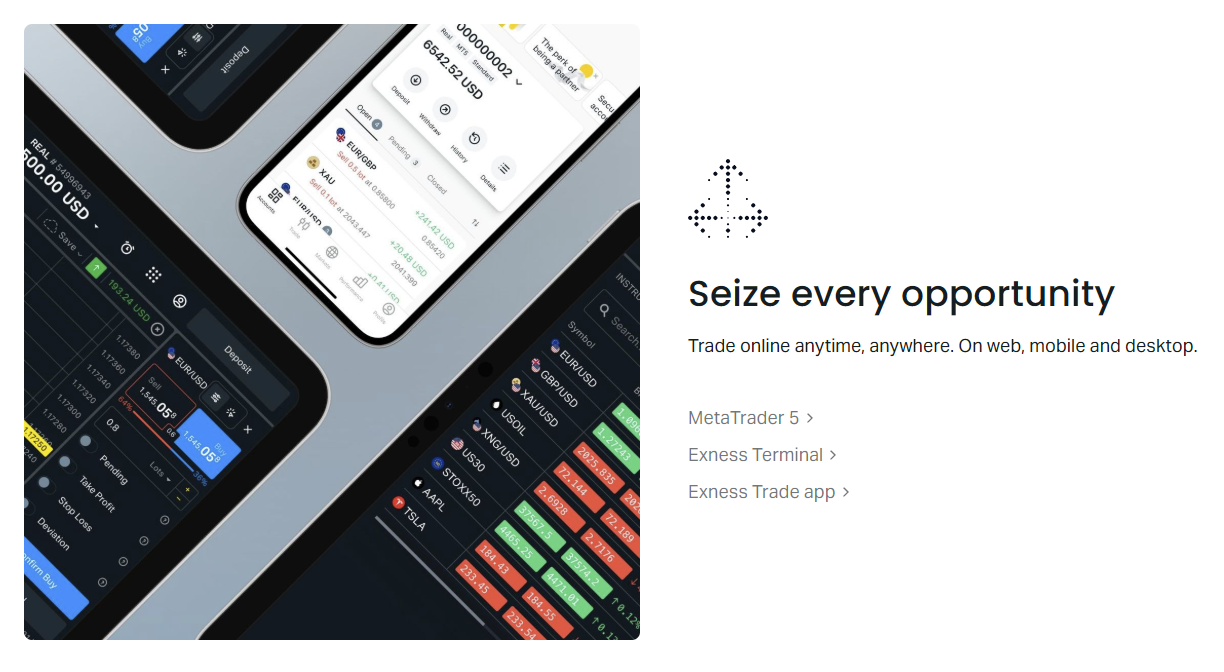
The Exness web terminal and mobile app provide the same specification data. On mobile, tap and hold a symbol in the quotes list to see details. The web terminal includes a Trading Hours page accessible from the main menu, which lists all instruments grouped by asset class with their current schedules. This is especially useful when you are away from your desktop and need to verify whether a market is open before placing an order.
Trading During High Volatility Session Overlaps
The most active trading periods on Exness occur when major financial centers overlap. The London-New York overlap (13:00–17:00 server time winter / 12:00–16:00 summer) generates the highest volume across forex majors, gold, and US indices. The Tokyo-London overlap (08:00–09:00 server time) is shorter but can produce sharp moves in JPY and EUR crosses as European traders enter and Asian traders square positions. The Sydney-Tokyo overlap (00:00–02:00 server time) is quieter but relevant for AUD and NZD pairs.
- London-New York overlap: Best for EURUSD, GBPUSD, XAUUSD, US indices — highest liquidity, lowest spreads
- Tokyo-London overlap: Good for EURJPY, GBPJPY, EURGBP — volatility spikes on European open
- Sydney-Tokyo overlap: Suitable for AUDJPY, NZDJPY, AUDUSD — lower volume but clean trends
- New York close (21:00–23:55): Watch for position squaring, fixing flows, and end-of-day rebalancing
- Asian session (00:00–08:00): Range-bound conditions ideal for mean-reversion strategies on majors
Exness offers some of the industry's tightest spreads during these overlaps, particularly on Raw Spread and Zero accounts where the markup is minimal. However, high volatility also means wider spreads during news releases (NFP, CPI, central bank decisions) even within the overlap. The economic calendar shows high-impact events marked in red; consider reducing position size or avoiding new entries during the 15-minute window around these releases unless your strategy specifically targets news volatility.

Gold often sees its largest daily range during the London-New York overlap, driven by dollar index moves, bond yield shifts, and risk sentiment changes. Energy markets react strongly to inventory data released at 15:30 server time (10:30 AM ET) on Wednesdays. Index CFDs are only tradable during their cash sessions, so the overlap is the only time you can actively trade US indices on Exness. Plan your most size-dependent strategies — large orders, algorithmic execution, or tight stop-loss approaches — for these windows to minimize slippage and maximize fill quality.
Weekend and Holiday Trading Availability
Forex, metals, energies, indices, and stocks are closed on weekends. The market closes Friday at 23:55 server time and reopens Monday at 00:05 server time (forex) or 01:00 (metals/energies). Cryptocurrencies are the exception, trading continuously through Saturday and Sunday. During major global holidays — such as Christmas Day, New Year's Day, and Good Friday — many underlying exchanges close or operate on reduced hours. Exness publishes a holiday trading schedule each December detailing which instruments are affected and any early closes or full-day suspensions.
Weekend gaps are not random — they are the market pricing in 48 hours of news you could not trade.
Holding positions over the weekend exposes you to gap risk. A stop-loss placed at a specific price will not protect you if the market opens Monday at a level far beyond your stop. The only way to eliminate weekend gap risk is to close all non-crypto positions before Friday 23:55 server time. Some traders use options or correlated instruments that trade over the weekend to hedge, but this adds complexity and cost. Exness does not offer guaranteed stop-loss orders that would protect against gaps.
Managing Positions Around Market Close and Rollovers
The daily rollover at 23:55 server time is when swap charges are applied and the trading day resets. For forex, triple swap is charged on Wednesday night to cover the weekend (Saturday and Sunday when the market is closed). For metals and energies, triple swap is charged on Friday night. For cryptocurrencies, swap is charged daily including weekends. If you hold a position through the rollover, you will see the swap amount reflected in your account equity. Positive swap (carry trade) can add to profits over time; negative swap erodes them.

During the rollover window (approximately 23:55–00:05 server time), spreads widen significantly as liquidity providers reset their books. Market orders placed in this window may fill at poor prices. Pending orders (buy stop, sell stop, buy limit, sell limit) are not executed until the new day opens. If you need to enter a trade at a specific price near the rollover, use a pending order placed well in advance rather than a market order at the last minute.
Exness Trading Hours for Different Account Types
Trading hours are consistent across all Exness account types — Standard, Standard Cent, Pro, Raw Spread, and Zero. The server time, session schedules, daily breaks, and holiday calendars are identical regardless of account. The differences between account types lie in spreads, commissions, minimum deposits, and leverage limits, not in when you can trade. Islamic (swap-free) accounts follow the same trading hours; the only distinction is that no swap is charged or credited at rollover, and an administration fee may apply after a certain holding period on some instruments.
Scroll horizontally to see all columns
| Account Type | Spreads | Commission | Trading Hours |
|---|---|---|---|
| Standard | From 0.3 pips | None | Identical |
| Standard Cent | From 0.3 pips | None | Identical |
| Pro | From 0.1 pips | None | Identical |
| Raw Spread | From 0.0 pips | Per lot | Identical |
| Zero | From 0.0 pips | Per lot | Identical |
Demo accounts on Exness replicate live trading hours exactly, including the daily breaks, weekend closures, and holiday schedules. This makes demo an effective tool for testing strategies across different sessions without risking capital. The only limitation is that demo server time may occasionally differ by a few seconds from live during maintenance windows, but the schedule itself is the same.
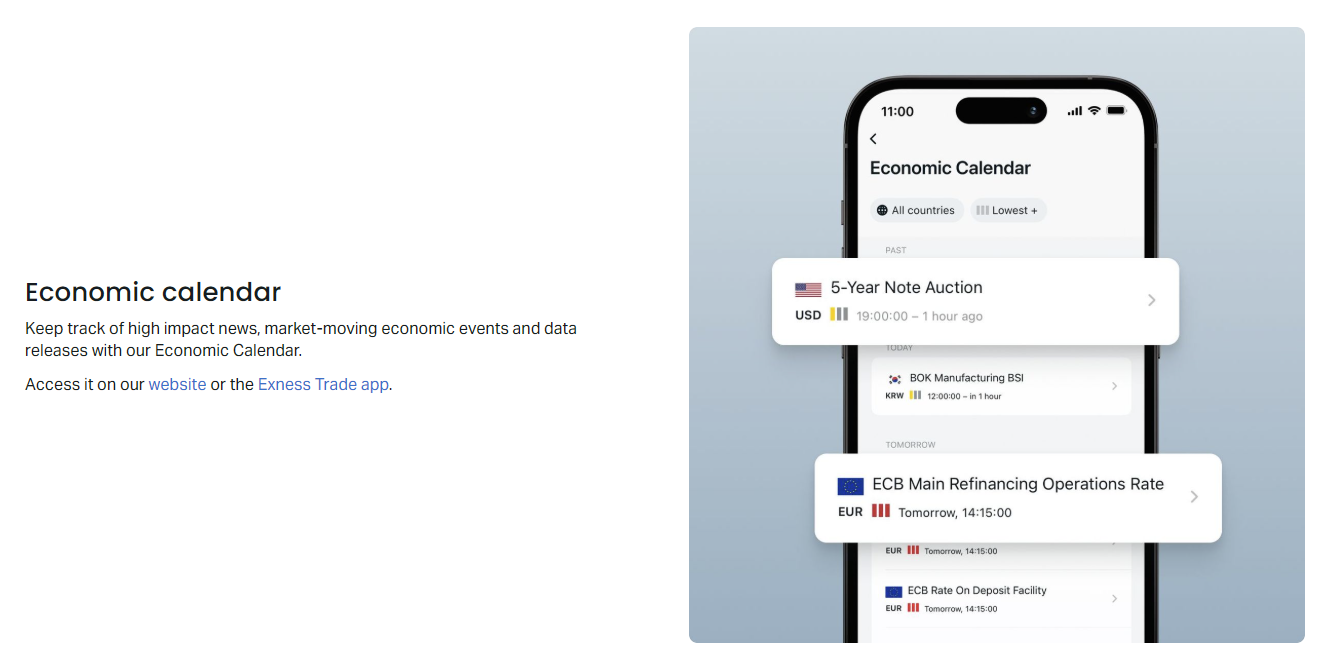
Using the Economic Calendar for Session Planning
The Exness economic calendar, accessible from the platform and the website, lists upcoming macroeconomic events with their scheduled release times in server time. Each event shows the affected currency, expected impact (low, medium, high), previous value, forecast, and actual result once released. Aligning your trading hours with high-impact events allows you to either capitalize on volatility or step aside to avoid unpredictable spreads. For example, if US CPI is released at 13:30 server time (08:30 ET), the New York session open at 13:30 will see immediate reaction in USD pairs, gold, and US indices.
You can filter the calendar by currency, impact level, and date range. Many traders build a weekly routine: review the calendar on Sunday evening, mark high-impact events for each session, and adjust position sizes or set alerts for those windows. The calendar also shows central bank meeting dates, speeches by policymakers, and bond auctions — all of which can move markets outside the usual session patterns. Exness updates the calendar in real time as revisions and actuals are published.
The calendar does not predict the market — it tells you when the market will pay attention.
Key Takeaways for Exness Trading Hours
Exness trading hours are built around the MetaTrader server time standard (UTC+0 winter, UTC+3 summer), which aligns the daily candle close with 5:00 PM New York time. Forex trades 24/5 from Monday 00:05 to Friday 23:55 server time. Gold and silver trade 01:00–23:55 with a 65-minute daily break. Energies follow similar schedules. Index CFDs trade only during their home exchange cash hours. Stock CFDs match regular exchange sessions with no pre- or after-hours access. Cryptocurrencies trade 24/7 with daily swap charges. Daylight saving transitions in March and November create temporary session shifts. Always verify current hours in the symbol specification window before trading, especially around holidays and transition weekends. Managing positions around the 23:55 rollover and weekend close is essential for controlling gap and swap risk.
Frequently Asked Questions
What time does Exness open on Monday for forex trading?
Forex trading on Exness opens at 00:05 server time on Monday, which corresponds to Sunday 17:05 Eastern Time (US) during standard time and Sunday 18:05 during daylight saving time.
What are the Exness gold trading hours for XAUUSD?
XAUUSD trades from 01:00 server time Monday to 23:55 server time Friday, with a daily trading break from 23:55 to 01:00 server time (65 minutes).
Does Exness have different trading hours for different account types?
No, trading hours are identical across all Exness account types including Standard, Standard Cent, Pro, Raw Spread, Zero, and Islamic accounts.
Can I trade cryptocurrencies on Exness during weekends?
Yes, cryptocurrency CFDs on Exness trade 24 hours a day, 7 days a week, including weekends and holidays, with only brief maintenance windows.
What time does Exness close on Friday?
Most instruments close at 23:55 server time on Friday. Forex closes at 23:55, metals and energies at 23:55, and indices/stocks close with their respective exchange hours earlier in the day.
How does daylight saving time affect Exness trading hours?
Exness server time shifts from UTC+0 to UTC+3 (or back) on the last Sunday of March and October. US exchanges shift on different dates, creating temporary 4-hour gaps between London and New York sessions for 1–2 weeks.
Where can I check the exact trading hours for a specific symbol on Exness?
Right-click any symbol in the MetaTrader Market Watch window and select Specification, or view the Trading Hours page in the Exness web terminal and mobile app.