

Trading Guides
Exness S&P500 Trading: Complete Guide to Index CFDs
Comprehensive guide covering platforms, costs, strategies, and risk management for S&P500 index trading on Exness.

Forex Analyst
Forex Analyst specializing in currency markets, market trends, technical and fundamental analysis, and providing clear insights to help traders make informed decisions.
Trading the S&P500 through contracts for difference (CFDs) has become a popular way for retail traders to gain exposure to the broad U.S. equity market without owning the underlying stocks. Exness offers S&P500 trading under the symbol US500, providing access to one of the world's most widely followed stock market benchmarks. This guide covers everything you need to know about trading the S&P500 on Exness, from platform selection and account types to trading costs, execution quality, and risk management considerations.
Contents
- Exness Platforms for S&P500 Trading
- Exness Terminal Web Platform Features
- Account Types and S&P500 Trading Conditions
- Spreads, Swaps, and Trading Hours for US500
- Leverage and Margin Requirements
- Execution Quality and Order Types
- Technical Analysis Tools for S&P500
- Fundamental Drivers of S&P500 Movements
- Risk Management for Index CFD Trading
- Trading Strategies for S&P500 on Exness
- Day Trading and Scalping
- Swing Trading
- Position Trading and Hedging
- Using Exness Analytical Resources
- Deposits, Withdrawals, and Account Funding
- Demo Account for Strategy Development
- Mobile Trading for S&P500 Monitoring
- Tax Considerations for Index CFD Trading
- Common Mistakes in S&P500 CFD Trading
- Comparing Exness S&P500 Trading to Alternatives
- Final Assessment of Exness S&P500 Trading
The S&P500 index tracks the performance of 500 large-cap companies listed on U.S. stock exchanges, representing approximately 80% of the total U.S. equity market capitalization. When you trade US500 CFDs on Exness, you speculate on the price movements of this index without taking ownership of any constituent shares. This approach allows for both long and short positions, leverage, and the ability to trade during extended hours that often exceed regular U.S. market sessions.
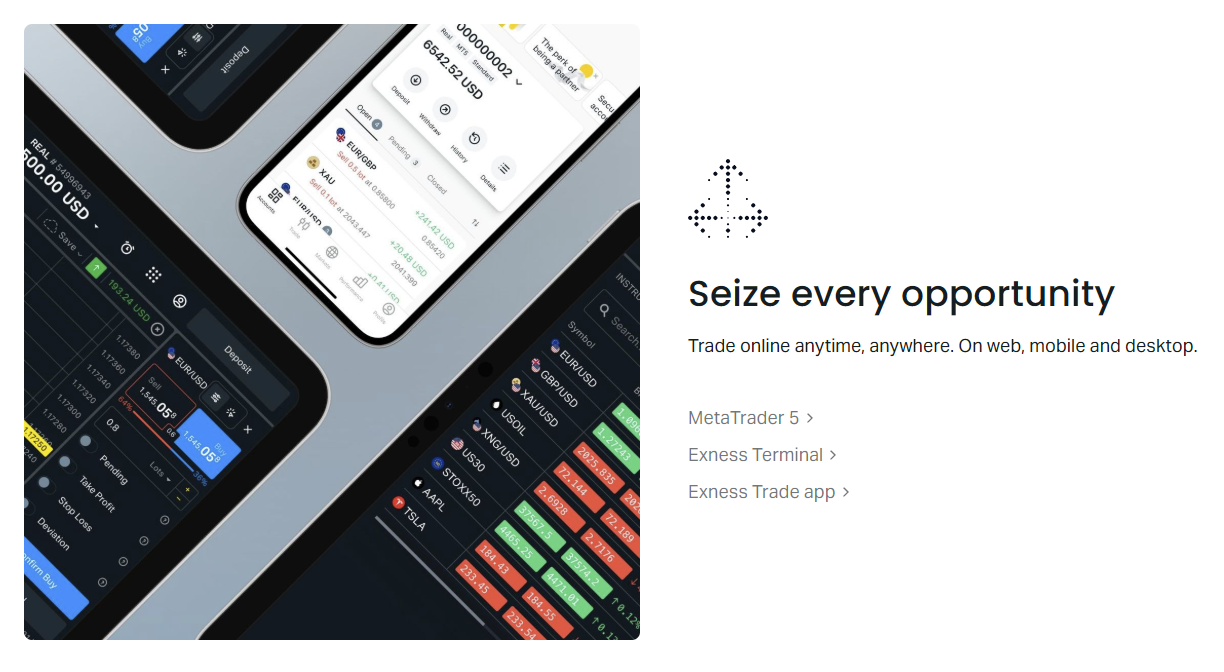
Exness provides multiple trading platforms for S&P500 access, including MetaTrader 4, MetaTrader 5, the proprietary Exness Terminal web platform, and mobile applications. Each platform offers charting tools, technical indicators, and order types suitable for index trading strategies. The broker's market execution model aims to fill orders at the best available price with minimal slippage, which is particularly important during high-volatility periods around major economic releases or earnings seasons.
Exness Platforms for S&P500 Trading
Choosing the right platform affects your trading experience, available tools, and execution speed. Exness supports four main platforms for US500 trading, each with distinct advantages depending on your trading style and technical requirements.
MetaTrader 5 (MT5) is the most feature-rich option for index traders. It provides 21 timeframes, 38 built-in technical indicators, 44 analytical objects, and an economic calendar integrated directly into the platform. MT5 supports hedging and netting modes, depth of market (DOM) for viewing liquidity, and algorithmic trading through Expert Advisors (EAs). The platform handles multi-asset trading, so you can analyze correlations between US500 and other instruments like forex pairs or commodities within a single workspace.
MetaTrader 4 (MT4) remains popular for its simplicity and vast ecosystem of custom indicators and EAs. While it offers fewer timeframes (9) and indicators (30 built-in) compared to MT5, many traders prefer its lightweight interface and extensive community support. MT4 is well-suited for traders who rely on custom tools developed specifically for this platform or who run multiple EAs simultaneously on a VPS.
Exness Terminal Web Platform Features
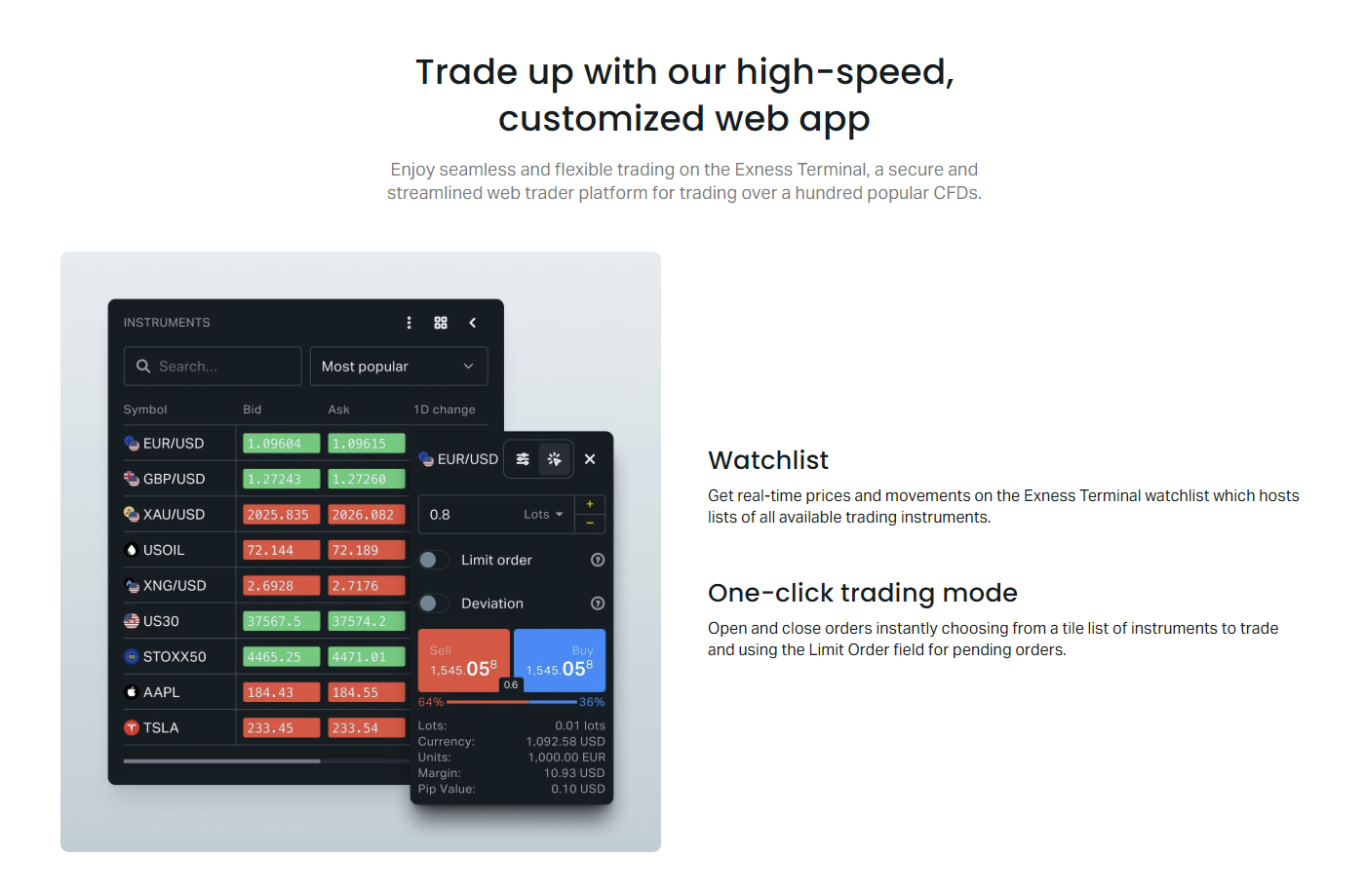
The Exness Terminal is a browser-based platform that requires no installation. It loads quickly, works across operating systems, and provides a clean interface optimized for the broker's specific trading conditions. The web terminal includes TradingView charts, one-click trading, and direct access to Exness analytical resources.
Mobile applications for iOS and Android extend platform access to smartphones and tablets. The Exness Trade app provides a streamlined experience with essential charting, position management, and account functions. MT4 and MT5 mobile apps offer more advanced features including custom indicators and EA monitoring. Mobile access is valuable for index traders who need to react to U.S. market openings, Federal Reserve announcements, or earnings releases while away from their primary workstation.
Account Types and S&P500 Trading Conditions
Exness offers several account types with different cost structures for US500 trading. Understanding these differences helps you select the account that aligns with your trading volume, strategy, and cost sensitivity.
Scroll horizontally to see all columns
| Account Type | Typical Spread US500 | Commission | Min Deposit | Best For |
|---|---|---|---|---|
| Standard | From 0.4 pips | None | $1 | Beginners, low volume |
| Standard Cent | From 0.4 pips | None | $1 | Micro lot practice |
| Pro | From 0.2 pips | None | $200 | Active traders |
| Zero | From 0.0 pips | $3.5 per side/lot | $200 | Scalpers, high volume |
| Raw Spread | From 0.0 pips | $3.5 per side/lot | $200 | Algorithmic trading |
Standard and Standard Cent accounts use spread-only pricing with no commissions. The spread on US500 typically starts around 0.4 pips but widens during volatile periods. These accounts suit traders who prefer simplicity and lower minimum deposits. The Cent account denominates balances in cents, allowing micro-lot trading with very small position sizes — useful for learning index dynamics without significant capital at risk.
Pro, Zero, and Raw Spread accounts offer tighter spreads starting from 0.0–0.2 pips on US500 but charge a round-turn commission of $3.5 per lot per side ($7 per lot round trip). For high-frequency strategies or large position sizes, the commission-based model often reduces total trading costs despite the per-trade fee. The Raw Spread account is optimized for algorithmic trading with the most stable spreads and fastest execution priority.
Spreads, Swaps, and Trading Hours for US500
Trading costs extend beyond the visible spread. Swap rates (overnight financing charges) apply to positions held past the daily rollover time, and trading hours determine when you can open or close positions. Exness provides extended hours for index CFDs, allowing participation in pre-market and after-hours moves driven by earnings reports or economic data.
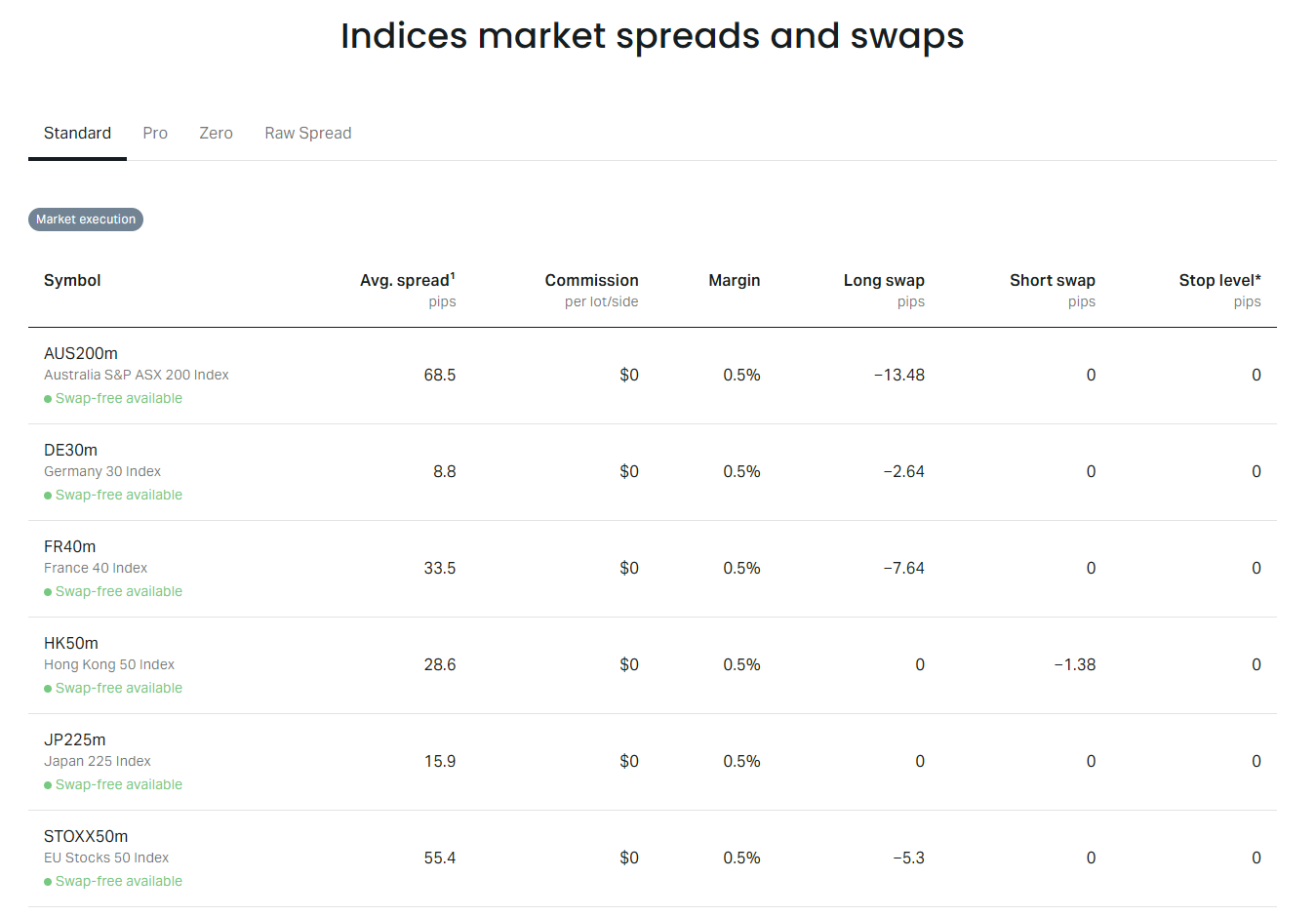
US500 trading hours on Exness typically run from Monday 00:05 server time to Friday 23:55 server time, with a daily break from 23:55 to 00:05. This schedule covers the full U.S. cash session (9:30 AM – 4:00 PM ET), pre-market (4:00 AM – 9:30 AM ET), and after-hours (4:00 PM – 8:00 PM ET). Liquidity is highest during the cash session; spreads widen significantly during the daily break and lower-liquidity extended hours.
Swap rates for US500 differ for long and short positions and are expressed in points per lot per night. Long positions typically incur a negative swap (cost) reflecting the financing charge, while short positions may receive a positive swap (credit) or smaller negative swap depending on interest rate differentials. Triple swaps apply on Wednesdays to account for weekend financing. Check the current swap rates in your platform's specification window before holding positions overnight.
Leverage and Margin Requirements
Leverage amplifies both potential returns and losses. Exness offers dynamic leverage on US500 that adjusts based on your account equity and the instrument's volatility. Maximum leverage for major indices can reach 1:2000 on Standard and Pro accounts under certain conditions, though regulatory restrictions may apply in specific jurisdictions.
- Margin requirement = Position size / Leverage
- Higher equity tiers may reduce maximum available leverage
- Margin call typically at 50% margin level
- Stop out occurs at 0% margin level on most accounts
- Leverage changes take effect immediately on open positions
For example, trading 1 lot of US500 (contract size typically 1 index point per lot) at a price of 4,500 with 1:200 leverage requires $22.50 margin (4,500 / 200). The same position at 1:500 leverage requires only $9 margin. While higher leverage frees capital for other trades, it reduces the buffer against adverse price moves. A 1% move against a 1:500 leveraged position triggers a 50% margin level drop.
Execution Quality and Order Types
Execution quality directly impacts trading outcomes, especially for short-term strategies on volatile instruments like US500. Exness uses a market execution model with no dealing desk intervention, meaning orders are filled at the best available price from liquidity providers. The broker publishes execution statistics including slippage, requote rates, and fill ratios.
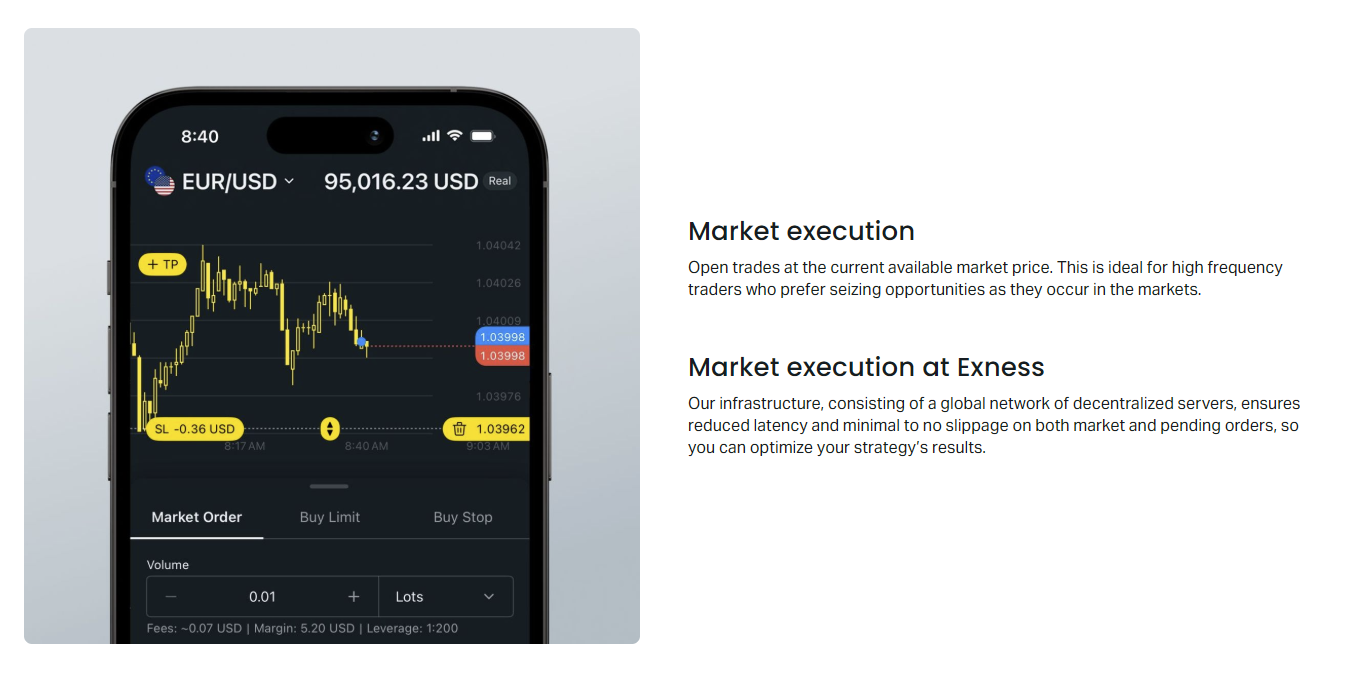
Available order types include market orders (instant execution at current price), pending orders (buy limit, sell limit, buy stop, sell stop), and stop orders (stop loss, take profit). MT5 adds buy stop limit and sell stop limit orders. One-click trading from the chart or market watch window enables rapid entry during fast-moving conditions. The platform also supports partial fills and fill-or-kill policies depending on order type and liquidity.
During high-impact events like FOMC decisions or NFP releases, US500 spreads can widen 3–5x normal levels. Market orders may experience positive or negative slippage. Pending orders provide price certainty but risk non-execution if price gaps through your level.
Technical Analysis Tools for S&P500
Effective index trading relies on technical analysis adapted to the S&P500's characteristics. The index tends to trend persistently during bull markets, exhibits mean-reversion tendencies in ranges, and respects key psychological levels (round numbers like 4,000, 4,500, 5,000). Exness platforms provide comprehensive toolsets for this analysis.
- Trend identification: Moving averages (50, 200-period), ADX, Ichimoku Cloud
- Momentum oscillators: RSI (14), Stochastic, MACD for divergence signals
- Volume analysis: On-balance volume, volume-weighted average price (VWAP) on MT5
- Support/resistance: Pivot points, Fibonacci retracements, previous session highs/lows
- Market breadth: Advance-decline line, new highs-new lows (via external data)
MT5's additional timeframes (2-hour, 3-hour, 4-hour, 6-hour, 8-hour, 12-hour) allow finer granularity for intraday index trading. The platform's DOM feature shows bid/ask depth, helping identify liquidity clusters where large orders may act as support or resistance. Custom indicators from the MQL5 marketplace can add specialized tools like session high/low markers, opening range breakout levels, or correlation matrices with sector ETFs.
Fundamental Drivers of S&P500 Movements
While technical analysis guides entry and exit timing, fundamental factors drive the S&P500's medium- to long-term direction. Exness provides an economic calendar and market news feed to help traders stay informed about catalysts that move the index.
- Federal Reserve policy: Interest rate decisions, FOMC minutes, dot plot projections
- Economic data: Non-farm payrolls, CPI/PCE inflation, GDP, ISM PMI, retail sales
- Corporate earnings: Quarterly reports from index heavyweights (Apple, Microsoft, Nvidia, etc.)
- Fiscal policy: Government spending, tax legislation, debt ceiling negotiations
- Geopolitical events: Trade policy, conflicts, regulatory changes affecting sectors
- Market sentiment: VIX, put/call ratio, AAII sentiment survey, fund flows
Earnings season (January, April, July, October) creates elevated volatility as ~500 companies report results over 4–6 weeks. The index often gaps on open following major earnings beats or misses from mega-cap constituents. Exness's extended trading hours allow positioning before the cash session open, though with wider spreads and lower liquidity. The economic calendar in MT5 and the web terminal highlights high-impact events with expected/previous values and volatility forecasts.
Risk Management for Index CFD Trading
Risk management is the foundation of sustainable S&P500 trading. The index's 24/5 availability, leverage, and correlation with global risk sentiment create unique risk parameters that differ from forex or individual stock trading.
Scroll horizontally to see all columns
| Risk Element | Guideline | Implementation |
|---|---|---|
| Position Sizing | 1–2% equity per trade | Calculate lot size from stop distance |
| Stop Loss Placement | Beyond noise, at structure | Use ATR multiple or key levels |
| Risk/Reward Target | Minimum 1:2, prefer 1:3 | Set take profit at measured moves |
| Correlation Exposure | Limit net delta across indices | Avoid max long US500 + Nasdaq + Dow |
| Daily Loss Limit | 3–5% of equity | Stop trading if hit, review next day |
| Drawdown Cap | Monthly 6–10% max | Reduce size or pause at threshold |
Correlation risk is often overlooked. US500, Nasdaq 100 (USTEC), and Dow Jones 30 (US30) typically move together with correlations above 0.85. Holding simultaneous long positions in multiple U.S. indices concentrates risk rather than diversifying it. If you trade multiple indices, treat them as a single position for risk budgeting. Sector rotation — where money flows from tech to energy or financials — can create divergence, but broad risk-off events correlate all major indices sharply.
The most common account blowups in index trading come from averaging down losing positions without a defined invalidation level. The S&P500 can trend against you for weeks during corrections. Define your maximum adverse excursion before entry and honor it.
Trading Strategies for S&P500 on Exness
Different trading styles suit different personalities, time availability, and capital bases. Exness's platform variety and account types accommodate multiple approaches to US500 trading.
Day Trading and Scalping
Day traders open and close positions within the same session, avoiding overnight swap costs and gap risk. Scalpers target small moves (5–20 points) with high frequency, requiring the tightest spreads and fastest execution. The Zero or Raw Spread accounts with commission pricing suit this style best. Focus on the first two hours of the U.S. cash session (9:30–11:30 AM ET) for highest liquidity and cleanest trends. Use 1-minute to 15-minute charts with VWAP, opening range breakouts, and order flow tools.
Swing Trading
Swing traders hold positions for days to weeks, capturing intermediate trends. This style tolerates wider spreads and overnight swaps in exchange for larger profit targets (50–200+ points). Daily and 4-hour charts with trend-following systems (moving average crossovers, Donchian channels, trendline breaks) work well. Pro or Standard accounts are viable since commission savings matter less than on high-frequency approaches. Position sizing must account for multi-day drawdowns and weekend gap risk.
Position Trading and Hedging
Position traders hold for weeks to months, aligning with macroeconomic cycles. They use weekly/monthly charts, fundamental analysis, and very wide stops. Some equity portfolio holders use US500 short CFDs to hedge long stock exposure during anticipated corrections. This requires careful sizing: a 10% portfolio hedge might use 0.1–0.2 lots per $100k equity. Swap costs accumulate over months, so calculate the carry cost versus expected protection benefit.
Using Exness Analytical Resources
Exness provides integrated analytical tools that can enhance S&P500 trading decisions. These resources include Trading Central signals, an economic calendar, market news from FXStreet, and the Exness calculator suite for position sizing and risk management.
Trading Central delivers automated technical analysis across multiple timeframes, identifying patterns, support/resistance levels, and directional bias for US500. The signals appear directly in MT4/MT5 and the web terminal. While not a substitute for personal analysis, they can confirm or challenge your view and highlight levels you may have missed. The economic calendar filters events by impact (high/medium/low) and currency/index relevance, with consensus forecasts and previous values.
The Exness trading calculator suite includes a profit calculator, margin calculator, pip value calculator, and swap calculator. For US500, the profit calculator helps estimate P&L for hypothetical trades at different exit prices. The margin calculator shows required margin for a given position size at current leverage. The swap calculator projects overnight costs for holding periods. These tools are accessible via the web terminal and mobile app for quick pre-trade checks.
Deposits, Withdrawals, and Account Funding
Funding your Exness account efficiently ensures capital is available when trading opportunities arise. The broker supports numerous deposit and withdrawal methods with varying processing times, limits, and regional availability.
- Bank cards (Visa, Mastercard): Instant deposits, 1–3 business days withdrawal
- Electronic wallets (Skrill, Neteller, WebMoney, Perfect Money): Instant both ways
- Bank wire: 1–5 business days, higher limits for large amounts
- Local payment methods: Region-specific options (Pix, UPI, local banks)
- Cryptocurrency: USDT, USDC, BTC, ETH — near-instant, 24/7 availability
Exness processes withdrawal requests 24/7, including weekends, with most electronic methods completing within minutes to hours after approval. Bank cards and wires follow banking hours. There are no withdrawal fees from Exness, though payment processors may charge their own fees. Minimum withdrawal amounts vary by method but are generally low ($1–$10). Verify your account (KYC) before attempting withdrawals to avoid delays.
Demo Account for Strategy Development
Before risking real capital on US500, use the Exness demo account to validate your strategy, test platform features, and practice risk management. The demo replicates live trading conditions including spreads, execution, swaps, and platform functionality.
Demo accounts can be opened for any account type (Standard, Pro, Zero, Raw Spread) with virtual balances up to $100,000 or more. They do not expire as long as you log in periodically. Use the demo to: test your position sizing calculator against actual margin requirements, measure real slippage during news events, practice order entry speed, and evaluate psychological discipline without financial consequence. Treat demo trading seriously — habits formed here transfer to live trading.
A strategy that fails on demo will fail on live. A strategy that succeeds on demo may still fail on live due to psychological pressure. The gap between demo and live is primarily emotional, not technical. Bridge it by trading demo with the same position sizing rules and risk limits you plan for live.
Mobile Trading for S&P500 Monitoring
The U.S. market session often coincides with evening or nighttime hours for traders in Asia, Europe, and the Middle East. Mobile access becomes essential for managing positions, adjusting stops, or entering trades during key events without being at a desktop.
The Exness Trade app provides a streamlined mobile experience with real-time quotes, interactive charts (9 timeframes, 30+ indicators), position management with one-tap stop/take profit modification, and push notifications for price alerts, margin calls, and economic events. MT4 and MT5 mobile apps offer deeper functionality including custom indicators, EA monitoring, and full order history. Enable biometric login for quick access. Set price alerts at key technical levels (support/resistance, moving averages) to stay informed without constant screen watching.
Tax Considerations for Index CFD Trading
Tax treatment of CFD profits varies significantly by country. In some jurisdictions, CFD gains are taxed as capital gains; in others, as ordinary income or gambling winnings. Some countries treat CFDs as speculative instruments with distinct tax rules. Exness does not provide tax advice and does not withhold taxes on trading profits. You are responsible for understanding and complying with your local tax obligations.
- Maintain detailed trade records: entry/exit time, price, size, P&L, fees
- Export account statements monthly from Personal Area
- Track swap costs separately — may be deductible in some regimes
- Consult a tax professional familiar with derivative instruments
- Be aware of wash sale rules if applicable to CFDs in your country
Exness provides comprehensive transaction history in the Personal Area, downloadable as CSV or PDF. Statements show all trades, deposits, withdrawals, swaps, commissions, and adjustments. This data is essential for accurate tax reporting and performance analysis. Some traders use third-party portfolio tracking software that imports Exness statements via API or manual upload for automated tax lot accounting.
Common Mistakes in S&P500 CFD Trading
Awareness of common pitfalls helps avoid costly errors. Many mistakes stem from misunderstanding index CFD mechanics, overleveraging, or neglecting risk management during volatile periods.
- Ignoring swap costs on multi-day positions — they compound significantly
- Trading extended hours with wide spreads and poor liquidity
- Overleveraging: using maximum available leverage without sizing rules
- No stop loss: hoping for reversal instead of accepting small loss
- Correlation blindness: doubling risk via multiple index positions
- Revenge trading after losses: increasing size to recover quickly
- Neglecting economic calendar: surprised by scheduled high-impact events
- Platform unfamiliarity: order entry errors during fast markets
Comparing Exness S&P500 Trading to Alternatives
Traders evaluating Exness for US500 should consider how it compares to other brokers and to alternative instruments like ETFs, futures, or options. Each vehicle has distinct advantages for different objectives.
Scroll horizontally to see all columns
| Vehicle | Leverage | Cost Structure | Access | Best For |
|---|---|---|---|---|
| Exness US500 CFD | Up to 1:2000 | Spread + optional commission | 24/5, low minimum | Active traders, small accounts |
| S&P500 Futures (CME) | ~1:20 (margin-based) | Commission + exchange fees | Near 24/6, high minimum | Institutional, high volume |
| SPY ETF | 1:2 (Reg T margin) | Commission + expense ratio | Market hours only | Long-term investors |
| Index Options | Variable (defined risk) | Premium + commission | Market hours | Hedging, defined risk |
CFDs offer the highest leverage and lowest capital requirement, making them accessible to retail traders. Futures provide centralized exchange clearing and transparent volume data but require significantly more capital. ETFs suit buy-and-hold investors seeking dividend yield and no expiration. Options provide defined-risk strategies but involve time decay and complexity. Exness CFDs fill the niche for leveraged, flexible, low-minimum index speculation and hedging.
Final Assessment of Exness S&P500 Trading
Exness provides a robust environment for S&P500 CFD trading with competitive spreads, multiple platform choices, flexible account types, and reliable execution. The broker's strength lies in its combination of low entry barriers (minimum deposit $1), high maximum leverage, instant withdrawal processing, and comprehensive analytical tools. For traders seeking US500 exposure, the key decisions involve selecting the right account type for your volume, mastering your chosen platform's order management, and applying disciplined risk management appropriate to the index's volatility profile.
The S&P500's status as a global risk barometer means it responds to a wide array of macroeconomic, geopolitical, and corporate catalysts. Successful trading requires both technical proficiency and fundamental awareness. Exness supports this dual approach through integrated news, economic calendars, Trading Central signals, and advanced charting. Whether you day trade the opening range, swing trade earnings momentum, or hedge a long equity portfolio, the infrastructure exists to execute your strategy efficiently.
Frequently Asked Questions
What is the minimum deposit to trade S&P500 on Exness?
The minimum deposit is $1 for Standard and Standard Cent accounts. Pro, Zero, and Raw Spread accounts require a minimum deposit of $200.
What are the trading hours for US500 on Exness?
US500 trades Monday 00:05 to Friday 23:55 server time with a daily break 23:55–00:05. This covers U.S. pre-market, cash session, and after-hours.
Does Exness charge commission on S&P500 trades?
Standard and Standard Cent accounts have no commission (spread only). Pro, Zero, and Raw Spread accounts charge $3.5 per lot per side ($7 round trip) with tighter spreads.
What leverage is available for S&P500 trading?
Maximum leverage reaches 1:2000 on Standard and Pro accounts under dynamic leverage rules, adjusting based on account equity and market conditions.
Can I trade S&P500 on the Exness mobile app?
Yes, the Exness Trade app, MT4 mobile, and MT5 mobile all support US500 trading with full charting, order management, and position monitoring.
Are there swap charges for holding US500 overnight?
Yes, swap rates apply to positions held past the daily rollover. Long positions typically pay negative swap; short positions may receive credit or pay smaller debit. Triple swaps apply Wednesday.
How do I calculate position size for US500 on Exness?
Use the Exness trading calculator or formula: Position size = (Account equity × Risk %) / (Stop loss distance in points × Point value). Point value for 1 lot US500 is typically $1 per index point.
Is Exness regulated for index CFD trading?
Exness operates under multiple regulatory licenses globally. Specific regulation depends on your country of residence and the entity you register with. Check the Exness website for current regulatory status in your jurisdiction.