

Forex Trading Accounts
Exness Standard Account Features and Trading Conditions
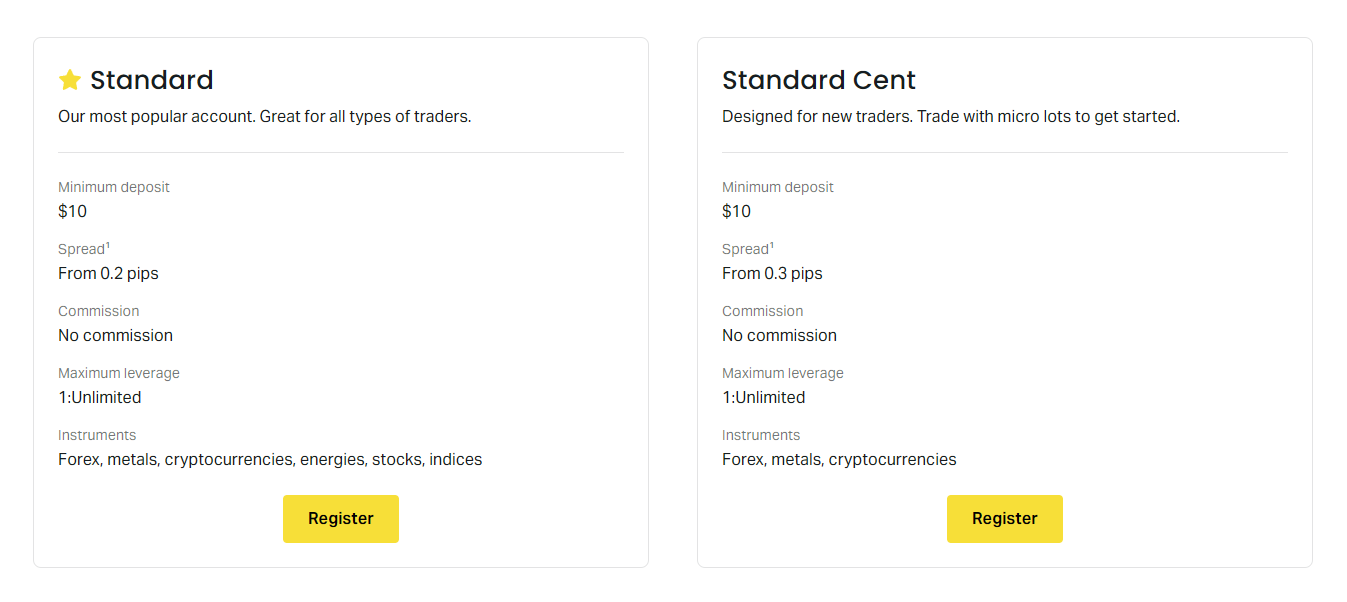
Understanding the Standard account type for forex and CFD trading

Forex Analyst
Forex Analyst specializing in currency markets, market trends, technical and fundamental analysis, and providing clear insights to help traders make informed decisions.
The Exness Standard Account represents one of the most accessible entry points for traders entering the forex and CFD markets. Designed to balance simplicity with professional-grade trading conditions, this account type serves both beginners taking their first steps and experienced traders who prefer straightforward pricing without commissions. Understanding its structure, costs, and capabilities helps traders decide whether it aligns with their strategy and capital requirements.
Contents
- Exness Standard Account Overview
- Account Features and Specifications
- Trading Costs: Spreads and Commissions
- Leverage and Margin Requirements
- Available Trading Instruments
- Platform Compatibility and Execution
- Minimum Deposit and Funding Options
- Comparison with Other Exness Account Types
- Risk Management Tools and Protection
- Opening and Verifying Your Standard Account
- Key Takeaways for Exness Standard Account Traders
Exness positions the Standard Account as a versatile option within its broader lineup, which includes Standard Cent, Raw Spread, Zero, and Pro accounts. Each tier targets different trader profiles, but the Standard Account occupies a middle ground: it requires no commission fees, offers market execution, and supports the full range of instruments available through the broker. This makes it a practical choice for those who want to trade forex pairs, metals, energies, indices, stocks, and cryptocurrencies from a single account without navigating complex fee schedules.
Before committing capital, traders should evaluate how the Standard Account's spread structure, leverage limits, and minimum deposit requirements interact with their trading style. Scalpers, swing traders, and position traders each experience different cost profiles under the same conditions. This guide examines every relevant aspect — from spreads and swaps to platform compatibility and risk management tools — so you can make an informed decision based on your own objectives.
Exness Standard Account Overview
The Standard Account operates on a spread-only pricing model, meaning the broker's compensation is built into the bid-ask spread rather than charged as a separate commission per lot. This approach simplifies cost calculation: what you see on the platform is what you pay, with no additional line items on trade confirmations. Spreads on major forex pairs typically start from 0.3 pips under normal market conditions, though they widen during periods of low liquidity or high volatility such as news releases or market open.
Account currency options include USD, EUR, GBP, CHF, JPY, AUD, CAD, NZD, SGD, HKD, and several others, allowing traders to avoid conversion fees when funding from local bank accounts. The account supports both MetaTrader 4 and MetaTrader 5 platforms across desktop, web, and mobile versions, plus the proprietary Exness Terminal and Exness Trade app. This multi-platform access ensures continuity whether you trade from a workstation, browser, or smartphone.
A notable feature is the absence of a minimum deposit requirement for most payment methods. While some brokers enforce a hard floor — often $100 or $200 — Exness allows Standard Account holders to start with whatever amount their chosen payment processor permits. In practice, this can be as low as $1 for certain e-wallets or local payment systems, though bank transfers may have higher minimums imposed by the sending institution. This flexibility lowers the barrier to entry significantly.
The Standard Account also includes negative balance protection, a critical safeguard that prevents losses from exceeding deposited funds. This protection applies automatically to all retail clients under applicable regulations. Additionally, the account benefits from Exness's order execution technology, which aims to fill orders at the best available price with minimal slippage. Execution statistics published by the broker indicate that a high percentage of orders are filled at the requested price or better, though individual results vary with market conditions.
Account Features and Specifications
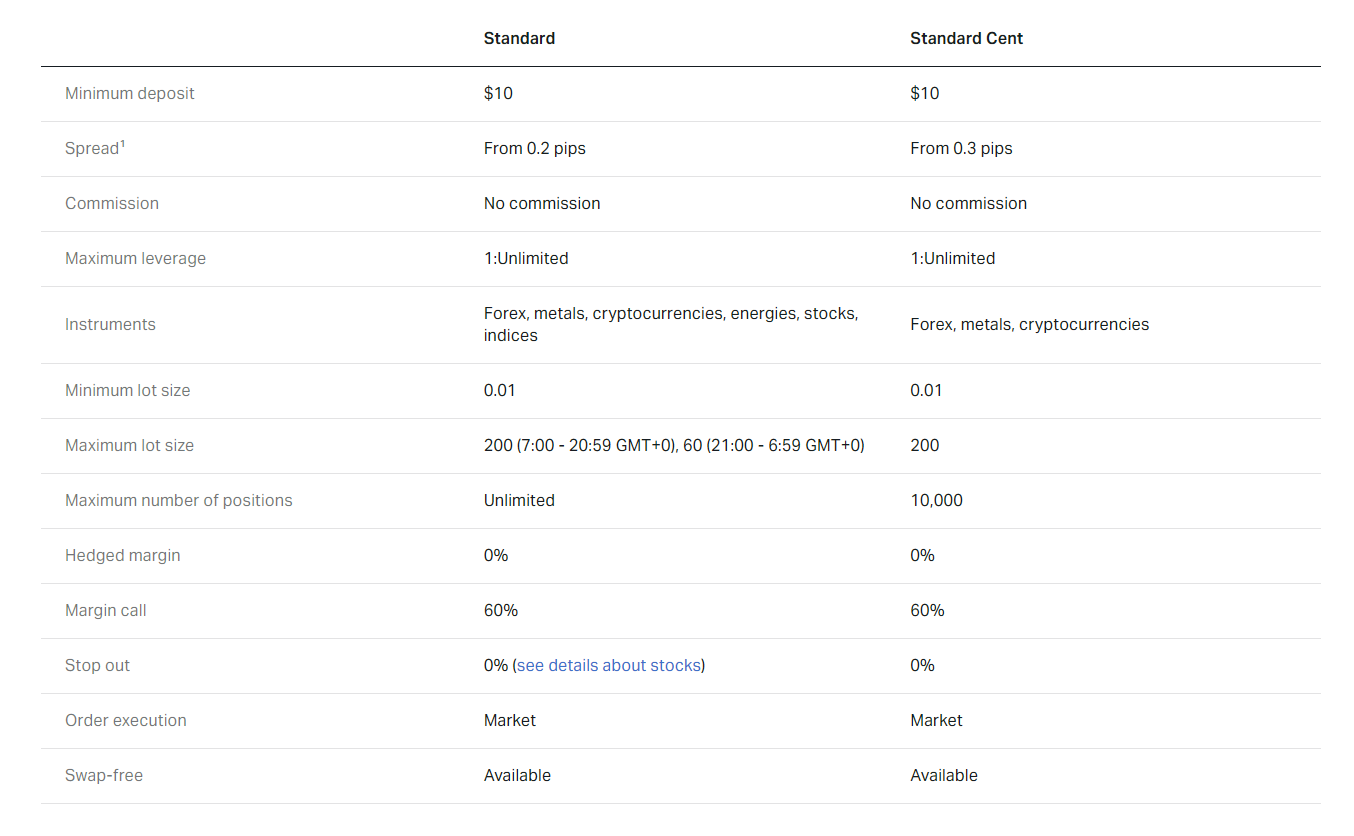
Every Standard Account comes with a baseline set of specifications that define how trading operates on a daily basis. The maximum leverage available depends on the instrument class and the regulatory jurisdiction governing the account. For forex majors under most regulators, leverage reaches up to 1:2000 for accounts with equity below certain thresholds, though it scales down as account equity grows. This dynamic leverage model protects both the trader and the broker from excessive risk exposure at higher balance levels.
The minimum trade size is 0.01 lots (1,000 units of base currency) for forex, with step increments of 0.01 lots. For metals, energies, and indices, contract specifications differ — gold (XAUUSD) allows 0.01 lots minimum, while some index CFDs may require 0.1 or 1 lot minimums. Maximum position sizes are generous, typically capped at 200 lots for forex and proportionally for other instruments, which accommodates even large institutional-style orders from retail accounts.
Margin requirements follow a tiered structure. For forex majors at 1:2000 leverage, the margin is 0.05% of notional value. As leverage decreases with higher equity, margin requirements rise accordingly. The margin call level sits at 60% and stop-out at 0%, meaning positions are automatically closed only when equity reaches zero. This stop-out level is more favorable than many competitors who stop out at 20% or 50%, giving trades more room to recover during adverse moves.
- Spread-only pricing with no commissions
- Dynamic leverage up to 1:2000 on forex majors
- Minimum trade size 0.01 lots for forex
- Margin call at 60%, stop-out at 0%
- Negative balance protection included
- Supports MT4, MT5, Exness Terminal, and mobile apps
- Multiple base currencies available
- No minimum deposit for most payment methods
Swap rates (overnight financing costs) apply to positions held past the daily rollover at 22:00 UTC. These rates vary by instrument and direction (long vs short) and are derived from interbank interest rate differentials plus the broker's markup. Exness publishes swap values transparently in the platform and on its website. Notably, swap-free (Islamic) accounts are available as a separate account type rather than a toggle on the Standard Account, so traders requiring swap-free conditions must open a dedicated Islamic account.
Trading Costs: Spreads and Commissions
Since the Standard Account charges no commissions, the spread constitutes the entire explicit trading cost. Understanding how spreads behave across different instruments and market sessions is essential for cost management. Major pairs like EURUSD, GBPUSD, and USDJPY typically show the tightest spreads, often ranging between 0.3 and 0.7 pips during the London-New York overlap when liquidity peaks. Cross pairs and minor currencies carry wider spreads, commonly 1.5 to 3 pips or more.
Precious metals trading on the Standard Account features competitive spreads on gold and silver. XAUUSD spreads often start around 15-25 cents (1.5-2.5 pips in standard quoting), while XAGUSD runs approximately 2-3 pips. Energy CFDs such as USOIL and UKOIL typically show spreads of 3-5 pips during active hours. Index CFDs vary widely: major indices like US30, US500, and USTEC may spread 0.4-1.0 points, while less liquid indices can exceed 5 points.
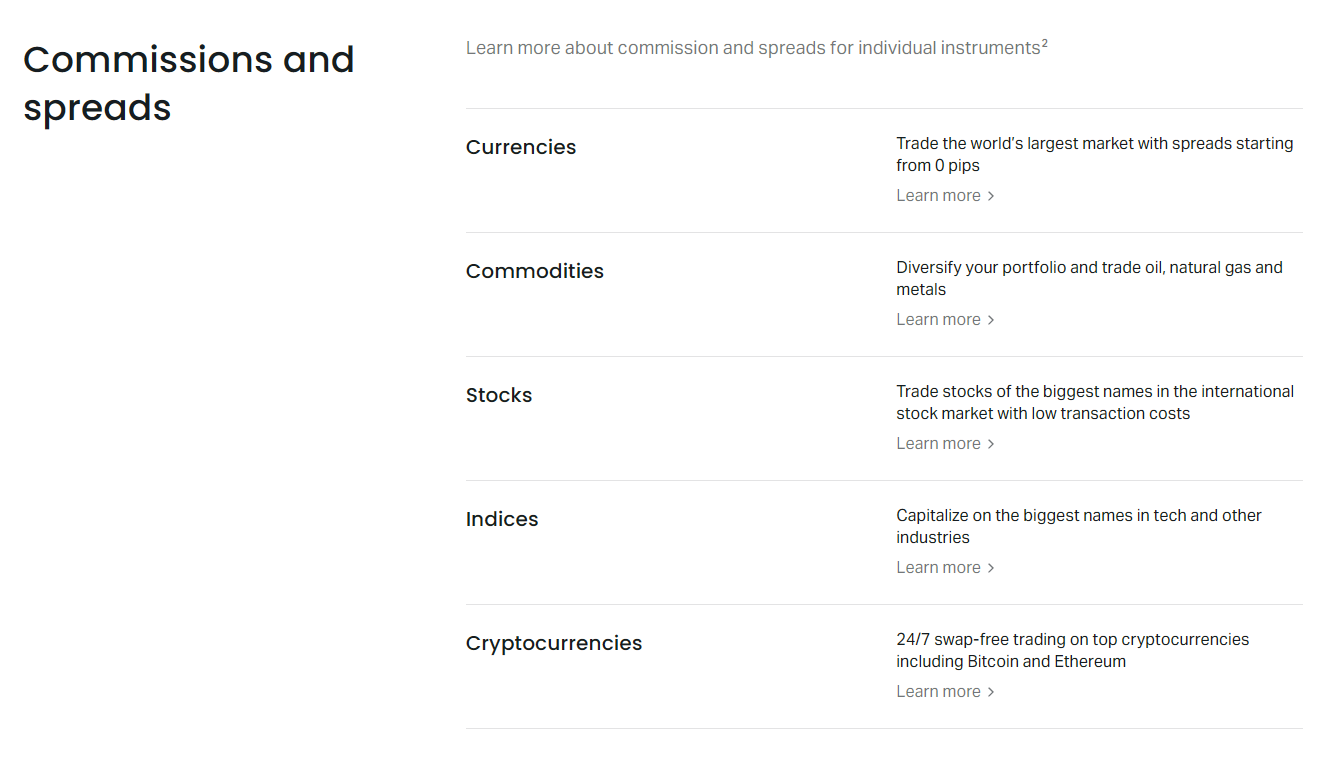
Cryptocurrency CFDs carry the widest spreads due to inherent market fragmentation and volatility. BTCUSD spreads can range from 200-500 pips (equivalent to $20-$50) depending on conditions, while altcoins like ETHUSD, LTCUSD, and XRPUSD proportionally wider. Traders holding crypto positions overnight should also factor in substantial swap charges, which reflect the high cost of borrowing these assets in the underlying market.
Scroll horizontally to see all columns
| Instrument Class | Examples | Typical Spread Range |
|---|---|---|
| Forex Majors | EURUSD, GBPUSD, USDJPY | 0.3 - 0.7 pips |
| Forex Minors | EURGBP, AUDJPY, GBPCAD | 1.0 - 2.5 pips |
| Forex Exotics | USDTRY, USDZAR, USDMXN | 10 - 50+ pips |
| Metals | XAUUSD, XAGUSD | 1.5 - 3.0 pips |
| Energies | USOIL, UKOIL, NGAS | 3 - 6 pips |
| Indices | US30, US500, GER40 | 0.4 - 2.0 points |
| Stocks | AAPL, TSLA, AMZN | 0.1 - 0.5% of price |
| Cryptocurrencies | BTCUSD, ETHUSD, XRPUSD | 200 - 500+ pips |
Spread widening during news events is a universal characteristic of spread-only accounts. Major economic releases — Non-Farm Payrolls, CPI, central bank decisions — can cause spreads to expand 3-10x normal levels for seconds or minutes. Traders using the Standard Account should either avoid trading during these windows or use wider stop-losses to accommodate the temporary cost increase. The Exness economic calendar, integrated into the platform and website, flags high-impact events in advance.
Leverage and Margin Requirements
Leverage on the Exness Standard Account operates on a dynamic model that adjusts automatically based on account equity. This system replaces the fixed leverage tiers found at many brokers and aims to align risk capacity with account size. For forex majors, the maximum leverage of 1:2000 applies when account equity is below $999. Between $1,000 and $4,999, maximum leverage reduces to 1:1000. From $5,000 to $29,999, it drops to 1:500. At $30,000 to $99,999, leverage caps at 1:200. Above $100,000 equity, the maximum is 1:100.
This tiered approach means a trader depositing $500 enjoys 1:2000 leverage, while the same trader growing the account to $10,000 sees leverage automatically reduced to 1:500. The change happens in real time as equity fluctuates. Importantly, open positions are not forcibly closed when leverage tiers shift; only new positions are subject to the current maximum. However, if equity drops enough to trigger a margin call or stop-out, the system will close positions regardless of the leverage tier.
Different instrument classes have their own leverage ceilings. Forex majors reach 1:2000 at the lowest equity tier. Forex minors and exotics typically max out at 1:1000 or 1:500. Metals (gold, silver) offer up to 1:1000. Energies and indices generally cap at 1:200 or 1:500. Stock CFDs and cryptocurrencies have the most conservative leverage, often 1:20 to 1:100 depending on the specific asset and regulator. These limits reflect the inherent volatility and liquidity risk of each asset class.
Scroll horizontally to see all columns
| Account Equity | Maximum Leverage | Margin Requirement |
|---|---|---|
| Below $1,000 | 1:2000 | 0.05% |
| $1,000 - $4,999 | 1:1000 | 0.1% |
| $5,000 - $29,999 | 1:500 | 0.2% |
| $30,000 - $99,999 | 1:200 | 0.5% |
| $100,000 and above | 1:100 | 1.0% |
Margin calculations follow the standard formula: Margin = (Contract Size × Lot Size × Asset Price) / Leverage. For a 1-lot EURUSD position at 1.0800 with 1:1000 leverage, the required margin is (100,000 × 1 × 1.0800) / 1000 = $108. The platform displays free margin, used margin, and margin level in real time. Traders should monitor margin level closely; at 60% a margin call warning triggers, and at 0% the stop-out process begins closing the most unprofitable positions first.
Dynamic leverage protects growing accounts from excessive risk while giving small accounts room to operate. It's a thoughtful compromise between accessibility and responsibility.
Available Trading Instruments
The Standard Account provides access to the full Exness instrument catalog, which spans over 200 trading pairs and CFDs across multiple asset classes. This breadth allows diversification within a single account without needing to manage separate logins or margin pools. The forex offering includes 100+ currency pairs covering majors, minors, and exotics. Major pairs benefit from the tightest spreads and deepest liquidity, while exotic pairs offer higher volatility at wider costs.
Metals trading covers gold (XAUUSD), silver (XAGUSD), platinum (XPTUSD), and palladium (XPDUSD) against USD, plus cross pairs like XAUEUR and XAUAUD. Gold remains the most actively traded metal, with sessions aligning with forex market hours for near-continuous coverage. Energies include US crude (USOIL), Brent crude (UKOIL), and natural gas (NGAS), with spreads and swaps reflecting the underlying futures curve structure.
Index CFDs cover major global benchmarks: US30 (Dow Jones), US500 (S&P 500), USTEC (Nasdaq 100), GER40 (DAX), UK100 (FTSE 100), FRA40 (CAC 40), JP225 (Nikkei 225), AUS200 (ASX 200), HK50 (Hang Seng), and others. These track cash indices or futures depending on the symbol, with trading hours matching the underlying exchange. Stock CFDs encompass hundreds of US, EU, and UK equities, allowing long and short positions with leverage up to 1:20. Cryptocurrency CFDs include BTCUSD, ETHUSD, LTCUSD, XRPUSD, BCHUSD, ADAUSD, and several DeFi tokens, traded 24/7 with wider spreads.
- 100+ forex pairs: majors, minors, exotics
- Precious metals: gold, silver, platinum, palladium
- Energies: WTI, Brent, natural gas
- 15+ global index CFDs
- 200+ stock CFDs from US, EU, UK exchanges
- 10+ cryptocurrency CFDs traded 24/7
- All instruments available on Standard Account
Instrument specifications — contract size, tick value, swap rates, trading hours — are viewable in the Market Watch window of MT4/MT5 or the instrument details panel in Exness Terminal. Traders should review these before trading unfamiliar markets, as tick values and margin calculations differ from forex. For example, one lot of US500 represents $1 per index point, while one lot of GER40 represents €1 per point. These differences affect position sizing and risk per pip/point.
Platform Compatibility and Execution
The Standard Account functions identically across all supported platforms: MetaTrader 4, MetaTrader 5, Exness Terminal (web-based), and the Exness Trade mobile app. This consistency means chart templates, indicators, expert advisors, and trade history synchronize when using the same login credentials. MT4 remains popular for its vast library of custom indicators and EAs, while MT5 adds more timeframes, order types, and an integrated economic calendar. Exness Terminal requires no installation and works from any modern browser, making it convenient for quick access or restricted environments.
Execution mode for the Standard Account is Market Execution, meaning orders are filled at the best available price in the market at the moment of processing. There is no requote mechanism — orders either fill at the current market price or are rejected if liquidity is insufficient. This model eliminates the frustration of requotes during fast markets but introduces slippage risk: the fill price may differ from the requested price, positively or negatively. Exness publishes execution quality reports showing slippage distribution, with the majority of orders experiencing zero or positive slippage.
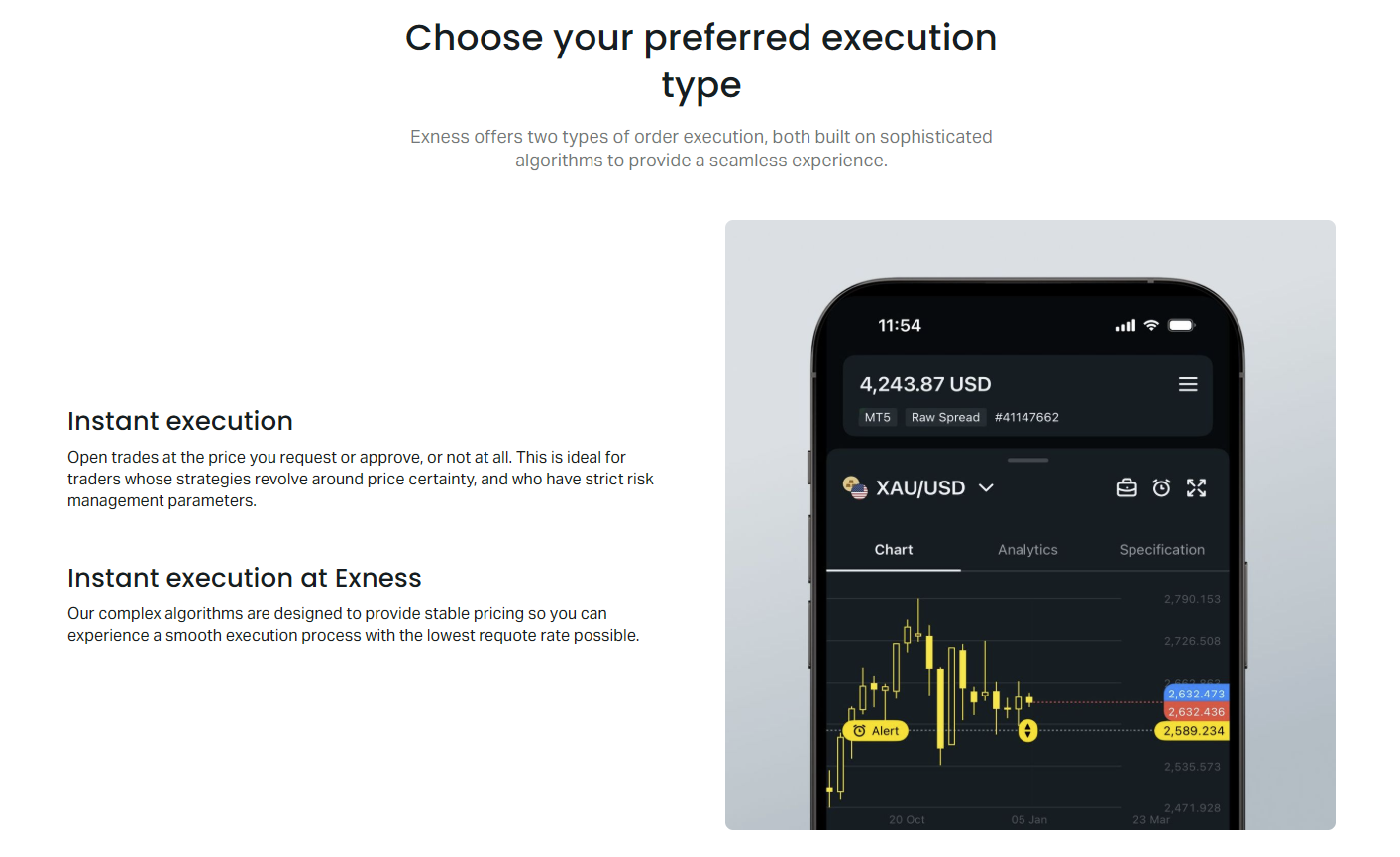
The Exness Trade app deserves specific attention for mobile-first traders. It provides a streamlined interface with one-tap trading, real-time quotes, charting with 15+ indicators, and full account management including deposits and withdrawals. Push notifications alert for margin calls, price levels, and economic events. The app also integrates the Exness calculator for quick margin, pip, and profit calculations without leaving the interface. For traders who monitor positions throughout the day, the mobile experience is robust and feature-complete.
Minimum Deposit and Funding Options
The Exness Standard Account minimum deposit is effectively zero for most electronic payment methods, a significant differentiator in an industry where $100-$500 minimums are common. This policy applies to popular e-wallets (Skrill, Neteller, WebMoney, Perfect Money), cryptocurrency deposits (BTC, USDT, USDC, ETH), and many local payment systems across Asia, Africa, and Latin America. Bank wire transfers typically require a minimum of $10 or equivalent due to intermediary bank fees, while card deposits (Visa, Mastercard) often start at $3-$10 depending on the processor.
Deposit processing times vary by method. E-wallets and cryptocurrencies are usually instant or within minutes. Card deposits process instantly in most cases but can take up to 24 hours if additional verification is triggered. Bank wires take 1-5 business days depending on the corridor. Exness does not charge deposit fees, though payment providers may impose their own charges. The Personal Area displays all available methods for your region with current limits and processing estimates before you initiate a transaction.
Withdrawals follow the same method priority rule common in regulated environments: funds must return to the original deposit source up to the deposited amount before profits can be withdrawn to an alternative method. This anti-money laundering measure means if you deposit $500 via Skrill and grow the account to $2,000, the first $500 withdrawn must go back to Skrill. The remaining $1,500 can go to any verified method. Withdrawal processing is notably fast — e-wallets and crypto often complete within minutes, cards within 1-3 business days, bank wires 1-5 days.
Comparison with Other Exness Account Types
Choosing between Exness account types depends on trading volume, strategy, and cost sensitivity. The Standard Account competes directly with the Standard Cent Account (which denominates balance in cents for micro-position sizing) and the professional-tier accounts: Pro, Raw Spread, and Zero. Each has a distinct cost structure suited to different profiles. The Standard Cent Account mirrors Standard conditions but with 100x smaller contract sizes — ideal for testing strategies with real money at minimal risk.
The Pro Account targets high-volume traders with spreads from 0.1 pips on majors and a $3.5 per lot per side commission. The Raw Spread Account offers similar spreads with the same commission but requires a higher minimum deposit ($500). The Zero Account provides zero spreads on top 30 instruments for a commission of $3.5-$20 per lot per side depending on the pair, with a $200 minimum deposit. For traders executing fewer than 50 lots monthly, the Standard Account's spread-only model often proves cheaper overall because the commission savings outweigh the slightly wider spreads.
Scroll horizontally to see all columns
| Account Type | Min Deposit | Spread Model | Commission | Best For |
|---|---|---|---|---|
| Standard Cent | $1 | From 0.3 pips | None | Micro trading, strategy testing |
| Standard | $1 (most methods) | From 0.3 pips | None | General retail trading, simplicity |
| Pro | $200 | From 0.1 pips | $3.5/lot/side | High volume, tight spreads |
| Raw Spread | $500 | From 0.0 pips | $3.5/lot/side | Scalpers, EA traders |
| Zero | $200 | Zero on top 30 | $3.5-$20/lot/side | Major pair specialists |
Leverage limits also differ. Standard and Standard Cent share the same dynamic leverage schedule up to 1:2000. Pro, Raw Spread, and Zero accounts cap at 1:2000 for equity under $999 but have stricter scaling at higher equity levels. The professional accounts also offer tighter stop-out levels (20% vs 0% for Standard), meaning positions close earlier during drawdowns. This trade-off reflects the professional accounts' focus on institutional-style risk management versus the Standard Account's emphasis on staying power for smaller accounts.
The Standard Account isn't a 'beginner' account — it's a full-featured trading environment. Many profitable traders never need the commission-based tiers because their strategy doesn't generate enough volume to justify the switch.
Risk Management Tools and Protection
Risk management on the Standard Account extends beyond negative balance protection. The platform provides several built-in tools that help traders control exposure without external calculators. The Exness Trading Calculator, accessible from the Personal Area and integrated into Exness Terminal, computes required margin, pip value, swap costs, and projected profit/loss for any hypothetical position across all instruments. This eliminates manual calculation errors and speeds up position sizing decisions.
Stop-loss and take-profit orders can be set at order entry or attached to open positions at any time. Trailing stops function on MT4/MT5 (client-side) and Exness Terminal (server-side), with the server-side version continuing to operate even when the platform is closed. This distinction matters for traders who cannot maintain 24/7 connectivity. Guaranteed stop-losses are not offered on the Standard Account; slippage on stop orders can occur during gaps or extreme volatility.
The margin call at 60% and stop-out at 0% provide a wide buffer compared to industry norms. Most brokers stop out at 20-50% margin level, forcing liquidation while the account still holds significant equity. Exness's 0% stop-out means positions remain open until equity is fully depleted, giving trades maximum recovery opportunity. However, this also means losses can accumulate to the full deposit amount. Traders should not rely on the stop-out as a risk control substitute for proper position sizing.
- Negative balance protection (regulatory)
- Margin call alert at 60% margin level
- Stop-out at 0% margin level (not 20-50%)
- Server-side trailing stops in Exness Terminal
- Integrated trading calculator for position sizing
- Real-time margin level monitoring in platform
- Customizable price alerts via app and platform
Opening and Verifying Your Standard Account
Account opening begins on the Exness website or app with email registration and password creation. The process takes under five minutes for the initial setup. After registration, you receive a Personal Area login where you can create your first Standard Account (or Standard Cent, Pro, etc.). During account creation, you select the account currency (cannot be changed later), set a trading password (different from Personal Area password), and choose leverage preference — though dynamic leverage will apply regardless.
Verification (KYC) is required before withdrawals can be processed, though deposits and trading can begin immediately with some limits. Standard verification requires a government-issued photo ID (passport, national ID, driver's license) and proof of address (utility bill, bank statement) dated within the last three months. Documents are uploaded through the Personal Area and typically reviewed within a few hours. Once verified, all deposit and withdrawal limits are lifted. Unverified accounts face withdrawal restrictions and lower deposit caps depending on the payment method.
The Exness Personal Area serves as the central hub for account management. From here you can create additional accounts (up to 200 per profile), transfer funds between accounts instantly, manage leverage settings, download platform installers, access the trading calculator, view trading history and statements, and contact support. The interface is available in 15+ languages. For traders managing multiple strategies, the ability to segregate capital across separate Standard Accounts under one login simplifies performance tracking and risk isolation.
Key Takeaways for Exness Standard Account Traders
The Exness Standard Account delivers a compelling combination of accessibility, transparency, and professional infrastructure. Its spread-only pricing eliminates commission complexity, making cost tracking straightforward for traders at any volume. The effectively zero minimum deposit for electronic methods removes a common barrier to entry, while dynamic leverage up to 1:2000 provides flexibility for small accounts without exposing the broker to unbounded risk. Negative balance protection and a 0% stop-out level add safety layers that exceed many competitors' offerings.
Traders should weigh the Standard Account against commission-based alternatives based on their monthly volume. Below roughly 50-100 lots per month, the Standard Account's wider-but-commission-free spreads often result in lower total costs. Above that threshold, Raw Spread, Zero, or Pro accounts typically become more economical despite their commissions. The ability to open multiple account types under one Personal Area means you can run parallel strategies — perhaps a Standard Account for swing trades and a Raw Spread account for scalping — without administrative friction.
Platform choice should match your workflow: MT4 for algorithmic traders reliant on custom EAs, MT5 for those needing more timeframes and order types, Exness Terminal for browser-based convenience, and the Exness Trade app for mobile-first monitoring. All connect to the same Standard Account with identical pricing and execution. The integrated trading calculator, economic calendar, and analytical resources (Trading Central signals, FXStreet news) add value without requiring third-party subscriptions.
The Standard Account proves that 'standard' doesn't mean basic. It's a fully capable professional environment with pricing that scales fairly for retail volumes.
Frequently Asked Questions
What is the minimum deposit for Exness Standard Account?
There is no fixed minimum deposit for most electronic payment methods including e-wallets and cryptocurrencies. You can start with as little as $1 depending on the payment processor. Bank wire transfers typically require at least $10 due to intermediary fees.
Does Exness Standard Account charge commissions?
No, the Standard Account uses a spread-only pricing model with zero commissions. All trading costs are embedded in the bid-ask spread you see on the platform.
What leverage is available on Exness Standard Account?
Dynamic leverage up to 1:2000 on forex majors for accounts with equity below $1,000. Leverage decreases automatically as equity grows: 1:1000 up to $5,000, 1:500 up to $30,000, 1:200 up to $100,000, and 1:100 above $100,000. Other instruments have lower maximums.
Can I trade cryptocurrencies on Exness Standard Account?
Yes, the Standard Account offers 10+ cryptocurrency CFDs including BTCUSD, ETHUSD, LTCUSD, XRPUSD, and others. These trade 24/7 with wider spreads than forex and significant overnight swap charges.
What is the stop-out level for Exness Standard Account?
The stop-out level is 0% margin level, meaning positions are only closed when equity reaches zero. This is more favorable than many brokers who stop out at 20-50%. A margin call warning triggers at 60% margin level.
Is Exness Standard Account available on MetaTrader 5?
Yes, the Standard Account works on both MetaTrader 4 and MetaTrader 5, plus the Exness Terminal web platform and Exness Trade mobile app. All platforms connect to the same account with identical conditions.
How do I switch from Standard to Raw Spread account?
You cannot convert an existing account. Instead, create a new Raw Spread account from your Personal Area (supports up to 200 accounts per profile). Fund it separately and trade from the platform of your choice.