

Commodities Trading
Exness Silver Trading XAGUSD: Complete Guide
Discover silver trading conditions, account types, and strategies for XAGUSD on Exness platforms.

Forex Analyst
Forex Analyst specializing in currency markets, market trends, technical and fundamental analysis, and providing clear insights to help traders make informed decisions.
Silver trading through the XAGUSD pair offers traders exposure to one of the most versatile precious metals in the financial markets. Unlike gold, which functions primarily as a monetary asset and safe haven, silver carries significant industrial demand that creates unique price dynamics. Exness provides access to this market through competitive trading conditions that cater to both speculative and hedging strategies.
Contents
- Why Trade Silver on Exness
- XAGUSD Trading Conditions on Exness
- Account Types for Silver Trading
- Trading Platforms for Silver on Exness
- Silver Trading Strategies for XAGUSD
- Risk Management for Silver Trading
- Silver vs Gold Trading Comparison
- Trading Hours and Session Dynamics
- Technical Analysis for Silver
- Fundamental Factors Affecting Silver
- Using Exness Tools for Silver Trading
- Common Silver Trading Mistakes
- Getting Started with XAGUSD on Exness
- Final Assessment of Exness Silver Trading
The XAGUSD symbol represents the price of one troy ounce of silver quoted in US dollars. This pairing allows traders to speculate on silver price movements without taking physical delivery. Exness offers this instrument across multiple account types with varying spread structures, commission models, and leverage tiers, making it accessible to traders with different capital levels and risk appetites.
Understanding the dual nature of silver as both a precious metal and an industrial commodity is essential for effective trading. Industrial applications in electronics, solar panels, medical devices, and automotive manufacturing create demand that responds to economic cycles differently than gold. This characteristic means silver often exhibits higher volatility and stronger correlation with equity markets and manufacturing data.
Why Trade Silver on Exness
Exness has established itself as a prominent broker for metals trading by combining tight pricing with reliable execution infrastructure. The broker's aggregation model connects to multiple liquidity providers, which helps maintain competitive spreads on XAGUSD even during periods of elevated market volatility. This multi-source liquidity approach reduces the likelihood of excessive slippage during news events or session transitions.
The platform supports both MetaTrader 4 and MetaTrader 5, along with a proprietary web terminal and mobile applications. This multi-platform availability ensures traders can access silver markets from desktop, browser, or mobile devices without functionality gaps. The web terminal is particularly useful for traders who cannot install software on work computers or prefer browser-based access.
Exness offers instant withdrawal processing for most payment methods, which is a significant operational advantage for active metals traders who need quick access to profits. The broker also provides negative balance protection, ensuring that client losses cannot exceed deposited funds. This protection is especially relevant for silver trading where leverage can amplify both gains and losses rapidly.
The broker's regulatory framework includes licenses from multiple jurisdictions, providing a layer of oversight that many offshore-only brokers lack. Client funds are held in segregated accounts with top-tier banks, and the company undergoes regular external audits. These structural safeguards matter for metals traders who may maintain larger account balances due to margin requirements on leveraged positions.
XAGUSD Trading Conditions on Exness
Trading conditions for XAGUSD vary by account type, with the most notable differences appearing in spread structure, commission charges, and minimum lot sizes. The Standard and Standard Cent accounts operate on a spread-only model with no commissions, while the Zero, Raw Spread, and Pro accounts charge commissions in exchange for tighter raw spreads. Understanding these differences is crucial for calculating true trading costs.
Typical spreads on XAGUSD range from approximately 0.3 pips on Raw Spread accounts to 2.0 pips on Standard accounts during normal market conditions. However, spreads widen during major economic releases, rollover periods, and low-liquidity hours. The commission on Raw Spread accounts is typically $3.50 per side per lot, making the all-in cost approximately 1.0 pip equivalent for a round trip on a standard lot.
Leverage for silver trading reaches up to 1:2000 on certain account types, though this maximum applies only to accounts with equity below specific thresholds. As account equity grows, maximum leverage decreases in tiers. For example, accounts above $2,000 equity may see maximum leverage reduced to 1:200, and further reductions apply at higher equity levels. This tiered approach is a risk management feature mandated by regulatory requirements.
Scroll horizontally to see all columns
| Account Type | Typical Spread | Commission | Min Lot | Max Leverage |
|---|---|---|---|---|
| Standard | ~2.0 pips | None | 0.01 | 1:2000* |
| Standard Cent | ~2.0 pips | None | 0.01 | 1:2000* |
| Pro | ~0.7 pips | None | 0.01 | 1:2000* |
| Zero | ~0.3 pips | $3.50/lot/side | 0.01 | 1:2000* |
| Raw Spread | ~0.3 pips | $3.50/lot/side | 0.01 | 1:2000* |
Swap rates for XAGUSD positions held overnight vary by account type and market conditions. Long positions typically incur negative swaps (cost to hold), while short positions may receive positive swaps or pay reduced negative swaps depending on interest rate differentials and the broker's swap calculation methodology. Islamic accounts are swap-free but may have wider spreads or administrative fees to compensate.
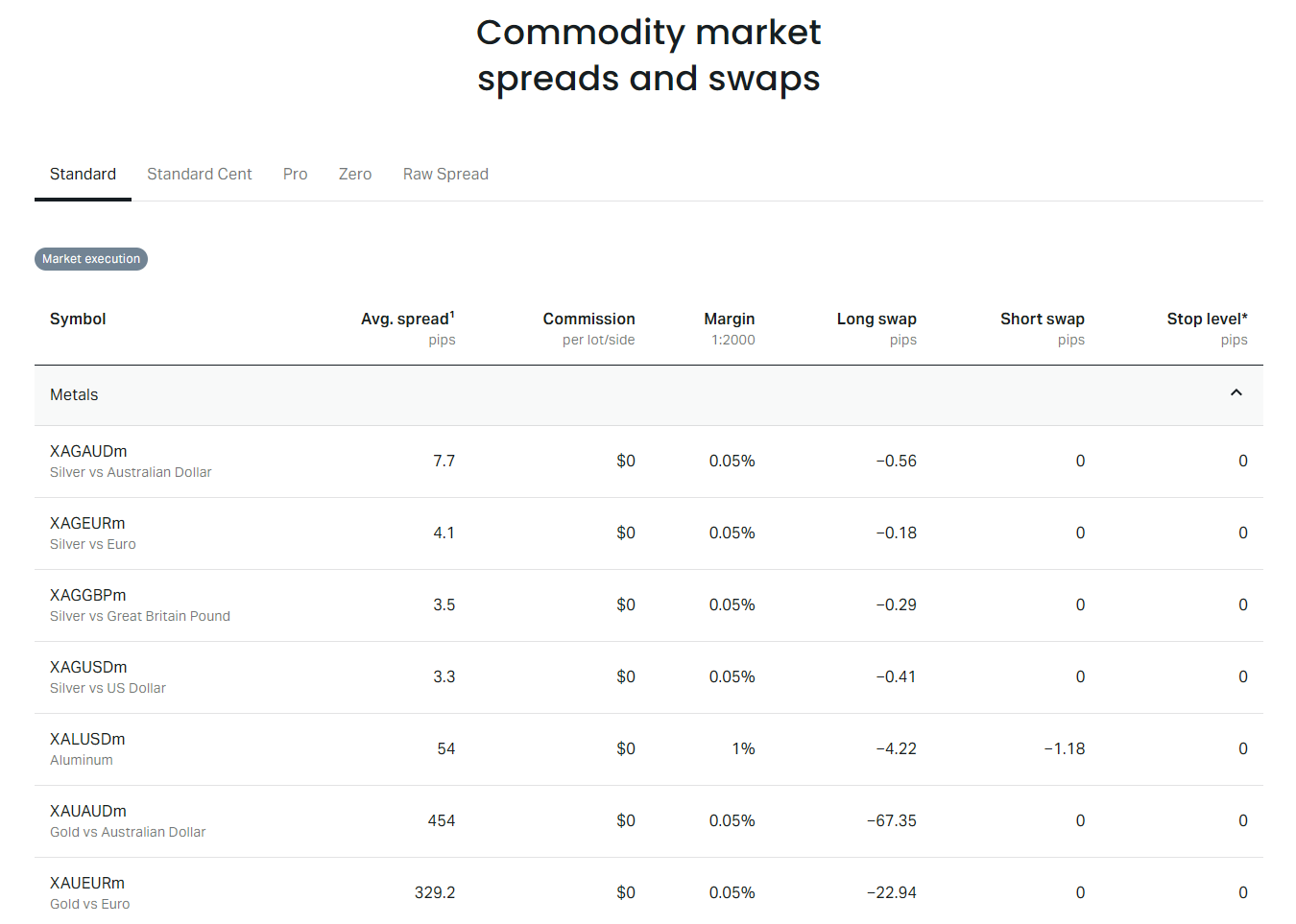
The minimum lot size for XAGUSD is 0.01 lots across all account types, representing 10 troy ounces of silver. This granularity allows precise position sizing even for smaller accounts. Maximum lot size per position is typically 100 lots, though aggregate exposure limits may apply. Margin requirements are calculated based on the notional value of the position divided by the applicable leverage tier.
Account Types for Silver Trading
Choosing the right account type for silver trading depends on trading frequency, position size, and cost sensitivity. High-frequency scalpers and algorithmic traders typically benefit from Raw Spread or Zero accounts where the commission structure rewards volume. Swing traders and position traders holding positions for days or weeks may find the spread-only Standard or Pro accounts more cost-effective since they avoid commission drag on longer-held trades.
The Standard Cent account deserves special mention for traders new to silver. It denominates the account balance in cents rather than dollars, meaning a $10 deposit appears as 1,000 cents. This psychological scaling allows traders to experience real market conditions with minimal financial risk while learning position sizing and risk management. The trading conditions mirror the Standard account, including spreads and execution.
Professional accounts (Pro, Zero, Raw Spread) require higher minimum deposits but offer superior pricing. The Pro account provides tight spreads without commissions, making it suitable for traders who prefer simplicity. Zero and Raw Spread accounts are functionally similar, both offering near-interbank spreads with transparent commission charges. The choice between them often comes down to regional availability and specific instrument coverage.
- Standard: Best for beginners, low frequency, simplicity preferred
- Standard Cent: Ideal for learning with real money at micro scale
- Pro: Good for swing traders wanting tight spreads without commissions
- Zero: Optimal for high-frequency and algorithmic silver trading
- Raw Spread: Equivalent to Zero, availability varies by region
Trading Platforms for Silver on Exness
Exness supports four primary trading venues for XAGUSD: MetaTrader 4, MetaTrader 5, the Exness Web Terminal, and the Exness Trade mobile app. Each platform offers full access to silver trading with charting, technical indicators, and order management capabilities. The choice often depends on trader preference for specific platform ecosystems and feature sets.
MetaTrader 4 remains the most widely used platform globally, with extensive third-party indicator and expert advisor support. For silver traders using custom technical analysis tools or automated strategies, MT4's mature ecosystem provides the largest library of ready-made solutions. The platform supports 9 timeframes and 30 built-in indicators, sufficient for most silver trading approaches.
MetaTrader 5 adds 21 timeframes, 38 built-in indicators, an economic calendar, and improved strategy tester with multi-currency backtesting. The Depth of Market (DOM) feature is particularly valuable for silver traders who want to see liquidity levels at different prices. MT5 also supports netting and hedging modes, giving flexibility in position management.
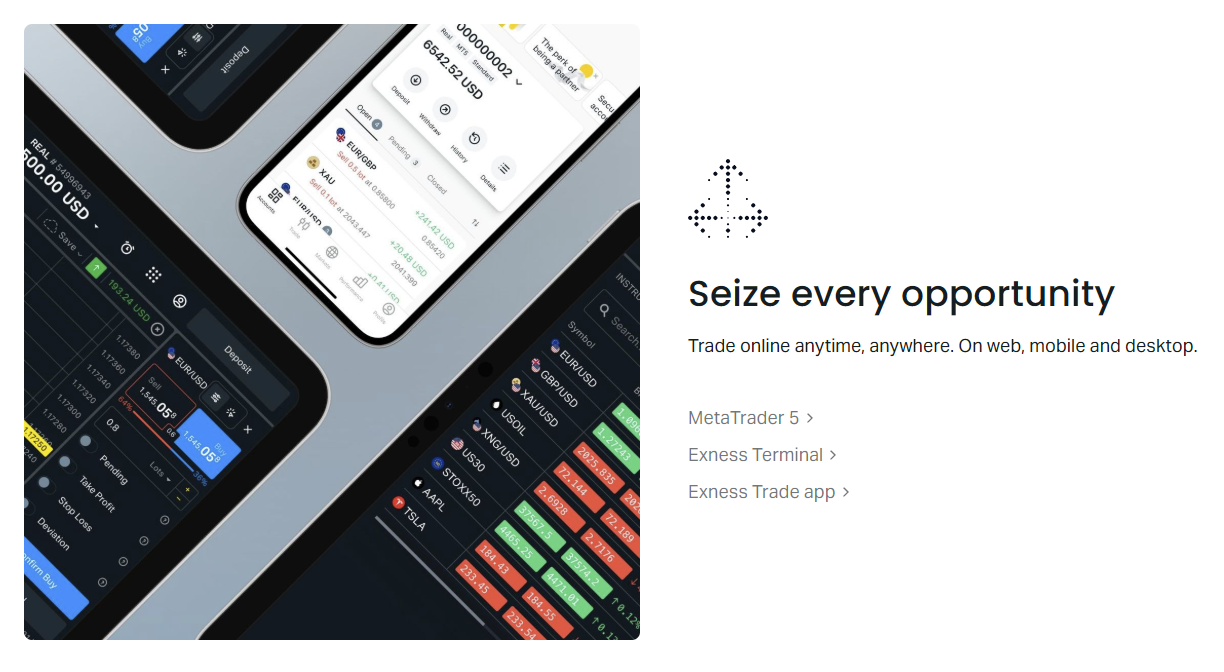
The Exness Web Terminal requires no installation and runs in any modern browser. It replicates core MT5 functionality including charting, one-click trading, and indicator support. This platform is ideal for traders who switch devices frequently or face installation restrictions. The web terminal synchronizes with MT5 accounts, so positions and charts remain consistent across platforms.
The Exness Trade mobile app provides full trading functionality on iOS and Android. It includes real-time quotes, interactive charts with technical indicators, economic calendar integration, and push notifications for price alerts and margin calls. The app supports biometric login and offers a streamlined interface optimized for smaller screens without sacrificing analytical capability.
Silver Trading Strategies for XAGUSD
Effective silver trading strategies must account for the metal's hybrid nature. Trend-following approaches work well during sustained industrial demand cycles or monetary policy regimes. Mean-reversion strategies can exploit silver's tendency to overshoot during sentiment extremes. Breakout strategies capture volatility expansions around economic data releases. The key is matching strategy timeframe to the dominant market driver.
Intraday scalping on XAGUSD focuses on capturing small price movements during high-liquidity sessions, particularly the London-New York overlap (13:00-17:00 UTC). Scalpers typically use 1-minute to 15-minute charts with tight stops and targets. This approach requires Raw Spread or Zero accounts to keep transaction costs from eroding the small per-trade profits. Execution speed and minimal slippage are critical success factors.
Swing trading silver involves holding positions for several days to weeks, targeting moves driven by macroeconomic shifts. Traders monitor the US Dollar Index (DXY), real yields, manufacturing PMIs, and inflation expectations. A common approach uses daily and 4-hour charts with moving averages, RSI, and Fibonacci retracements. Position sizing accounts for wider stops needed to withstand normal silver volatility.
- Trend following: Trade in direction of 200-day MA with pullback entries
- Range trading: Buy support, sell resistance during low-volatility periods
- Breakout trading: Enter on volatility expansion above/below key levels
- Correlation trading: Trade silver-gold ratio extremes (XAGUSD/XAUUSD)
- Seasonal patterns: Historical strength in Q1 and Q4, weakness in summer
Risk Management for Silver Trading
Risk management is paramount when trading XAGUSD due to silver's elevated volatility and leverage availability. The combination can produce rapid account drawdowns if position sizing and stop-loss discipline are neglected. Professional traders typically risk 1-2% of account equity per trade, adjusting position size so that the stop-loss distance in dollars equals the risk budget.
Silver's price can gap during major news events such as Federal Reserve announcements, non-farm payrolls, or geopolitical developments. Weekend gaps are also common when markets reopen Sunday evening. Traders holding positions over weekends or high-impact events should consider reducing position size or using guaranteed stop-loss orders where available. Exness offers stop-out protection that closes positions at 0% margin level, but this does not prevent negative slippage during gaps.
Correlation risk is another consideration. Silver often correlates positively with gold (XAUUSD), copper, and equity indices, while correlating negatively with the US dollar and real yields. Holding simultaneous long positions in silver, gold, and mining stocks concentrates risk rather than diversifying it. Portfolio-level risk management requires monitoring aggregate exposure to these correlated assets.
Scroll horizontally to see all columns
| Metric | Typical Range | Implication |
|---|---|---|
| Daily ATR (14) | 1.5-3.0% | Wider stops needed vs gold |
| Correlation to Gold | 0.7-0.9 | Limited diversification benefit |
| Correlation to DXY | -0.6 to -0.8 | Dollar strength pressures silver |
| Correlation to SPX | 0.3-0.6 | Risk-on supports silver |
| Weekend Gap Frequency | Moderate | Reduce size over weekends |
Margin management becomes critical during volatile periods. Exness uses a tiered margin system where required margin increases as position size grows. Traders should monitor free margin and margin level continuously, especially when using high leverage. The broker's margin call occurs at 100% margin level, and stop-out triggers at 0%. Maintaining margin level above 200% provides a comfortable buffer for normal silver price fluctuations.
Silver vs Gold Trading Comparison
While both are precious metals, silver and gold serve different roles in portfolios and exhibit distinct trading characteristics. Gold functions primarily as a monetary asset and safe haven, with price driven by real yields, dollar strength, and risk sentiment. Silver adds industrial demand to this mix, creating a dual-driver dynamic that produces higher beta to economic cycles. This fundamental difference shapes how traders approach each metal.
The gold-silver ratio (XAUUSD/XAGUSD) measures how many ounces of silver buy one ounce of gold. Historically, this ratio has ranged from 30:1 to 100:1, with extremes signaling potential mean-reversion opportunities. When the ratio reaches historical highs, silver is relatively cheap versus gold, potentially favoring long silver/short gold pairs trades. Conversely, low ratios suggest silver is expensive relative to gold.
Silver's smaller market size and lower liquidity compared to gold result in wider spreads, higher volatility, and greater slippage risk. However, this also means larger percentage moves are possible, offering greater profit potential for correctly positioned trades. The Exness spread on XAGUSD is typically wider than on XAUUSD, reflecting this liquidity difference. Traders must factor this into strategy selection and cost calculations.
- Volatility: Silver ~1.5-2x gold daily range
- Liquidity: Gold deeper, tighter spreads, less slippage
- Industrial demand: Silver ~50% industrial, gold ~10%
- Monetary role: Gold primary reserve asset, silver secondary
- Correlation: High (0.7-0.9) but diverges at extremes
- Ratio trading: Gold-silver ratio offers pairs opportunities
Silver's industrial demand component creates a structural link to global manufacturing cycles that gold lacks, making it a more cyclical and volatile trading vehicle.
Trading Hours and Session Dynamics
XAGUSD trading on Exness follows the standard metals schedule: Monday 00:00 to Friday 23:59 server time (typically UTC+2 or UTC+3 depending on daylight saving), with a daily break from 23:59 to 00:01. The most active periods align with major financial center hours. Understanding session characteristics helps traders choose optimal entry and exit times for their strategies.
The Asian session (00:00-08:00 UTC) typically sees lower volume and tighter ranges, suitable for range-bound strategies. The London session (08:00-16:00 UTC) brings increased volume and volatility as European markets open. The New York session (13:00-21:00 UTC) overlaps with London for several hours, creating the highest liquidity and tightest spreads of the day. This overlap is when most institutional silver trading occurs.
Economic data releases create predictable volatility windows. US releases at 13:30 UTC (8:30 ET) including CPI, PPI, NFP, ISM, and retail sales often trigger sharp silver moves. Federal Reserve speeches and FOMC minutes at 19:00 UTC (14:00 ET) are also high-impact. Chinese manufacturing PMI (01:00 UTC) affects silver due to China's dominant role in industrial metals consumption. Traders should consult the economic calendar and adjust risk around these events.
Rollover at 23:59 UTC involves swap charges or credits for positions held overnight. Wednesday rollover carries triple swap to account for the weekend. Spreads typically widen 30-60 minutes before rollover as liquidity providers adjust books. Traders not intending to hold positions through rollover should close or reduce exposure before this window to avoid widened spreads and swap costs.
Technical Analysis for Silver
Technical analysis on XAGUSD benefits from silver's tendency to respect key levels and trend structures, particularly on higher timeframes. The metal's dual monetary-industrial nature means it responds to both technical patterns and fundamental drivers. Combining technical setups with fundamental awareness improves trade selection and timing. Exness platforms provide comprehensive charting tools for this analysis.
Moving averages serve as dynamic support and resistance. The 50-day and 200-day simple moving averages on daily charts are widely watched by institutional traders. Golden crosses (50 DMA crossing above 200 DMA) and death crosses (50 DMA crossing below 200 DMA) signal major trend shifts. On intraday timeframes, the 20-period EMA on 15-minute and 1-hour charts helps identify short-term trend direction and pullback entries.
Momentum oscillators like RSI (14) and Stochastic (14,3,3) identify overbought and oversold conditions. However, in strong trends, these indicators can remain at extremes for extended periods. Using them for counter-trend trades without confirmation often leads to premature entries. Better application involves watching for divergence between price and oscillator at key levels, signaling potential exhaustion.
- Key daily levels: 50 DMA, 200 DMA, prior swing highs/lows
- Intraday: VWAP, 20 EMA, session open/close levels
- Fibonacci retracements: 38.2%, 50%, 61.8% of major swings
- Volume profile: Identify high-volume nodes as support/resistance
- RSI divergence: Bullish/bearish at extremes with confirmation
- Bollinger Bands: Squeeze patterns precede volatility expansion
Fundamental Factors Affecting Silver
Silver prices respond to a broader set of fundamental drivers than most financial assets. Monetary policy, particularly US Federal Reserve decisions, affects silver through real yields and dollar valuation. Lower real yields reduce the opportunity cost of holding non-yielding silver, while a weaker dollar makes silver cheaper for foreign buyers. These channels operate similarly to gold but with amplified effect due to silver's smaller market.
Industrial demand constitutes approximately 50% of total silver consumption. Key sectors include photovoltaics (solar panels), electronics, automotive (especially electric vehicles), and medical applications. Global manufacturing PMI data, particularly from China, the US, and Germany, provides leading indicators for industrial silver demand. Strong manufacturing data typically supports silver prices, while contraction signals demand destruction.
Supply dynamics add another layer. Mine production, recycling rates, and government stockpile sales affect available supply. Silver is often a byproduct of copper, lead, and zinc mining, meaning primary silver mine supply responds to base metal economics rather than silver prices directly. This inelastic supply response can exacerbate price moves during demand shocks. Exness provides an economic calendar and market news feed to track these fundamentals.
Scroll horizontally to see all columns
| Driver | Impact on Silver | Monitoring Frequency |
|---|---|---|
| US Real Yields | Negative correlation | Daily (TIPS yields) |
| US Dollar Index | Negative correlation | Daily (DXY) |
| Global Manufacturing PMI | Positive correlation | Monthly |
| Solar Installation Forecasts | Positive long-term | Quarterly/Annual |
| Mine Supply Growth | Negative if increasing | Annual |
| Gold Price | Strong positive correlation | Real-time |
| Inflation Expectations | Positive (hedge demand) | Monthly (CPI/PCE) |
| Risk Sentiment (VIX) | Mixed (safe haven vs industrial) | Daily |
Geopolitical events affect silver through both safe-haven demand and supply disruption channels. Conflicts in major mining regions (Mexico, Peru, China, Poland, Chile) can constrain supply. Simultaneously, geopolitical tension increases safe-haven buying. The net effect depends on which channel dominates. Traders should monitor mining region stability and global tension indices alongside traditional financial metrics.
Using Exness Tools for Silver Trading
Exness provides several built-in tools that enhance silver trading decisions. The trading calculator allows precise position sizing by computing required margin, pip value, and swap costs for any XAGUSD position size. This eliminates manual calculation errors and helps maintain consistent risk parameters. The calculator accounts for account type, leverage tier, and current market prices.
The economic calendar integrated into the web terminal and mobile app highlights high-impact events affecting silver. Events are color-coded by expected volatility impact, with filters for specific currencies and event types. Traders can set notifications for upcoming releases, ensuring they never miss a market-moving announcement. The calendar also shows consensus forecasts and previous values for quick assessment.
Trading Central signals, available to Exness clients, provide technical analysis-based trade ideas for XAGUSD among other instruments. These signals identify potential entry, stop-loss, and take-profit levels based on pattern recognition and indicator confluence. While not a substitute for personal analysis, they serve as a useful second opinion or starting point for further research. Signals cover multiple timeframes from intraday to weekly.
The Exness VPS (Virtual Private Server) service benefits algorithmic silver traders running expert advisors on MT4 or MT5. Low-latency connectivity to Exness trade servers reduces execution delay, which is critical for strategies sensitive to slippage. The VPS runs 24/7 independent of the trader's local computer and internet connection, ensuring uninterrupted strategy operation during power outages or connectivity issues.
The trading calculator is an underutilized tool that prevents the most common error in metals trading: incorrect position sizing due to misunderstanding contract specifications.
Common Silver Trading Mistakes
Several recurring mistakes undermine silver traders on Exness and other platforms. Overleveraging tops the list, driven by the availability of up to 1:2000 leverage. While high leverage reduces margin requirements, it magnifies losses proportionally. A 0.5% adverse move on 1:2000 leverage wipes out the entire position margin. Prudent traders use effective leverage of 1:10 to 1:50 regardless of maximum available.
Ignoring the gold-silver ratio leads to missed context. Silver rarely moves independently of gold for extended periods. Trading silver without monitoring gold price action and the ratio is like trading a stock without watching its sector index. The ratio provides valuation context and signals potential mean-reversion trades when it reaches historical extremes.
Failing to account for wider spreads during rollover and news events increases transaction costs unexpectedly. Many traders calculate costs using typical spreads but execute during high-volatility windows where spreads can triple. Always check current spread before entering, and consider using limit orders instead of market orders during uncertain conditions to control entry price.
- Overleveraging: Using maximum available leverage instead of risk-based sizing
- Ignoring gold correlation: Trading silver in isolation from XAUUSD
- Neglecting spread timing: Entering during rollover or news without adjustment
- No stop-loss: Relying on mental stops that fail during fast moves
- Averaging down: Adding to losing positions without defined plan
- Overtrading: Taking too many positions correlated to same driver
- Ignoring swaps: Holding negative-carry positions too long
- No journal: Failing to track and review silver-specific trade outcomes
Getting Started with XAGUSD on Exness
Opening an Exness account for silver trading follows a streamlined digital process. Registration requires email verification, followed by profile completion with personal details and address verification. The KYC (Know Your Customer) process typically completes within minutes for most jurisdictions, though some regions may require additional documentation. Once verified, traders can deposit funds and access XAGUSD immediately.
Minimum deposit requirements vary by payment method and region but start as low as $1 for Standard Cent accounts. For meaningful silver trading with proper risk management, a deposit of $100-$500 allows reasonable position sizing on Standard or Pro accounts. Raw Spread and Zero accounts typically require higher minimums ($200-$500) but offer better pricing for active traders.
New traders should begin with the demo account, which replicates live market conditions with virtual funds. The Exness demo account has no expiration and can be reset at any time. Use it to practice position sizing, test strategies, and familiarize yourself with platform features before risking real capital. Treat demo trading seriously by following the same risk rules you would apply to a live account.
After gaining confidence, transition to a live Standard Cent account for micro-scale real-money experience. This bridges the psychological gap between demo and standard live trading. Once consistent profitability is demonstrated over 50-100 trades, consider upgrading to Standard, Pro, or Raw Spread accounts based on your trading style and volume. Exness allows multiple accounts under one profile, facilitating this progression.
Final Assessment of Exness Silver Trading
Exness delivers a compelling offering for XAGUSD traders through its combination of competitive pricing, multiple account structures, robust platform ecosystem, and strong regulatory framework. The availability of raw spread accounts with transparent commissions benefits high-volume traders, while spread-only accounts serve those preferring simplicity. The tiered leverage system balances accessibility with responsible risk management.
The broker's execution quality, supported by multi-provider liquidity aggregation, ensures that silver orders fill at or near requested prices under normal conditions. Instant withdrawal processing enhances operational flexibility for active traders. The comprehensive toolset including calculators, economic calendar, Trading Central signals, and VPS hosting addresses the practical needs of serious metals traders.
Silver's unique dual nature as monetary asset and industrial commodity creates trading opportunities distinct from gold or base metals. Traders who understand the fundamental drivers, respect the higher volatility, and apply disciplined risk management can find XAGUSD a valuable addition to their trading portfolio. Exness provides the infrastructure to access this market efficiently, but success ultimately depends on the trader's skill, discipline, and continuous learning.
Frequently Asked Questions
What is the minimum deposit to trade XAGUSD on Exness?
The minimum deposit varies by payment method and region, starting from $1 for Standard Cent accounts. For Standard, Pro, Zero, and Raw Spread accounts, typical minimums range from $10 to $200 depending on the funding method.
What are the typical spreads for XAGUSD on Exness?
Spreads vary by account type: Standard and Standard Cent accounts typically see ~2.0 pips, Pro accounts ~0.7 pips, and Zero/Raw Spread accounts ~0.3 pips plus $3.50 commission per lot per side.
What is the maximum leverage for silver trading on Exness?
Maximum leverage reaches 1:2000 on eligible accounts, but this applies only to accounts with equity below certain thresholds. Leverage tiers decrease as account equity grows, with accounts above $2,000 typically limited to 1:200 or lower.
Can I trade silver on Exness demo account?
Yes, the Exness demo account provides full access to XAGUSD with virtual funds. The demo has no expiration and replicates live market conditions including spreads, execution, and platform features.
What are the trading hours for XAGUSD on Exness?
XAGUSD trades Monday 00:00 to Friday 23:59 server time (UTC+2/UTC+3), with a daily break from 23:59 to 00:01. The most active periods are during London-New York session overlap (13:00-17:00 UTC).
Does Exness charge swap fees for holding silver overnight?
Yes, swap rates apply to positions held past 23:59 UTC. Long XAGUSD positions typically incur negative swaps. Wednesday rollover carries triple swap. Islamic accounts are swap-free but may have alternative fee structures.
Which Exness account type is best for scalping silver?
Raw Spread or Zero accounts are optimal for scalping XAGUSD due to near-interbank spreads and transparent commission structure, minimizing transaction costs on high-frequency trades.
How does silver volatility compare to gold on Exness?
Silver typically exhibits 1.5-2x the daily volatility of gold, with wider spreads and higher beta to economic data. This requires wider stops and smaller position sizes relative to account equity.