

Forex Trading Guides
Exness NZDUSD Trading: Complete Guide for Forex Traders
Master NZDUSD trading on Exness with professional tools, competitive pricing, and reliable execution.

Forex Analyst
Forex Analyst specializing in currency markets, market trends, technical and fundamental analysis, and providing clear insights to help traders make informed decisions.
The NZDUSD currency pair represents the exchange rate between the New Zealand dollar and the United States dollar. As one of the major commodity currency pairs, NZDUSD attracts traders seeking exposure to agricultural exports, dairy prices, and risk sentiment shifts. Exness provides a robust environment for trading this pair with institutional-grade infrastructure, multiple account types, and platforms designed for both discretionary and algorithmic approaches.
Contents
- Understanding NZDUSD Currency Pair Dynamics
- Key Fundamental Drivers
- Seasonal Patterns and Correlations
- Exness Trading Platforms for NZDUSD
- Exness Terminal Web Platform
- Mobile Trading Applications
- Account Types and NZDUSD Trading Conditions
- Standard and Standard Cent Accounts
- Pro, Raw Spread, and Zero Accounts
- Spreads, Commissions, and Trading Costs
- Cost Calculation Examples
- Execution Quality and Order Types
- Order Execution During High Volatility
- Risk Management Tools for NZDUSD
- Position Sizing and Leverage Management
- Stop-Out and Margin Call Levels
- Technical Analysis Resources on Exness
- Trading Central Signals Integration
- Charting Features and Customization
- Fundamental Factors Affecting NZDUSD
- New Zealand Economic Indicators
- United States Economic Indicators
- Trading Strategies for NZDUSD
- Trend Following with Moving Averages
- Range Trading During Consolidation
- Breakout Trading on News Catalysts
- Carry Trade Considerations
- Mobile Trading Experience
- MetaTrader Mobile Capabilities
- Advanced Tools: VPS, Calculator, and Analytics
- Exness VPS for Algorithmic Trading
- Trading Calculator and Analytics
- Deposits, Withdrawals, and Account Management
- Verification and Compliance
- Key Takeaways for Exness NZDUSD Trading
Trading NZDUSD on Exness gives access to deep liquidity pools, competitive spreads starting from 0.0 pips on Raw Spread and Zero accounts, and execution speeds that average under 25 milliseconds. The broker supports MetaTrader 4, MetaTrader 5, the proprietary Exness Terminal, and mobile applications that maintain full functionality across devices. This combination of technology and pricing makes Exness a practical choice for traders focusing on the New Zealand dollar against the US dollar.
New Zealand's economy relies heavily on commodity exports, particularly dairy products, meat, and wool. The Reserve Bank of New Zealand (RBNZ) monetary policy decisions, Global Dairy Trade auction results, and Chinese demand data create regular volatility windows. Meanwhile, US Federal Reserve policy, non-farm payrolls, and inflation reports drive the USD side. Understanding these fundamental drivers helps traders anticipate NZDUSD movements and position accordingly on Exness platforms.
This guide covers everything needed to trade NZDUSD effectively on Exness, from platform selection and account configuration to risk management, analysis tools, and strategy considerations. Each section addresses practical aspects that affect daily trading decisions, supported by the broker's specific features and trading conditions.
Understanding NZDUSD Currency Pair Dynamics
NZDUSD ranks among the top ten most traded currency pairs globally, offering consistent liquidity during Asian, European, and North American sessions. The pair typically shows higher volatility during the Asian session when New Zealand economic data releases occur, and during the New York session overlap when US data hits the wires. Average daily ranges vary between 50-100 pips under normal conditions, expanding significantly during major risk events or central bank announcements.
Key Fundamental Drivers
Several interconnected factors drive NZDUSD price action. Dairy prices, published through the Global Dairy Trade auctions twice monthly, directly impact New Zealand's terms of trade. RBNZ Official Cash Rate decisions and monetary policy statements create immediate directional moves. Chinese economic indicators matter because China is New Zealand's largest trading partner. On the USD side, Federal Reserve interest rate decisions, CPI inflation data, employment reports, and GDP releases dominate. Risk sentiment, measured through equity indices and bond yields, influences the pair as NZD acts as a risk-sensitive currency while USD often serves as a safe haven.
- Global Dairy Trade auction results (bi-weekly)
- RBNZ monetary policy meetings (7-8 times annually)
- Chinese manufacturing PMI and trade data
- US Federal Reserve rate decisions and minutes
- US non-farm payrolls (first Friday monthly)
- US CPI and PCE inflation reports
- Risk-on/risk-off sentiment shifts
Seasonal Patterns and Correlations
NZDUSD exhibits seasonal tendencies linked to agricultural cycles. The New Zealand dairy season peaks between October and March, often supporting NZD during these months. The pair correlates positively with AUDUSD (typically 0.85-0.95) due to similar economic structures, and negatively with USD index movements. Gold prices show moderate positive correlation as both benefit from USD weakness. Traders on Exness can monitor these correlations using the platform's built-in correlation matrix or by overlaying multiple charts on MetaTrader 5.
Scroll horizontally to see all columns
| Characteristic | Detail |
|---|---|
| Pip Value (Standard Lot) | $10 USD per pip |
| Typical Spread (Standard Account) | 1.0-1.5 pips |
| Typical Spread (Raw Spread Account) | 0.0-0.3 pips + commission |
| Trading Hours (Server Time) | Monday 00:05 - Friday 23:59 |
| Margin Requirement (1:2000) | 0.5% of notional value |
| Swap Long (Approximate) | -0.5 to -1.5 pips |
| Swap Short (Approximate) | 0.2 to 0.8 pips |
Exness Trading Platforms for NZDUSD
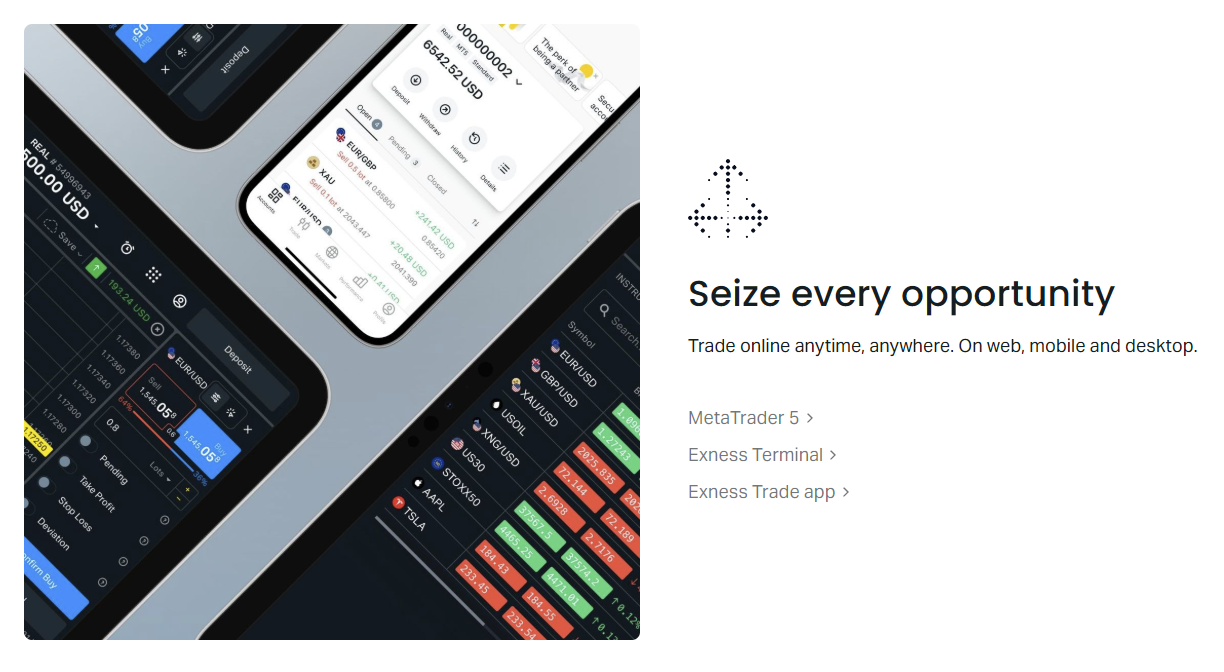
Exness offers four primary trading venues for NZDUSD, each with distinct advantages. MetaTrader 4 remains popular for its extensive expert advisor ecosystem and familiar interface. MetaTrader 5 adds more timeframes, order types, and a built-in economic calendar. The proprietary Exness Terminal provides a browser-based experience with advanced charting and one-click trading. Mobile applications for iOS and Android replicate desktop functionality for position management on the go.
MetaTrader 4 on Exness supports hedging mode, allowing simultaneous long and short NZDUSD positions. The platform includes 30 built-in indicators, 24 analytical objects, and supports custom indicators written in MQL4. One-click trading from charts accelerates entry and exit. MetaTrader 5 expands this with 38 indicators, 44 analytical objects, depth of market (Level 2) data, and netting/hedging account modes. The economic calendar integrates directly into the platform, filtering for NZD and USD high-impact events.
Exness Terminal Web Platform
The Exness Terminal runs in any modern browser without installation. It features TradingView-powered charts with over 100 indicators, multiple chart layouts, and drawing tools saved to cloud profiles. One-click trading panels sit beside the chart for rapid NZDUSD execution. The terminal displays real-time spreads, swap rates, and margin requirements for the selected instrument. Account management functions including deposits, withdrawals, and verification are accessible without leaving the trading interface.
Mobile Trading Applications
Exness mobile apps for iOS and Android provide full trading capability. Charts support all standard timeframes with pinch-to-zoom and horizontal scrolling. Price alerts push notifications for NZDUSD level breaches. The apps support biometric login, quick deposit/withdrawal, and access to trading history. MetaTrader 4 and 5 mobile versions are also available separately, syncing with desktop installations through MQL5 cloud profiles.
Platform choice depends on trading style. Scalpers and high-frequency traders often prefer MetaTrader 5 for its additional order types and faster strategy tester. Discretionary swing traders may favor the Exness Terminal for its clean charting and integrated analysis. Algorithmic traders benefit from MetaTrader 4's vast EA marketplace or MetaTrader 5's more powerful MQL5 language. All platforms connect to the same Exness liquidity pool, ensuring consistent pricing and execution.
Account Types and NZDUSD Trading Conditions
Exness offers five main account types, each with different NZDUSD trading conditions. Standard and Standard Cent accounts target beginners with no commission and spreads from 0.3 pips. Pro, Raw Spread, and Zero accounts cater to experienced traders with commission-based pricing and spreads from 0.0 pips. Understanding the cost structure of each account type is essential for NZDUSD strategy profitability.
Standard and Standard Cent Accounts
Standard accounts require a minimum deposit of $10 (varies by region) and offer NZDUSD spreads from 0.3 pips with no commission. Maximum leverage reaches 1:2000 for equity under $2,000, scaling down at higher balances. Standard Cent accounts denominate balances in cents, allowing micro-lot trading (0.01 cent lots = 1,000 units) with identical spreads. Both account types support all platforms and offer negative balance protection. Swap-free versions exist for Islamic finance compliance.
Pro, Raw Spread, and Zero Accounts
Pro accounts start at $200 minimum deposit with NZDUSD spreads from 0.1 pips and no commission. Raw Spread accounts require $500 minimum, offering spreads from 0.0 pips with $3.50 per side commission per lot ($7 round turn). Zero accounts need $500 minimum, featuring fixed 0.0 pip spreads on top 30 instruments including NZDUSD during market hours, with $3.50 per side commission. These accounts suit scalpers, high-volume traders, and algorithmic strategies where spread cost dominates.
Scroll horizontally to see all columns
| Account Type | Min Deposit | NZDUSD Spread | Commission | Max Leverage |
|---|---|---|---|---|
| Standard | $10 | From 0.3 pips | None | 1:2000 |
| Standard Cent | $10 | From 0.3 pips | None | 1:2000 |
| Pro | $200 | From 0.1 pips | None | 1:2000 |
| Raw Spread | $500 | From 0.0 pips | $3.50/lot/side | 1:2000 |
| Zero | $500 | Fixed 0.0 pips* | $3.50/lot/side | 1:2000 |
*Zero account 0.0 pip spread applies to top 30 instruments during market hours. Outside these hours, spreads may widen. All accounts offer negative balance protection and segregated client funds. Leverage dynamically adjusts based on account equity: 1:2000 under $2,000, 1:1000 up to $5,000, 1:500 up to $30,000, 1:200 above $30,000. Professional clients may qualify for higher fixed leverage.
Spreads, Commissions, and Trading Costs
Total trading cost on NZDUSD combines spread, commission (if applicable), and swap for overnight positions. Exness publishes real-time and historical spread data, allowing precise cost modeling. During peak London-New York overlap (13:00-17:00 UTC), NZDUSD spreads typically reach their tightest levels. Asian session spreads widen moderately. Major news events can cause temporary spread expansion to 5-10 pips on Standard accounts, while Raw Spread and Zero accounts maintain tighter spreads with commission unchanged.
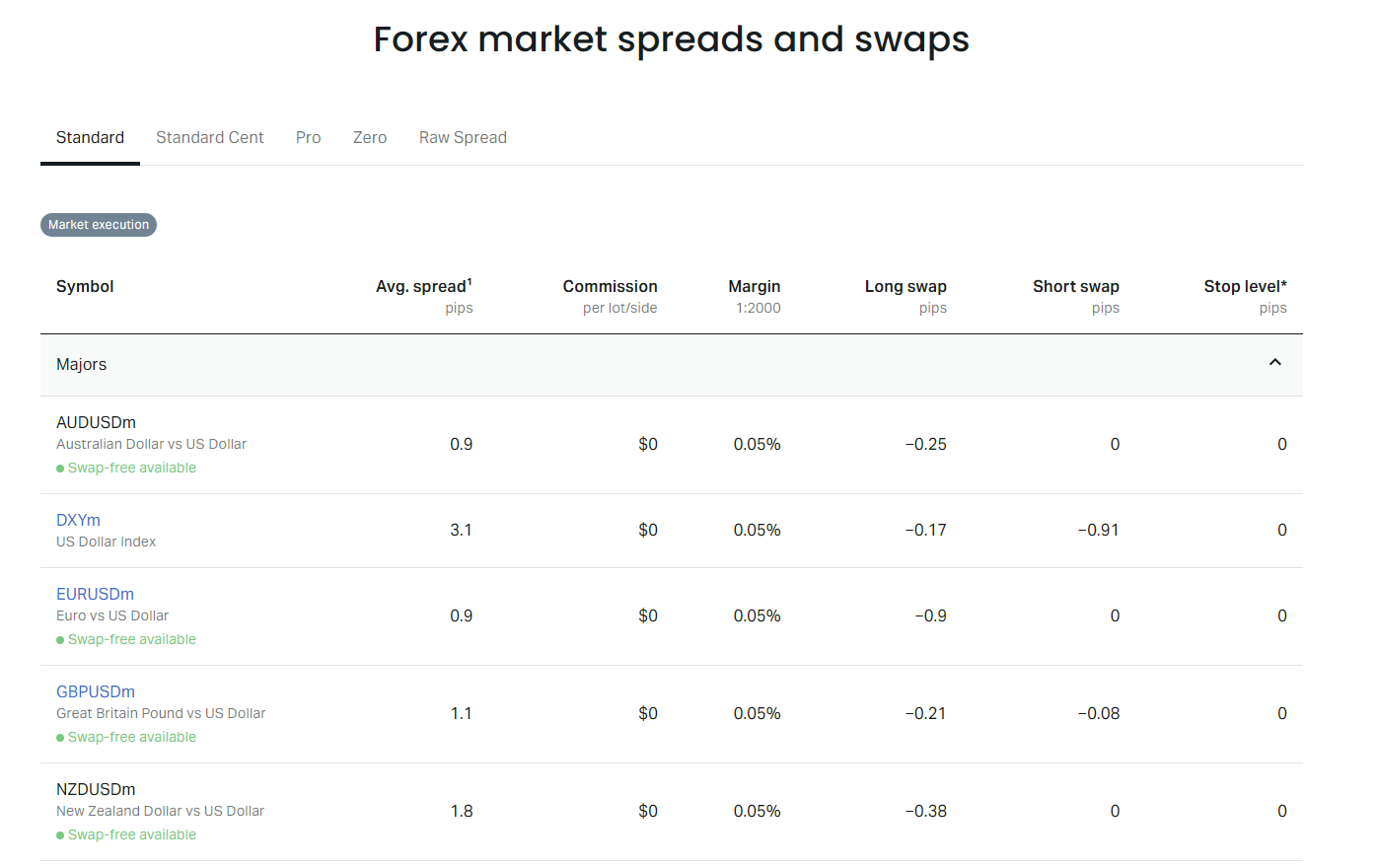
Commission on Raw Spread and Zero accounts is charged per side at position open and close. For NZDUSD, one standard lot (100,000 units) incurs $3.50 commission each way, totaling $7 per round turn. A 0.01 lot trade costs $0.07 round turn. Swap rates for NZDUSD typically show negative carry on long positions (paying swap) and positive or slightly negative on short positions, reflecting the interest rate differential between RBNZ and Fed policy rates. Swap-free accounts eliminate this cost for eligible clients.
Cost Calculation Examples
Consider a 1-lot NZDUSD trade held for three days. On a Standard account with 1.2 pip average spread: spread cost = $12. No commission. Swap (long) at -1.2 pips/day = -$36 for three days. Total cost = $48. On Raw Spread with 0.1 pip spread + $7 commission: spread cost = $1. Commission = $7. Swap = -$36. Total = $44. On Zero with 0.0 spread + $7 commission: spread = $0. Commission = $7. Swap = -$36. Total = $43. For short-term day trades without swap, Raw Spread and Zero accounts show clear advantage.
- Standard: Low fixed cost per trade, higher spread
- Pro: Moderate spread, no commission, good middle ground
- Raw Spread: Lowest variable spread, commission per trade
- Zero: Fixed zero spread during core hours, commission per trade
- Swap-free: No overnight cost, may have wider spreads or admin fee
The cheapest account on paper isn't always the cheapest in practice. Execution quality, slippage, and platform stability contribute to real trading costs as much as published spreads.
Execution Quality and Order Types
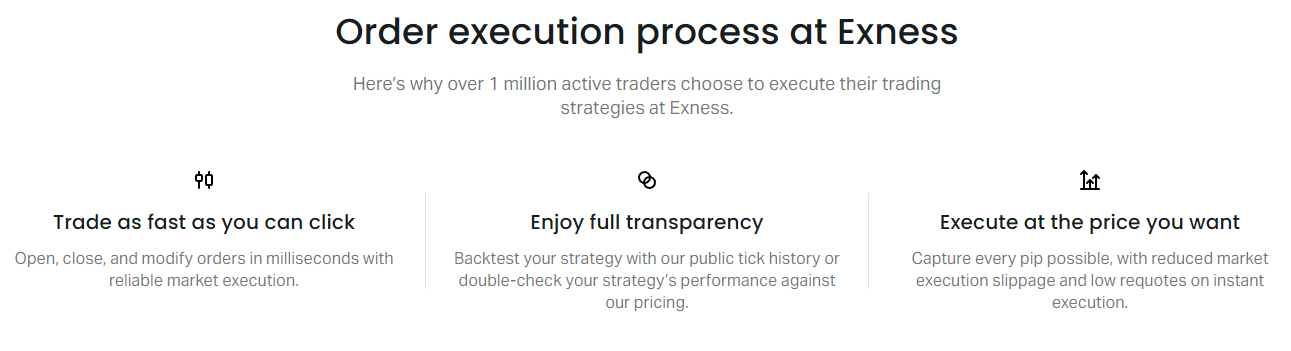
Exness emphasizes execution quality with market execution as the default model for all account types. Orders fill at the best available price from liquidity providers with no requotes. Average execution speed measures under 25 milliseconds. The broker publishes quarterly execution quality reports showing slippage statistics, fill rates, and price improvement frequency. For NZDUSD, positive slippage occurs on approximately 15-20% of orders during normal conditions, meaning traders receive better prices than requested.
Available order types vary by platform. MetaTrader 4 supports market, pending (buy/sell limit, buy/sell stop), stop loss, and take profit orders. MetaTrader 5 adds buy/sell stop limit orders, allowing precise entry with slippage control. The Exness Terminal provides market, limit, stop, and stop-limit orders with visual placement on charts. One-click trading panels enable instant market orders with predefined lot sizes. All platforms support trailing stops that adjust automatically as NZDUSD moves favorably.
Order Execution During High Volatility
During major news events like RBNZ rate decisions or US NFP releases, NZDUSD liquidity can thin momentarily. Exness maintains execution through aggregated liquidity from multiple tier-1 banks and non-bank market makers. Stop loss orders execute as market orders once triggered, subject to available liquidity. Guaranteed stop losses are not offered. Traders should consider wider stops or reduced position sizes during scheduled high-impact events. The economic calendar on Exness platforms flags these events with expected volatility ratings.
Risk Management Tools for NZDUSD
Effective risk management separates consistent traders from gamblers. Exness provides several built-in tools and account features that support disciplined NZDUSD trading. Position sizing calculators, margin monitoring, stop-out protection, and negative balance protection form the foundation. The trading calculator in the Personal Area and on platforms computes required margin, pip value, swap, and profit/loss for any NZDUSD position size before entry.
Position Sizing and Leverage Management
Dynamic leverage on Exness adjusts automatically as account equity changes. A trader with $1,000 equity accesses 1:2000 leverage (0.5% margin). The same trader at $10,000 equity gets 1:1000 (1% margin). This protects against over-leveraging as accounts grow. For NZDUSD, one standard lot at 1:2000 requires $50 margin. At 1:500, $200 margin. At 1:100, $1,000 margin. The trading calculator shows exact margin for any lot size. Professional risk management suggests risking 1-2% of account equity per trade. On a $5,000 account with 1% risk ($50), a 25-pip stop loss allows 0.2 lots ($2/pip × 25 pips = $50 risk).
Stop-Out and Margin Call Levels
Exness sets margin call at 100% margin level and stop-out at 0% (immediate liquidation when equity ≤ used margin). This aggressive stop-out level provides maximum staying power for positions but requires active monitoring. The platform displays margin level in real-time: (Equity / Used Margin) × 100%. At 100%, no new positions can open. At 0%, the largest losing position closes first. Negative balance protection ensures accounts never go below zero, with Exness absorbing any deficit.
Scroll horizontally to see all columns
| Account Equity | Risk Per Trade (1%) | Stop Loss (Pips) | Max Lot Size | Margin at 1:500 |
|---|---|---|---|---|
| $1,000 | $10 | 20 | 0.05 | $10 |
| $5,000 | $50 | 25 | 0.20 | $40 |
| $10,000 | $100 | 30 | 0.33 | $66 |
| $25,000 | $250 | 40 | 0.63 | $126 |
| $50,000 | $500 | 50 | 1.00 | $200 |
Technical Analysis Resources on Exness
Exness platforms integrate comprehensive technical analysis toolsets. MetaTrader 4 and 5 include 30+ and 38+ built-in indicators respectively, covering trend, momentum, volatility, and volume categories. The Exness Terminal leverages TradingView's charting library with 100+ indicators. All platforms support custom indicators, multiple timeframe analysis, and template saving. For NZDUSD, popular indicators include moving averages (20, 50, 200), RSI (14), MACD (12,26,9), Bollinger Bands (20,2), and ATR (14) for volatility-based stop placement.
Trading Central Signals Integration
Exness partners with Trading Central to provide technical analysis signals directly on platforms. These signals identify chart patterns, key levels, and directional bias for NZDUSD across multiple timeframes. The feature appears as an indicator overlay or separate panel showing pivot points, support/resistance, and pattern recognition (triangles, wedges, head and shoulders). Signals update in real-time and include confidence ratings. Traders can filter for NZDUSD specifically and set alerts for new pattern completions.
The Exness economic calendar integrates with platforms, highlighting NZD and USD high-impact events. Events show previous, forecast, and actual values with color-coded impact ratings. Clicking an event reveals historical charts showing typical NZDUSD reaction. The calendar syncs with device time zones and allows custom alerts. Combined with technical tools, traders can plan entries around known catalysts or avoid noise during uncertain periods.
Charting Features and Customization
All Exness platforms support multiple chart types: candlestick, bar, line, Heikin Ashi (MT5/Terminal), and Renko (Terminal). Timeframes range from 1-minute to monthly. MT5 offers 21 timeframes including 2-minute, 3-minute, 4-hour, and 12-hour. Charts support unlimited indicator overlays, drawing tools (trendlines, Fibonacci, Gann, Elliott Wave), and template saving. The Exness Terminal adds cloud-saved layouts accessible across devices. Traders can detach charts for multi-monitor setups on desktop platforms.
Technical analysis on NZDUSD works best when aligned with fundamental context. A breakout above resistance means more when supported by rising dairy prices or hawkish RBNZ commentary. Pure pattern trading without fundamental awareness often fails at key economic inflection points.
Fundamental Factors Affecting NZDUSD
Fundamental analysis for NZDUSD requires monitoring two distinct economies. New Zealand's small, open, commodity-dependent economy reacts sharply to export price changes and central bank policy. The United States' large, diversified economy responds to broad macroeconomic trends and Federal Reserve decisions. The interaction creates trading opportunities around policy divergence, commodity cycles, and risk sentiment shifts.
New Zealand Economic Indicators
The Reserve Bank of New Zealand meets seven times annually to set the Official Cash Rate (OCR). Rate hikes typically strengthen NZD; cuts weaken it. The RBNZ publishes Monetary Policy Statements with economic projections quarterly. Global Dairy Trade auctions occur twice monthly; rising prices support NZD. Quarterly GDP, monthly employment, quarterly CPI, and monthly trade balance data provide growth and inflation context. Business confidence surveys (ANZ Business Outlook) offer leading indicators. China's manufacturing PMI and import data correlate with NZD due to trade linkage.
United States Economic Indicators
The Federal Reserve meets eight times yearly for FOMC rate decisions. The dot plot, statement language, and press conference drive USD moves. Non-farm payrolls (first Friday monthly) is the most market-moving regular release. CPI (monthly) and PCE (monthly, Fed's preferred gauge) track inflation. ISM Manufacturing and Services PMIs indicate sector health. Retail sales, durable goods orders, and GDP (quarterly) complete the picture. Treasury yields, particularly the 2-year and 10-year, reflect rate expectations and drive USD directly.
- RBNZ OCR decisions and Monetary Policy Statements
- Global Dairy Trade auction results (1st/3rd Tuesday monthly)
- NZ GDP quarterly, CPI quarterly, Employment quarterly
- Fed FOMC decisions, minutes, and dot plots
- US Non-farm payrolls, CPI, PCE, ISM PMIs
- US 2-year and 10-year Treasury yields
- China Manufacturing PMI and Trade Balance
- Risk sentiment: S&P 500, VIX, credit spreads
Trading Strategies for NZDUSD
NZDUSD accommodates multiple trading styles due to its liquidity, volatility profile, and clear fundamental drivers. Strategy selection should match trader personality, time availability, and risk tolerance. Exness platforms support all approaches with appropriate tools. Below are four common frameworks adapted for NZDUSD on Exness.
Trend Following with Moving Averages
NZDUSD often develops sustained trends lasting weeks to months driven by monetary policy cycles. A simple trend-following approach uses the 50 and 200-period exponential moving averages (EMAs) on the 4-hour or daily chart. Long entries when 50 EMA crosses above 200 EMA (golden cross) with price above both. Short entries on death cross with price below both. Stop loss below recent swing low/high. Take profit at 2:1 or 3:1 reward-to-risk, or trail using 20 EMA. This works best during clear policy divergence periods (e.g., RBNZ hiking while Fed pausing).
Range Trading During Consolidation
NZDUSD spends significant time in ranges between major fundamental shifts. Identify ranges on daily charts using clear support/resistance tested at least twice. Trade bounces: buy near support with bullish reversal candle (hammer, engulfing) on 1-hour chart, stop below support, target resistance. Sell near resistance with bearish reversal, stop above resistance, target support. RSI(14) helps: buy when oversold (<30) at support, sell when overbought (>70) at resistance. Reduce size during low-volatility Asian session ranges; increase during London/New York range breaks.
Breakout Trading on News Catalysts
Scheduled high-impact events create breakout opportunities. Before RBNZ or FOMC decisions, NZDUSD often contracts into tight ranges. Place buy stop above range high and sell stop below range low 15-30 minutes before release. Use stop-limit orders on MT5 to control slippage. Cancel opposite order once one triggers. Target measured move (range height projected from breakout). Trail stop to breakeven once 1:1 reached. This strategy requires Raw Spread or Zero account for tight spreads during news. Risk: whipsaws during conflicting data or 'buy the rumor, sell the fact' reactions.
Carry Trade Considerations
Historically, NZD offered higher interest rates than USD, making NZDUSD a popular carry trade (long NZDUSD to earn positive swap). Current rate differentials vary; check Exness swap rates daily. Carry trades work best in stable, risk-on environments with low volatility. They unwind violently during risk-off events. Position sizing must account for potential 200-300 pip adverse moves. Only suitable for accounts with sufficient equity to withstand drawdowns. Swap-free accounts eliminate carry income but also remove negative swap cost on shorts.
Scroll horizontally to see all columns
| Strategy | Timeframe | Typical Hold | Risk/Reward | Best Account |
|---|---|---|---|---|
| Trend Following | 4H / Daily | Days-Weeks | 1:2 to 1:3 | Pro / Standard |
| Range Trading | 1H / 4H | Hours-Days | 1:1 to 1:2 | Standard / Pro |
| News Breakout | M15 / M5 | Minutes-Hours | 1:2 to 1:5 | Raw Spread / Zero |
| Carry Trade | Daily / Weekly | Weeks-Months | Swap Income | Swap-Free / Pro |
Mobile Trading Experience
Mobile trading has become essential for forex traders who need to monitor positions, adjust stops, or execute trades away from their desks. Exness provides native iOS and Android applications alongside MetaTrader 4 and 5 mobile versions. The Exness app integrates trading, account management, deposits/withdrawals, and analysis in one interface. MetaTrader mobile apps offer deeper technical analysis tools and expert advisor monitoring. Both approaches keep NZDUSD traders connected 24/5.
The Exness mobile app features a customizable watchlist with NZDUSD prominently displayed. Charts support all standard timeframes with gesture controls: pinch to zoom, swipe to scroll, long-press for crosshair values. Technical indicators apply with a tap. One-click trading from the chart or quote panel executes market orders instantly. Price alerts push notifications when NZDUSD hits specified levels. The app includes the economic calendar, trading calculator, and full transaction history. Biometric authentication (FaceID, fingerprint) secures access.
MetaTrader Mobile Capabilities
MetaTrader 4 and 5 mobile apps replicate most desktop functionality. MT5 mobile adds more timeframes, depth of market, and the economic calendar. Both support custom indicators and expert advisors (though EAs run on VPS, not phone). Charts allow template application and drawing tool synchronization via MQL5 cloud. Push notifications from desktop platforms forward to mobile. Trade history exports to CSV for journaling. The apps consume minimal data and battery, suitable for all-day monitoring.
Advanced Tools: VPS, Calculator, and Analytics
Exness provides supplementary tools that enhance NZDUSD trading efficiency. The free VPS (Virtual Private Server) for qualifying accounts hosts MetaTrader platforms with ultra-low latency to Exness trade servers. The trading calculator computes margin, pip value, swap, and profit for any position size. Analytics pages show trading statistics, performance metrics, and risk analysis. These tools support professional workflows and data-driven improvement.
Exness VPS for Algorithmic Trading
Traders maintaining $500 equity or trading 5 lots monthly qualify for free Exness VPS. The VPS runs Windows Server with MetaTrader 4/5 pre-installed, located in Equinix data centers near Exness trade servers. Latency averages 1-2 milliseconds. This enables 24/7 expert advisor operation without home internet/power dependency. For NZDUSD algorithmic strategies, VPS eliminates execution delay during Asian session when home connections may be slower. Multiple EAs can run simultaneously on the allocated resources (2 CPU cores, 2GB RAM, 30GB SSD standard).
Trading Calculator and Analytics
The Exness trading calculator, accessible in Personal Area and on platforms, calculates exact costs for NZDUSD trades. Inputs: account type, leverage, lot size, direction, open/close prices. Outputs: required margin, pip value, spread cost, commission, swap (daily and total), profit/loss. This prevents position sizing errors. The analytics dashboard shows win rate, average win/loss, profit factor, Sharpe ratio, maximum drawdown, and expectancy. Filter by symbol to isolate NZDUSD performance. Export data for external analysis.
Data-driven traders improve faster. The Exness analytics dashboard reveals patterns invisible in memory: you may discover your NZDUSD win rate doubles during London session, or that 80% of losses come from trades held overnight. Use this to refine strategy, not just review history.
Deposits, Withdrawals, and Account Management
Funding and withdrawing from Exness accounts uses multiple methods with varying speeds and limits. Most deposits process instantly. Withdrawals to electronic methods (Skrill, Neteller, WebMoney, Perfect Money, crypto) often complete within minutes. Bank transfers take 1-3 business days. Minimum deposit varies by method and region, typically $10 for electronic methods. No deposit fees from Exness; payment providers may charge. Withdrawal fees are zero for most methods. The Personal Area manages all transactions with full history.
Verification and Compliance
Exness requires identity verification (KYC) before first withdrawal. Submit government-issued ID (passport, driver's license) and proof of address (utility bill, bank statement) dated within 3 months. Verification typically completes within 24 hours. Source of funds verification may trigger for large deposits. The process complies with anti-money laundering regulations across Exness's licensed entities. Unverified accounts can deposit and trade but cannot withdraw. Complete verification early to avoid delays when profits are ready.
Key Takeaways for Exness NZDUSD Trading
Trading NZDUSD on Exness combines access to a fundamentally driven, liquid currency pair with a broker infrastructure built for execution quality and cost transparency. The pair's sensitivity to commodity prices, RBNZ policy, Chinese demand, and US macro data creates regular opportunities across timeframes. Exness meets these opportunities with five account types spanning commission-free and commission-based models, four trading platforms covering desktop, web, and mobile, and risk management tools that scale from beginner to professional.
Success requires matching account type to strategy: Standard for learning and swing trades, Pro for active day trading, Raw Spread for scalping, Zero for news trading certainty. Platform choice aligns with analysis style: MT4 for EA ecosystem, MT5 for advanced orders and testing, Exness Terminal for integrated charting and analysis, mobile for position management. Risk management remains paramount: 1-2% risk per trade, mandatory stops, correlation awareness, and leverage discipline as accounts grow.
Fundamental awareness separates informed trades from guesses. Track RBNZ meetings, GDT auctions, Chinese data, Fed decisions, US employment and inflation. Technical tools on Exness platforms—TradingView charts, Trading Central signals, 100+ indicators, custom templates—support precise entry and exit. The trading calculator prevents sizing errors. Analytics reveal performance patterns. VPS enables 24/7 algorithmic execution. Instant withdrawals preserve capital flexibility.
NZDUSD will continue offering opportunities as long as New Zealand exports commodities and the US dollar anchors global finance. Exness provides the venue. The trader provides the process. Combine the broker's competitive conditions with a tested strategy, disciplined risk management, and continuous learning. Start on demo, validate approach over 50+ trades, then scale gradually. The market rewards preparation and punishes improvisation.
Frequently Asked Questions
What is the minimum deposit to trade NZDUSD on Exness?
The minimum deposit is $10 for Standard and Standard Cent accounts using most electronic payment methods. Pro accounts require $200, while Raw Spread and Zero accounts require $500 minimum deposits.
Which Exness account type has the lowest spreads for NZDUSD?
Zero accounts offer fixed 0.0 pip spreads on NZDUSD during market hours with a $3.50 per side commission. Raw Spread accounts offer variable spreads from 0.0 pips with the same commission structure.
Can I trade NZDUSD on Exness during weekends?
No, forex markets close Friday 23:59 server time and reopen Monday 00:05 server time. NZDUSD is not available for trading during weekend hours on Exness or any other forex broker.
Does Exness offer swap-free accounts for NZDUSD?
Yes, Exness offers swap-free (Islamic) account options for Standard, Pro, Raw Spread, and Zero account types. These accounts eliminate overnight swap charges but may have wider spreads or administration fees depending on the account type.
What leverage is available for NZDUSD on Exness?
Exness offers dynamic leverage up to 1:2000 for accounts with equity under $2,000. Leverage reduces to 1:1000 up to $5,000, 1:500 up to $30,000, and 1:200 above $30,000. Professional clients may qualify for higher fixed leverage.
How fast are Exness withdrawals for NZDUSD profits?
Withdrawals to electronic payment methods (Skrill, Neteller, WebMoney, Perfect Money, cryptocurrency) typically process within minutes, 24/7. Bank transfers take 1-3 business days. Exness charges no withdrawal fees for most methods.
Can I use expert advisors for NZDUSD on Exness?
Yes, Exness supports expert advisors on MetaTrader 4 and MetaTrader 5. For 24/7 EA operation, qualifying clients (minimum $500 equity or 5 lots monthly volume) receive free VPS hosting with 1-2ms latency to trade servers.
What platforms support NZDUSD trading on Exness?
Exness supports MetaTrader 4, MetaTrader 5, the proprietary Exness Terminal (web-based), and mobile applications for iOS and Android. All platforms offer NZDUSD with identical pricing and execution from the same liquidity pool.