
Trading Education
Exness Energies Trading: Oil, Gas & Energy Markets Guide
Complete guide to trading energy commodities on Exness including crude oil, natural gas, and refined products with platform features and risk management.

Forex Analyst
Forex Analyst specializing in currency markets, market trends, technical and fundamental analysis, and providing clear insights to help traders make informed decisions.
Energy markets represent one of the most dynamic segments of global financial trading. Crude oil, natural gas, and refined products respond to geopolitical events, supply decisions, weather patterns, and economic cycles in ways that create both opportunity and risk for participants. Exness provides access to these markets through contracts for difference (CFDs), allowing traders to speculate on price movements without taking physical delivery of the underlying commodities.
Contents
- Energy Instruments Available on Exness
- Trading Platforms for Energy Markets
- Spreads, Commissions, and Swap Rates
- Leverage and Margin Requirements
- Market Execution and Order Types
- Risk Management Tools for Energy Trading
- Fundamental Drivers of Energy Prices
- Technical Analysis Applied to Energy CFDs
- Account Types and Energy Trading Suitability
- Deposits, Withdrawals, and Funding for Energy Traders
- Regulatory Framework and Client Protection
- Energy Trading Strategies for Exness Platforms
- Tax Considerations for Energy CFD Trading
- Education and Research Resources
- Common Pitfalls in Energy CFD Trading
- Advanced Energy Trading Features on Exness
- Key Takeaways for Exness Energy Traders
The broker offers energy instruments across its Standard, Professional, and specialized account types. Traders can access major benchmarks such as Brent crude, West Texas Intermediate (WTI), and Henry Hub natural gas alongside heating oil and gasoline contracts. Each instrument carries specific contract specifications, trading hours, and margin requirements that reflect the underlying market structure.
Understanding how energy CFDs function on the Exness platform requires familiarity with several interconnected components: the available instruments and their unique characteristics, the trading platforms and tools provided, the cost structure including spreads and swaps, risk management features, and the regulatory framework that governs client protection. This guide examines each element in detail.
Energy Instruments Available on Exness
Exness groups energy products under its commodities offering, with crude oil and natural gas serving as the primary liquid benchmarks. The most actively traded contracts include UK Oil (Brent), US Oil (WTI), and US Natural Gas. These instruments track futures prices on major exchanges and are priced continuously during exchange trading hours with brief daily breaks.
- UK Oil (Brent Crude) — tracks ICE Brent futures, global benchmark for two-thirds of internationally traded crude
- US Oil (WTI Crude) — tracks NYMEX WTI futures, primary North American benchmark priced at Cushing, Oklahoma
- US Natural Gas — tracks NYMEX Henry Hub futures, key reference for North American gas pricing
- Heating Oil — tracks NYMEX ultra-low sulfur diesel futures, proxy for distillate fuel demand
- Gasoline (RBOB) — tracks NYMEX reformulated gasoline blendstock futures, seasonal demand patterns
Each energy CFD mirrors the tick size, contract month rotation, and settlement calendar of its underlying futures contract. Exness rolls positions automatically at expiry unless the trader closes manually, with any price difference between expiring and new contracts reflected in the account. Traders should monitor roll dates published in the platform to avoid unexpected adjustments.
Liquidity varies across instruments and sessions. Brent and WTI see deepest order books during the London-New York overlap (13:00–17:00 UTC), while natural gas volume peaks around the US storage report release (Thursday 14:30 UTC). Heating oil and gasoline exhibit stronger seasonal patterns, with winter demand supporting heating oil and summer driving season boosting gasoline.
Trading Platforms for Energy Markets
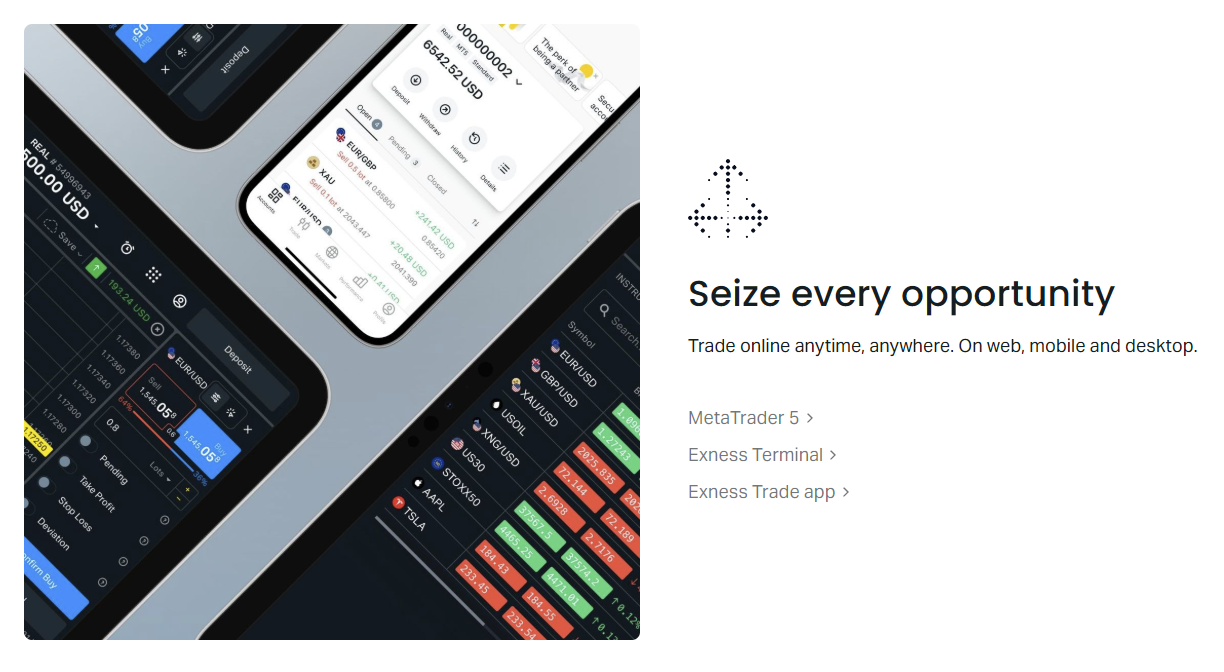
Exness supports energy trading across MetaTrader 4, MetaTrader 5, the proprietary Exness Terminal (web and desktop), and mobile applications for iOS and Android. Each platform delivers real-time pricing, charting, and order execution for energy CFDs, though feature depth differs. MetaTrader 5 provides the most comprehensive toolset including additional timeframes, depth of market, and an integrated economic calendar.
- MetaTrader 4 — mature ecosystem, extensive custom indicator library, hedging mode by default
- MetaTrader 5 — netting and hedging modes, more timeframes, built-in economic calendar, depth of market
- Exness Terminal — browser-based, no installation required, streamlined interface, one-click trading
- Exness Mobile App — full account management, push notifications, biometric login, chart trading
- MT4/MT5 Mobile — familiar desktop experience on smartphone, offline chart access
The Exness Terminal web platform deserves particular attention for energy traders who value speed and accessibility. It loads directly in modern browsers, supports multiple chart layouts, and integrates Trading Central signals for technical analysis on oil and gas. The platform also displays real-time spreads and swap rates for each energy instrument without requiring a separate specification window.
Automated trading via Expert Advisors (EAs) is supported on both MetaTrader versions. Energy markets, with their tendency for trend persistence and mean-reversion phases, attract algorithmic strategies. Exness imposes no restrictions on EA usage provided trading activity complies with terms of service. The broker also offers a free VPS service for qualifying accounts, reducing latency for automated energy strategies.
Spreads, Commissions, and Swap Rates
Trading costs on energy CFDs differ by account type. Standard and Standard Cent accounts incorporate all costs into the spread with no separate commission. Professional accounts (Pro, Raw Spread, Zero) charge a round-turn commission per lot while offering tighter raw spreads. The Zero account targets the lowest spread environment with a fixed commission, while Raw Spread passes through institutional pricing with variable commission.
Scroll horizontally to see all columns
| Instrument | Standard Spread | Pro Spread + Commission | Raw Spread Spread + Commission | Zero Spread + Commission |
|---|---|---|---|---|
| UK Oil (Brent) | ~0.03–0.05 USD | ~0.01–0.02 USD + $3.50/lot | ~0.00–0.01 USD + variable | 0.00 USD + $6.50/lot |
| US Oil (WTI) | ~0.03–0.05 USD | ~0.01–0.02 USD + $3.50/lot | ~0.00–0.01 USD + variable | 0.00 USD + $6.50/lot |
| US Natural Gas | ~0.003–0.005 USD | ~0.001–0.002 USD + $3.50/lot | ~0.000–0.001 USD + variable | 0.000 USD + $6.50/lot |
Swap rates (overnight financing) apply to positions held past 22:00 UTC. Energy CFDs typically carry negative swaps on long positions and positive or less negative swaps on shorts, reflecting the cost of carry in futures markets. Wednesday nights incur triple swaps to account for weekend rollover. Traders should consult the platform's specification window for current rates, as they adjust with interest rate differentials and futures curve structure.
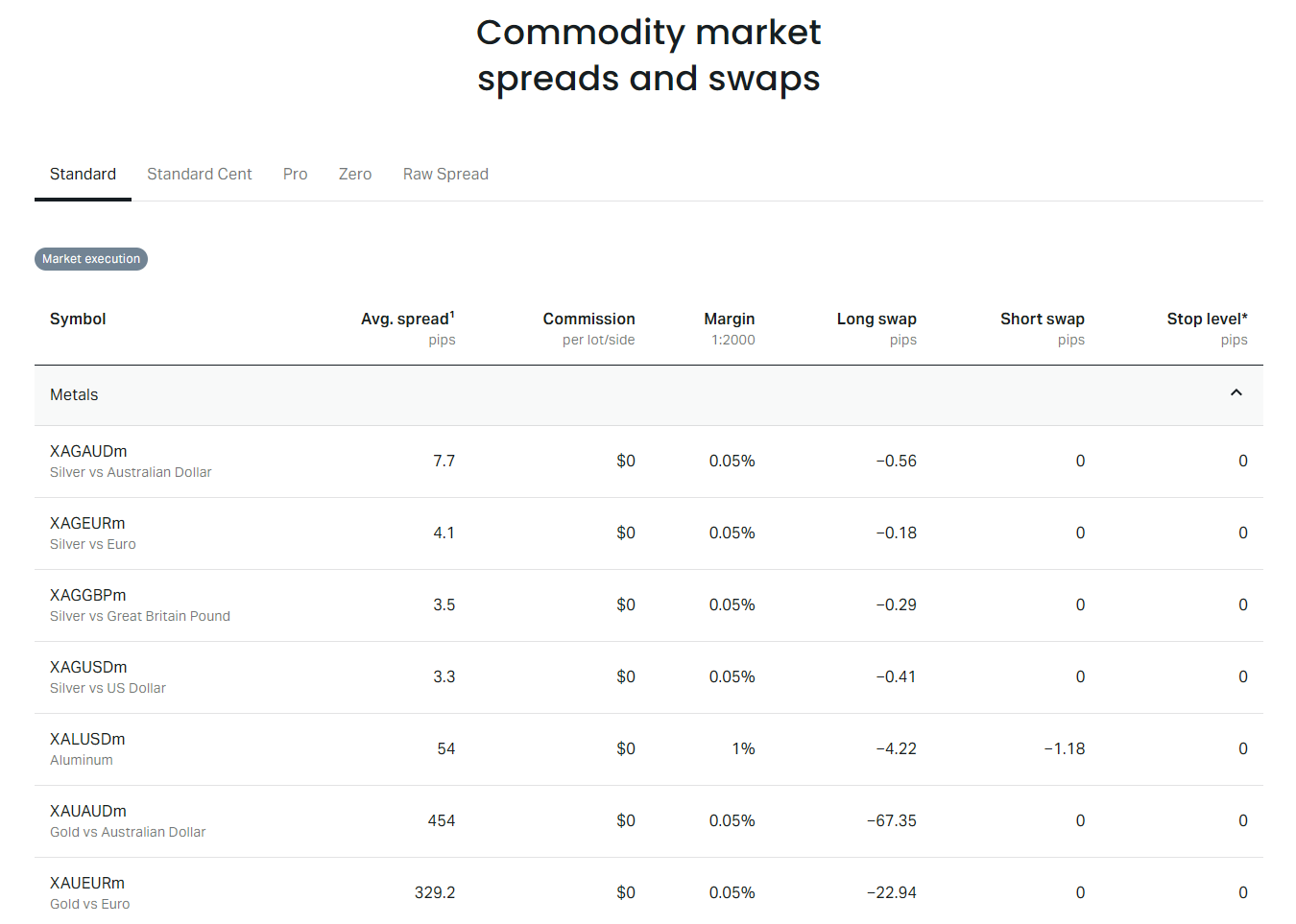
During high-impact events — OPEC+ meetings, EIA inventory releases, geopolitical escalations — spreads widen temporarily across all account types. Exness employs market execution with no requotes, meaning orders fill at the best available price. Slippage can occur in both directions. The broker publishes average execution speed metrics, typically under 100 milliseconds for energy instruments under normal conditions.
Leverage and Margin Requirements
Exness offers dynamic leverage on energy CFDs that adjusts based on account equity and instrument volatility. Maximum leverage for major energy pairs reaches 1:2000 on Standard and Pro accounts for eligible clients, though regulatory restrictions in certain jurisdictions cap leverage lower. Raw Spread and Zero accounts typically offer up to 1:200. Margin requirements increase during weekends and major news events as a protective measure.
- Standard/Pro: up to 1:2000 (subject to equity tiers and regional limits)
- Raw Spread/Zero: up to 1:200
- Standard Cent: up to 1:2000 (cent-denominated, smaller contract sizes)
- Weekend margin: typically 2–3x normal requirement
- News margin: temporary increase 30–60 minutes around major releases
The margin calculation for energy CFDs uses the formula: (Contract Size × Lot Size × Market Price) ÷ Leverage. For example, one standard lot of UK Oil (1,000 barrels) at $80 with 1:100 leverage requires $800 margin. Exness provides a built-in margin calculator in the Personal Area and trading platforms. Traders should monitor free margin closely, as energy volatility can trigger stop-outs rapidly when leverage is high.
Leverage amplifies both gains and losses proportionally. In energy markets where daily ranges of 2–3% are common, 1:100 leverage means a 1% adverse move consumes 100% of allocated margin. Conservative position sizing remains the most reliable risk control.
Market Execution and Order Types
Exness operates a market execution model for energy CFDs. Orders execute at the best available price from liquidity providers with no dealing desk intervention. This model eliminates requotes but introduces slippage risk during volatile periods. The platform supports market, limit, stop, and stop-limit orders, plus trailing stops that adjust automatically as price moves favorably.
- Market Order — immediate execution at best available price
- Limit Order — execute at specified price or better, used for entries and take-profits
- Stop Order — trigger market order when price reaches level, used for breakout entries and stop-losses
- Stop-Limit Order — trigger limit order after stop price hit, reduces slippage risk on entry
- Trailing Stop — dynamic stop-loss that follows price at fixed distance, locks in trends
One-click trading from the chart or market watch window accelerates execution for scalpers. The Exness Terminal and MT5 display depth of market (DOM) for energy instruments, showing aggregate liquidity at each price level. This transparency helps traders gauge fill probability for larger orders. Partial fills may occur if available volume at the top of book is insufficient for the full order size.
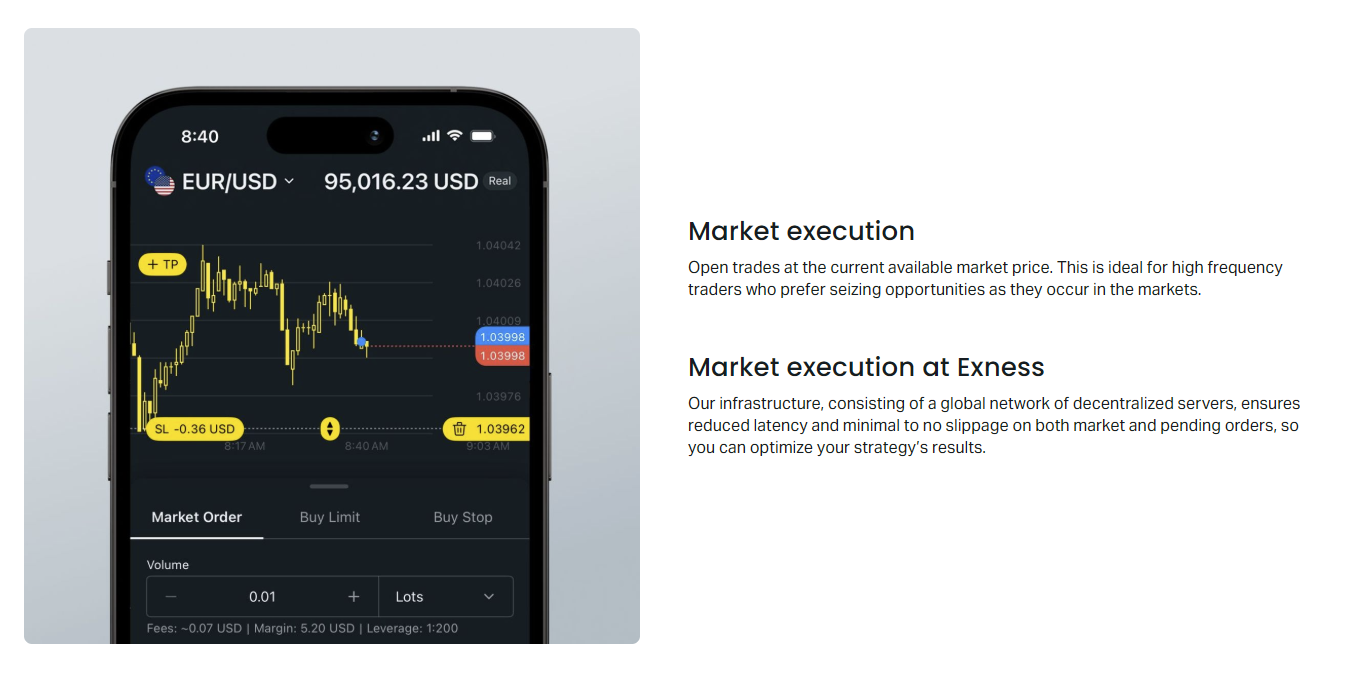
Execution quality metrics published by Exness show median fill times under 50 milliseconds for energy majors during peak liquidity. The broker participates in the Financial Commission's execution quality certification program. Traders can request execution quality reports for their accounts, detailing slippage distribution, fill rates, and price improvement statistics.
Risk Management Tools for Energy Trading
Energy markets exhibit fat-tailed return distributions — extreme moves occur more frequently than normal distribution models predict. Exness provides several platform-native risk controls. Stop-loss and take-profit orders attach to positions at entry or can be added later. Guaranteed stop-loss orders (GSLOs) are not currently offered; standard stops execute at the next available price during gaps.
- Stop-Loss — mandatory for responsible sizing, place beyond normal noise
- Take-Profit — defines exit target, removes emotional decision-making
- Trailing Stop — protects profits in trending markets like strong oil moves
- Margin Call Alert — configurable notification at 50%, 80%, or custom margin level
- Stop-Out — automatic liquidation at 0% margin level (varies by regulator)
Position sizing calculators in the Exness Personal Area and trading platforms help traders determine appropriate lot sizes based on account risk percentage. A common guideline risks 1–2% of equity per trade. For a $10,000 account risking 1% ($100) on a WTI trade with a $2 stop distance (200 ticks), the position size would be 0.5 lots. The calculator automates this arithmetic across all energy instruments.
Fundamental Drivers of Energy Prices
Successful energy trading requires monitoring a distinct set of fundamental catalysts. Unlike forex or equities, energy markets respond acutely to physical supply-demand balances, infrastructure constraints, and policy decisions. Exness integrates an economic calendar and FXStreet news feed directly into its platforms, flagging high-impact energy events.
- OPEC+ production decisions — monthly meetings, compliance data, spare capacity
- EIA Weekly Petroleum Status Report — Wednesday 14:30 UTC, crude/gasoline/distillate inventories
- API Weekly Statistical Bulletin — Tuesday 20:30 UTC, industry survey precursor to EIA
- EIA Natural Gas Storage Report — Thursday 14:30 UTC, injection/withdrawal vs. 5-year average
- Baker Hughes Rig Count — Friday 17:00 UTC, leading indicator for US production
- IEA/OPEC Monthly Oil Market Reports — supply/demand forecasts, inventory trends
- Weather models — heating/cooling degree days drive natural gas and heating oil demand
- Strategic Petroleum Reserve (SPR) — US government purchases/sales affect physical balances
The transition to cleaner energy adds a structural dimension. Long-term demand forecasts for oil and gas now incorporate electric vehicle adoption, renewable capacity additions, and policy targets like net-zero commitments. These factors influence the futures curve shape (contango vs. backwardation) which directly affects CFD swap costs and roll yields. Traders with longer horizons should track energy transition scenarios from IEA, OPEC, and major oil company outlooks.
The energy complex trades on two timeframes simultaneously: the physical market's weekly inventory pulse and the financial market's macro narrative. Aligning both improves trade timing. A bullish inventory draw means little if the macro backdrop signals recession-driven demand destruction.
Technical Analysis Applied to Energy CFDs
Energy charts display characteristics that technical traders exploit. Crude oil tends to trend persistently during supply-driven moves but ranges during demand uncertainty. Natural gas exhibits sharp mean-reversion around storage report cycles. Heating oil and gasoline show strong seasonal patterns — winter premiums for heating oil, summer strength for gasoline. Exness platforms provide 21 timeframes on MT5 and 9 on MT4, plus 30+ built-in indicators.
- Trend-following — moving average crossovers, ADX, Parabolic SAR work well in sustained oil trends
- Mean-reversion — Bollinger Bands, RSI, Stochastic effective on natural gas range-bound periods
- Volume analysis — tick volume on CFDs proxies futures volume, confirms breakout validity
- Seasonal charts — overlay multi-year seasonal patterns on current price action
- Intermarket — watch USD index (DXY), equity energy sector (XLE), and bond yields for confirmation
Trading Central signals, integrated into the Exness Terminal and available as an MT4/MT5 plugin, provide automated technical analysis on energy instruments. The system identifies chart patterns, key levels, and directional bias with time-horizon labels (intraday, short-term, medium-term). Traders should treat signals as decision support, not standalone trade calls, and always apply independent risk management.
Custom indicators and Expert Advisors expand analytical capacity. The MetaTrader Market and Code Base host thousands of free and paid tools. Energy-specific indicators include crack spread calculators (refining margin proxy), calendar spread analyzers, and inventory report countdown timers. Exness imposes no restrictions on third-party tools provided they operate within platform API limits.
Account Types and Energy Trading Suitability
Exness offers five live account categories, each with distinct energy trading characteristics. Standard and Standard Cent accounts suit beginners and low-capital traders with commission-free pricing and high leverage. Professional accounts (Pro, Raw Spread, Zero) cater to volume traders who benefit from tighter spreads and commission transparency. Islamic (swap-free) accounts accommodate faith-based requirements but may carry wider spreads or administration fees on energy positions held overnight.
Scroll horizontally to see all columns
| Feature | Standard | Standard Cent | Pro | Raw Spread | Zero |
|---|---|---|---|---|---|
| Min Deposit | $1 | $1 | $200 | $200 | $200 |
| Energy Commission | None (in spread) | None (in spread) | $3.50/lot round-turn | Variable per instrument | $6.50/lot round-turn |
| Typical Brent Spread | 0.03–0.05 | 0.03–0.05 | 0.01–0.02 | 0.00–0.01 | 0.00 |
| Max Leverage | 1:2000 | 1:2000 | 1:2000 | 1:200 | 1:200 |
| Swap-Free Option | Yes (Islamic) | Yes (Islamic) | Yes (Islamic) | Yes (Islamic) | Yes (Islamic) |
Demo accounts replicate live conditions for all energy instruments without financial risk. Exness provides unlimited demo duration and virtual balance top-ups. New energy traders should spend sufficient time on demo to understand contract specifications, margin behavior during news, and platform order flow before committing real capital. The transition from demo to live often reveals psychological differences that no simulation captures.
Deposits, Withdrawals, and Funding for Energy Traders
Exness supports over 100 payment methods globally, with availability varying by region. Popular options for energy traders include bank cards (Visa, Mastercard), electronic wallets (Skrill, Neteller, WebMoney, Perfect Money), bank wire transfers, and local payment systems. Most methods process deposits instantly with no broker-side fees. Minimum deposit starts at $1 for Standard and Standard Cent accounts.
- Instant methods: cards, e-wallets, local systems — immediate credit, 24/7 availability
- Bank wire: 1–3 business days, higher limits, suitable for large energy positions
- Cryptocurrency: USDT, USDC, BTC, ETH — blockchain confirmation times apply
- Withdrawal priority: same method as deposit (anti-money laundering compliance)
- Instant withdrawal: available for eligible methods and verified accounts
Withdrawal processing times depend on the method. E-wallets and cards typically complete within minutes to hours after internal approval. Bank wires take 1–5 business days. Exness does not charge withdrawal fees, though payment processors may apply their own. The broker's instant withdrawal feature, available for qualified clients on supported methods, automates approval for amounts within predefined limits.
Regulatory Framework and Client Protection
Exness operates through multiple regulated entities to serve global clients. The primary licenses include CySEC (Cyprus), FCA (UK), FSCA (South Africa), FSA (Seychelles), and CBCS (Curaçao). Regulatory jurisdiction determines leverage caps, negative balance protection scope, and compensation scheme eligibility. Energy traders should verify which entity services their region and the corresponding protections.
- CySEC (EU) — leverage capped at 1:30 retail, 1:500 professional, ICF compensation up to €20,000
- FCA (UK) — leverage capped at 1:30 retail, FSCS protection up to £85,000
- FSCA (South Africa) — leverage up to 1:2000, no statutory compensation scheme
- FSA (Seychelles) — leverage up to 1:2000, international clients, no compensation fund
- CBCS (Curaçao) — leverage up to 1:2000, Caribbean and LatAm focus
Negative balance protection applies across all entities, ensuring clients cannot lose more than their account equity. Segregated accounts hold client funds separate from operational capital at tier-1 banks. Exness publishes quarterly financial statements and undergoes annual audits by Big Four firms. The broker also maintains membership in the Financial Commission, providing external dispute resolution up to €20,000 per claim.
Regulatory jurisdiction is not a formality — it defines your maximum leverage, dispute recourse, and whether a compensation fund exists. Energy traders using high leverage should understand exactly which entity holds their account and what protections apply during extreme market events.
Energy Trading Strategies for Exness Platforms
The combination of tight spreads, high leverage availability, and multiple platforms enables diverse energy trading approaches. No single strategy fits all market conditions; successful traders adapt to prevailing volatility, trend state, and fundamental backdrop. Below are framework categories with energy-specific implementation notes.
- Intraday Momentum — trade 5–15 minute charts during London/NY overlap, use VWAP and volume profile, target 1:2 risk-reward, close all by 21:00 UTC
- Swing Trade Inventory Cycles — position around EIA/API reports, hold 2–5 days, use weekly charts for context, size for overnight gap risk
- Seasonal Spread — long heating oil / short RBOB gasoline in winter (crack spread), reverse in summer, hold weeks to months
- Calendar Spread — trade price difference between consecutive crude futures months, reflects storage economics, lower directional risk
- Macro Correlation — long oil / short USD during dollar weakness, or long energy equities / short oil during supply-driven rallies
Backtesting on Exness historical data requires attention to spread widening during news and roll adjustments at contract expiry. The MT5 Strategy Tester supports tick-data backtesting with variable spreads. Forward-testing on demo for at least 20–30 trades validates live viability. Traders should document each energy trade with setup rationale, entry/exit prices, and post-trade review to build a personal edge database.
Tax Considerations for Energy CFD Trading
Tax treatment of energy CFD profits varies significantly by country of residence. In many jurisdictions, CFDs are classified as financial instruments subject to capital gains tax or income tax depending on trading frequency and intent. Some countries treat them as gambling (tax-free), others as speculative income (full marginal rate). Exness does not provide tax advice and does not withhold taxes on trading profits. Clients are solely responsible for compliance with local tax obligations.
- Maintain detailed trade records: date, instrument, direction, size, entry, exit, P&L, fees
- Export account statements monthly from Personal Area (CSV, PDF formats available)
- Track swap charges separately — may be deductible as financing costs in some regimes
- Consult a qualified tax professional familiar with derivative taxation in your jurisdiction
- Be aware of wash-sale rules, mark-to-market elections, and trader tax status criteria where applicable
Corporate structures (LLC, LLP, offshore companies) are sometimes used by high-volume energy traders for tax efficiency and liability separation. Exness supports corporate accounts with enhanced KYC requirements: certificate of incorporation, register of directors/shareholders, proof of address for entity and beneficial owners, and board resolution authorizing trading. Corporate accounts may access different leverage tiers and rebate programs.
Education and Research Resources
Exness invests in trader education through multiple channels. The Exness Help Center contains detailed articles on energy contract specifications, margin calculations, and platform tutorials. The Exness Blog publishes market analysis pieces covering oil inventory reports, OPEC meetings, and natural gas seasonal outlooks. Video tutorials on the Exness YouTube channel demonstrate platform features for commodity trading.
- Help Center — searchable knowledge base, contract specs, platform guides, FAQ
- Exness Blog — weekly energy market commentary, fundamental analysis, strategy ideas
- YouTube Channel — platform walkthroughs, indicator tutorials, risk management videos
- Trading Central — integrated signals, webinars, pattern recognition education
- Economic Calendar — filter for energy events, set alerts, historical deviation data
- Market News (FXStreet) — real-time headlines, impact ratings, related instruments
Third-party education complements broker resources. The CME Group and ICE offer free courses on energy futures mechanics. The Energy Information Administration (EIA) provides comprehensive data, analysis, and forecasting reports. Industry publications like Platts, Argus, and S&P Global Commodity Insights deliver professional-grade fundamental coverage. Traders serious about energy markets should build a curated information diet from primary sources.
Common Pitfalls in Energy CFD Trading
Energy markets punish specific behavioral and analytical errors repeatedly. Recognizing these patterns helps traders avoid costly repetitions. The following pitfalls appear frequently among retail energy CFD traders on Exness and similar platforms.
- Overleveraging on inventory days — 1:2000 leverage + 3% gas move = account wipeout
- Ignoring roll costs — holding long in steep contango erodes profits via negative roll yield
- Fighting seasonal tendencies — short heating oil in January, long gasoline in February
- Conflating WTI and Brent — different supply drivers, infrastructure, and quality spreads
- Neglecting USD correlation — oil priced in dollars, DXY moves create spurious signals
- Single-timeframe analysis — daily trend bullish but 4-hour structure bearish causes whipsaws
- No exit plan for geopolitical spikes — news-driven gaps bypass standard stops
Psychological discipline separates consistent energy traders from gamblers. The 24-hour nature of energy futures (with brief daily pauses) tempts overtrading. Setting hard rules — maximum trades per day, mandatory breaks after losses, weekly review sessions — creates structure. Exness platform features like trade history export and account statistics support objective self-analysis.
The most expensive lesson in energy trading is learning that the market can stay irrational longer than your margin can survive. Respect the gap risk, respect the roll yield, and never let a single trade threaten your ability to trade tomorrow.
Advanced Energy Trading Features on Exness
Beyond basic execution, Exness provides tools that sophisticated energy traders leverage for edge. The trading calculator suite computes margin, pip value, swap, and profit/loss for any energy position size before entry. The currency converter helps multi-currency account holders understand P&L in their base currency. VPS hosting reduces latency for automated strategies trading energy volatility around news releases.
- Trading Calculator — margin, pip value, swap, profit projection for all energy instruments
- Currency Converter — real-time FX rates for cross-currency P&L translation
- VPS Hosting — free for qualifying equity/volume, <1ms latency to Exness trade servers
- Social Trading — copy energy-focused strategy providers, filter by drawdown and Sharpe
- Partner Program — rebates for introducing energy traders, multi-tier commission structure
- Premier Program — dedicated manager, priority support, exclusive conditions for high-volume clients
The Social Trading platform warrants attention for energy market participants. Verified strategy providers publish track records with full transparency: equity curve, drawdown, trade history, and risk metrics. Followers can allocate capital proportionally with customizable risk limits. Exness vets providers for minimum track record and compliance. This feature allows less experienced traders to gain energy exposure while learning from established approaches.
The Premier Program targets professional and high-net-worth energy traders. Benefits include raw spread access with negotiated commissions, dedicated account managers with energy market expertise, priority withdrawal processing, and invitations to exclusive market outlook events. Qualification typically requires sustained high volume or significant deposit thresholds. Interested traders should contact Exness support for current criteria.
Key Takeaways for Exness Energy Traders
Trading energy CFDs on Exness offers access to the world's most consequential commodity markets through a regulated, technology-forward broker. The combination of multiple platforms, competitive pricing tiers, high leverage availability, and robust risk controls creates a capable environment for both developing and experienced energy traders. Success depends less on platform features and more on disciplined process: understanding contract mechanics, respecting volatility, sizing positions conservatively, and maintaining a structured information routine.
- Master the specifications — contract size, tick value, trading hours, roll schedule for each energy instrument
- Match account type to strategy — commission structure and leverage should align with holding period and frequency
- Use risk tools religiously — stop-loss on every trade, position size calculator, margin alerts configured
- Build a fundamental calendar — OPEC, EIA, API, storage, rig count, weather, SPR — and plan around it
- Develop technical fluency — trend, mean-reversion, seasonal, and intermarket tools for energy charts
- Track everything — journal every trade, review weekly, iterate on edge, eliminate recurring errors
- Stay regulated — know your entity, your protections, and your leverage limits
Frequently Asked Questions
What energy instruments can I trade on Exness?
Exness offers CFDs on UK Oil (Brent), US Oil (WTI), US Natural Gas, Heating Oil, and Gasoline (RBOB). Each tracks its respective futures contract on ICE or NYMEX.
Which account type is best for energy scalping?
Raw Spread or Zero accounts typically provide the lowest all-in cost for high-frequency energy trading due to tight spreads and transparent commissions.
What are the trading hours for energy CFDs?
Energy CFDs follow underlying futures hours: generally Sunday 22:00 UTC to Friday 21:00 UTC with daily 1-hour breaks. Exact times vary by instrument and exchange.
How do swaps work on energy positions held overnight?
Swaps reflect the cost of carry in futures markets. Long positions typically pay negative swaps; shorts may receive positive swaps. Triple swaps apply Wednesday nights for weekend rollover.
Does Exness offer guaranteed stop-loss orders for energy?
No, Exness does not currently offer guaranteed stop-loss orders. Standard stop-losses execute at the next available price, which may differ from the set level during gaps.
Can I use Expert Advisors for automated energy trading?
Yes, EAs are permitted on MT4 and MT5 without restriction, provided trading activity complies with Exness terms of service. Free VPS is available for qualifying accounts.
What leverage is available for energy CFDs?
Up to 1:2000 on Standard and Pro accounts (subject to equity tiers and regional regulation), up to 1:200 on Raw Spread and Zero accounts. Weekend and news margins increase temporarily.
How do I access Trading Central signals for energy?
Trading Central is integrated into the Exness Terminal web platform and available as a plugin for MT4 and MT5. Signals cover technical patterns, key levels, and directional bias for energy instruments.